

Understanding the Obscure Antiferromagnetism in α-Mn by Nuclear Magnetic Resonance
© The Physical Society of Japan
This article is on
Site Split of Antiferromagnetic α-Mn Revealed by 55Mn Nuclear Magnetic Resonance
(JPSJ Editors' Choice)
J. Phys. Soc. Jpn.
91,
113701
(2022)
.
Although Mn is an elementary metal, the antiferromagnetic state of α-Mn is still obscure. Our NMR study on high-quality α-Mn provides new insights into the symmetry of its antiferromagnetism.
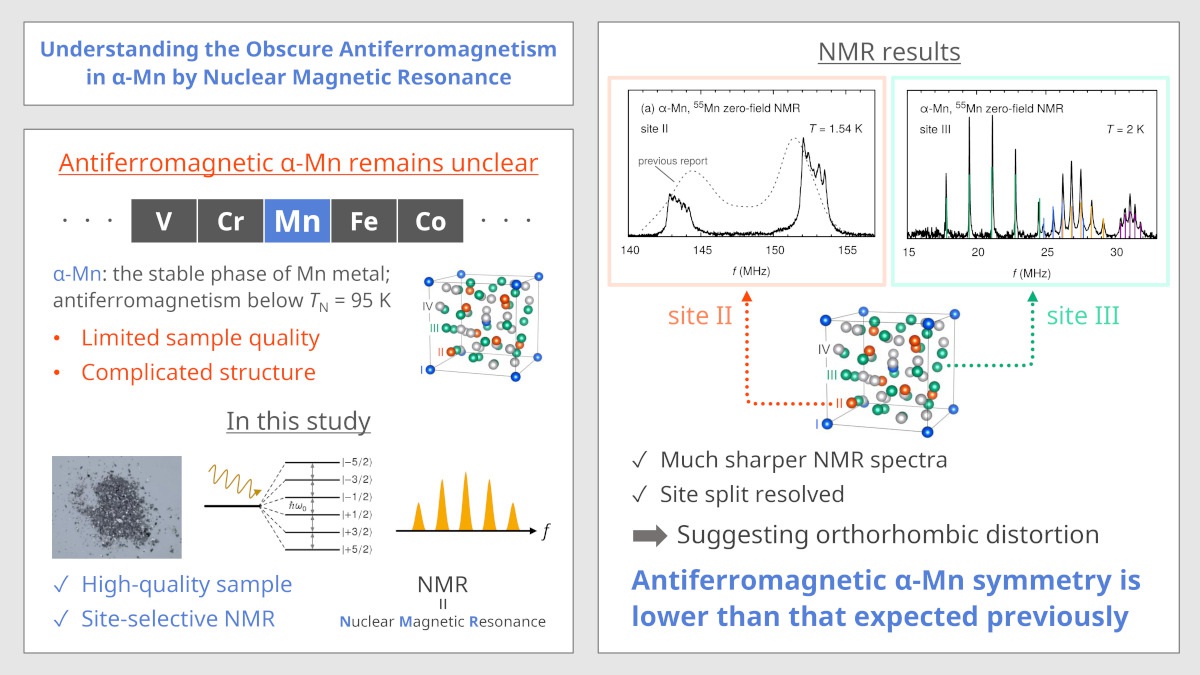
Magnetism in most elementary metals is well understood. An exception is α-Mn, the stable phase of metallic manganese at ambient temperature and pressure. This system crystallizes in a unique structure, wherein four Mn sites exist in a cubic structure with 58 atoms per unit cell. This system exhibits an antiferromagnetic ordering at a Néel temperature of TN = 95 K. In the antiferromagnetic state, all the four sites have magnetic moments. Despite active studies in the 70 years since the discovery of the antiferromagnetism in this system, knowledge regarding the symmetry and the moment directions remains insufficient. It is difficult to precisely clarify the magnetic structure because of the complexity of the crystal and the limited sample quality.
Since the discovery of the pressure-induced magnetic phase at above 1.5 GPa, the magnetism of α-Mn has received renewed attention. This phase shows a large anomalous Hall effect, which is common in ferromagnets. The anomalous Hall effect is closely related with the topological nature of the magnetic properties. The pressure-induced phase is also suppressed using pressure and shows quantum critical behavior at approximately 4.2 GPa. The elementary metal is still useful in condensed matter physics.
We measured a nuclear magnetic resonance (NMR) on a high-quality α-Mn sample and obtained a new insight into the magnetic structure. The NMR technique is a useful method for resolving the magnetic information of each site in a crystal. First, it was confirmed that site II split into two sites in the antiferromagnetic state, as previously suggested in the NMR studies. We discovered that each NMR spectrum of Mn-II site shows a fine structure owing to the titling of the magnetic moments with respect to the [001] direction. This shows the non-collinear magnetic structure and nearly parallel moments in the split site II. Furthermore, it was revealed that site III split into four sites below TN, whereas only two III sites were resolved in the previous studies. These findings suggest that α-Mn shows orthorhombic distortion in the antiferromagnetic state, as opposed to the previous expectation that α-Mn orders in the tetragonal one.
The progress in this study is largely owing to the improved sample quality. The present sample was synthesized using the Pb flux method, developed in Okayama University’s group. Further advances in identifying the magnetic structure of α-Mn in both the antiferromagnetic and pressure-induced phases are expected.
(Written by M. Manago on behalf of all the authors.)
Site Split of Antiferromagnetic α-Mn Revealed by 55Mn Nuclear Magnetic Resonance
(JPSJ Editors' Choice)
J. Phys. Soc. Jpn.
91,
113701
(2022)
.
Share this topic


Fields
Related Articles
-
Peculiar Magnet Pointing Against an Applied Magnetic Field
Cross-disciplinary physics and related areas of science and technology
Magnetic properties in condensed matter
2026-7-1
TbNiC2 exhibits negative magnetization. A new mechanism, based on the coupling between the charge density wave and the antiferromagnetic order, is proposed to account for this peculiar phenomenon.
-
Magnetic-Field Driven Switching of Multipolar Order in an f-Electron System
Magnetic properties in condensed matter
2026-5-22
This study investigates high-rank multipole physics in f-electron systems, providing the first clear experimental evidence for field-induced switching of ferro-quadrupole order in a non-Kramer ion system, along with a new conceptual framework
-
Toward Clarification of Physical Properties of Quasicrystals: Noncollinear Magnetic Orders in Icosahedral Approximants
Cross-disciplinary physics and related areas of science and technology
Electronic transport in condensed matter
Magnetic properties in condensed matter
2026-4-6
An effective model based on magnetic anisotropy arising from a crystalline electric field is constructed for icosahedral approximants, which not only explains measured ferromagnets and antiferromagnets but also reveals new types of noncollinear magnetic orders.
-
Definitive Momentum and Spin Imaging Resolves 20-Year Debate on Gold Surface Spin
Electronic structure and electrical properties of surfaces and nanostructures
Magnetic properties in condensed matter
2026-4-1
Researchers at the Institute for Molecular Science (IMS) have utilized a cutting-edge Photoelectron Momentum Microscope (PMM) at the UVSOR Synchrotron Facility to settle a two-decade-long controversy concerning the direction of electron spin on the Au(111) surface. This study provides a definitive, full-map, comprehensive reference for quantum imaging that is essential for advancing spintronics technology.
-
Topological Hall Effect in Praseodymium Diantimonide
Magnetic properties in condensed matter
2026-2-27
The discovery of the topological Hall effect in a praseodymium-based compound is significant because its magnetism is not limited to a simple spin-only configuration as in many previous rare-earth systems.