

Exploring Superconductivity in the Close Proximity of Polar-Nonpolar Structural Phase Transition
© The Physical Society of Japan
This article is on
Enhanced Superconductivity in Close Proximity to Polar-Nonpolar Structural Phase Transition in Se/Te-Substituted PtBi2
(JPSJ Editors' Choice)
J. Phys. Soc. Jpn.
91,
034703
(2022)
.
A polar-nonpolar structural phase transition and corresponding increase in superconducting transition temperature Tc are observed in chemically doped PtBi2. Tc increases as the system approaches the phase boundary.
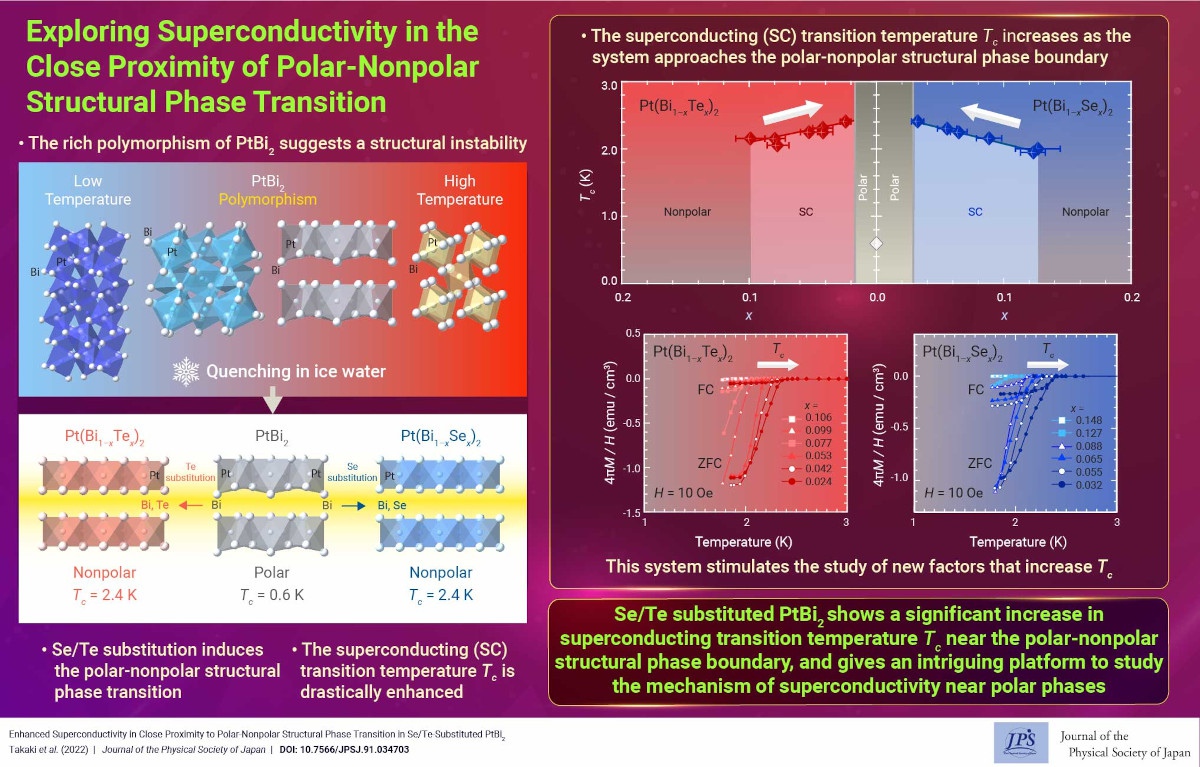
Depending on the way in which the elements in the periodic table are combined, the compounds represented by MX2 (M = transition metal and X = pnictogen or chalcogen) exhibit a wide variety of crystal structures. This is because the structure changes depending on the energies and band filling of the d and p states. In this respect, the combination of Pt and Bi is quite exquisite, and thus PtBi2 alone exhibits various crystal structures such as α-PtBi2 (Pbca,  , No. 61), β-PtBi2 (
 ,
,  , No. 205), γ-PtBi2(
 ,
,  , No. 147), γ'-PtBi2(P31m,
  , No. 157), and δ-PtBi2 (Pnnm,
  , No. 58). This is a remarkable feature because PtP2, PtAs2, and PtSb2that are composed of elements of the same groups, in contrast, crystallize only in the same structure as β-PtBi2, suggesting the structural instability of PtBi2.
In this study, the structural instability of PtBi2 has been utilized to explore structural phase transitions by chemical substitutions and the associated emergence of new physical properties. Notably, substituting Se or Te for some of the Bi in γ'-PtBi2 (P31m, , No. 157) with a polar structure stabilizes the nonpolar structure ( ,
,  , No. 164). This structural phase transition drastically increases superconducting transition temperature Tc from 0.6 K to 2.4 K. Tcincreases as the system approaches the polar-nonpolar structural phase boundary.
According to the Bardeen-Cooper-Schrieffer (BCS) theory, when phonons soften in close proximity to a structural phase transition, Tcincreases. Indeed, such compounds have been noted. However, in close proximity to a polar-nonpolar structural phase transition, the polar structural instability is crucial. The effect of this on superconductivity remains unclear, and studies to explore superconductivity beyond the BCS theory are currently being actively conducted. The present study reports new compounds in which Tcis enhanced in close proximity to the polar-nonpolar structural phase transition. The systems can provide a unique opportunity to study the relationship between polar-nonpolar structural phase transitions and superconductivity from the viewpoints of the competition between the spin splitting of the Fermi surface and the superconducting gap and the soft-phonons related to the polar structural instability. The results of this study are expected to lead to new guidelines for the future understanding of superconductivity and the efforts to search for new fluctuations to increase Tc.
(written by Kazutaka Kudo on behalf of all authors.)
Enhanced Superconductivity in Close Proximity to Polar-Nonpolar Structural Phase Transition in Se/Te-Substituted PtBi2
(JPSJ Editors' Choice)
J. Phys. Soc. Jpn.
91,
034703
(2022)
.
Share this topic


Fields
Related Articles
-
Unveiling the Nodal Topology of the Spin-Triplet Superconductor Candidate UTe2
Structure and mechanical and thermal properties in condensed matter
Superconductivity
2026-4-13
Using high-quality UTe2 (Tc = 2.1 K), we identify its nodal gap structure. Field-angle‑resolved specific‑heat reveals a b-axis singularity, supporting spin-triplet superconductivity with nodes along the b axis.
-
Do Superconductors Dream of Tsunamis?
— A Cross-disciplinary Journey of Solitons —
Mathematical methods, classical and quantum physics, relativity, gravitation, numerical simulation, computational modeling
Superconductivity
2026-2-10
Tsunami-like solitons propagating over rocky-desert-like disordered backgrounds have been identified in a novel soliton equation derived from the theory of parity-mixed superconductivity.
-
A Novel Type of Magnetic Band Splitting in a Fe Spin Ladder System
Dielectric, optical, and other properties in condensed matter
Magnetic properties in condensed matter
Superconductivity
2026-1-22
An investigation of a Fe spin ladder system using angle-resolved photoemission spectroscopy revealed a novel type of magnetic band splitting resembling that in altermagnets.
-
Advances in Photoemission Study of Functional Molecular Materials
Dielectric, optical, and other properties in condensed matter
Superconductivity
2025-11-25
This work provides the first observation of the superconducting gap in molecular superconductors and their gap symmetry using photoemission spectroscopy, which will significantly accelerate the study of molecular conductors.
-
Exotic Superconductivity in Altermagnets with Rashba Spin–Orbit Coupling
Superconductivity
2025-8-6
We theoretically demonstrate the emergence of finite-momentum superconductivity in a two-dimensional altermagnet with Rashba-type spin–orbit coupling (RSOC), where anisotropic deformations of the Fermi surfaces stabilize this unconventional superconducting state.