

Giant Vortices of Fish: Mechanisms and Patterns
© The Physical Society of Japan
This article is on
Emergence of a Giant Rotating Cluster of Fish in Three Dimensions by Local Interactions
(JPSJ Editors' Choice)
J. Phys. Soc. Jpn.
91,
064806
(2022)
.
The origin of giant rotating clusters of fish is revealed by a new agent-based model that incorporates the topological nature of interactions and the escape response characteristic to fish.
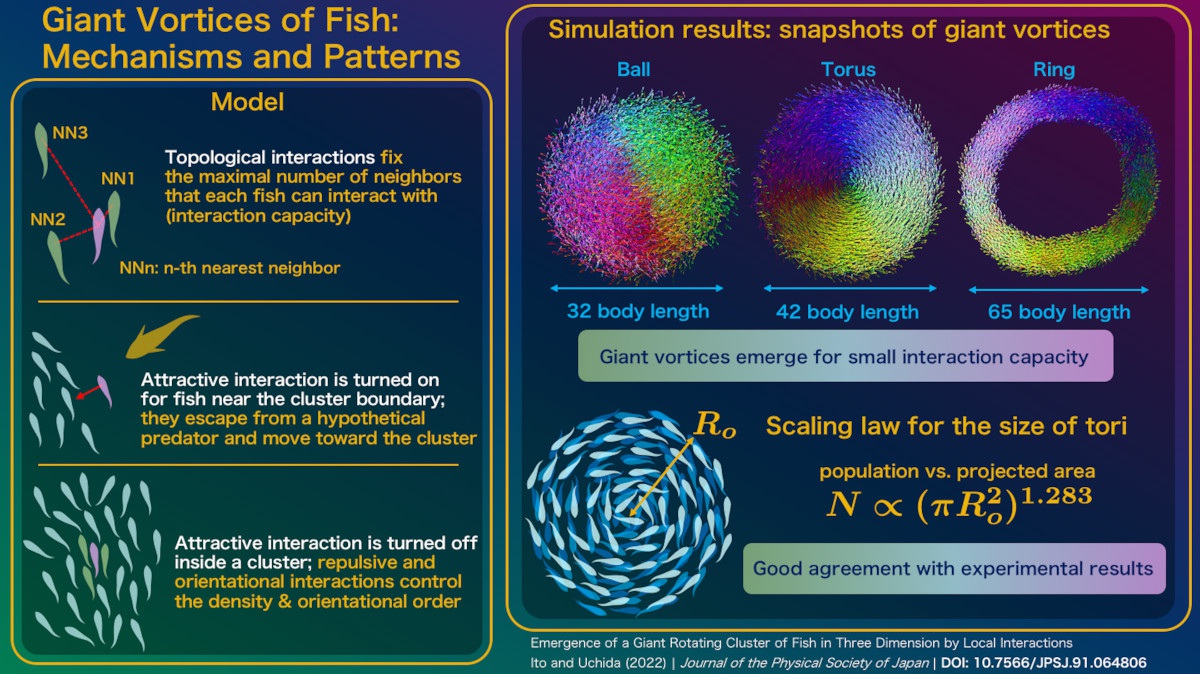
Fish schools form rotating balls, tori, and rings among other collective patterns.These vortex patterns are formed without inherent chirality of individual fish and are therefore considered as an example of spontaneous symmetry breaking due to interactions between self-propelling elements.
Origins of the vortex patterns are previously sought in potential-based attractive interactions, anisotropic interactions via a viewing angle, and/or long-range hydrodynamic interactions. However, several questions have remained on the formation of giant vortices consisting of tens of thousands of fish. For example, previous models require a large portion of fish in a school to interact with each other to form vortex patterns. However, in a high-density school of fish, visual and hydrodynamic interactions are screened, and thousands of fish simultaneously interacting with each other is unlikely. Furthermore, the dependence of the vortex size on the number of fish, which is known to obey a power law in schools of sardines and mackerels, has not been theoretically explained. Finally, three-dimensional rotating balls (known as "bait-balls") have not been reproduced in previous numerical studies.
In the present study, the above-mentioned problems are solved by a new model that incorporates the topological nature of interactions; fish are assumed to interact with up to a certain number of neighbors, which is called the interaction capacity. In addition, the attractive interactions are autonomously controlled such that they are turned on only when the fish has a small number of neighbors in the interaction range. This implies that fish near the cluster boundary are attracted by the cluster, which mimics the escape response characteristic to fish (“fast-start”). The model yields a rich phase diagram of collective patterns consisting of rotating balls, tori, rings, polarized schools, and randomly oriented swarms. The vortex patterns are obtained over a wide range of attraction strength when the interaction capacity is equal to or less than three. The projected area A of a torus scales with the number of fish N according to the power law N∝AV with the exponent ν = 1.283±0.004, which is close to the experimental value of 1.329. (Note that the values lie between 1 for a uniform disk and 3/2 for a uniform sphere.) Each fish in a torus exhibits random walk in the radial direction, instead of rigid-body rotation as predicted by non-topological models. These results indicate that the topological interactions enhance fluctuations in individual motion that trigger spontaneous breaking of the global rotational symmetry.
(Written by S. Ito and N. Uchida)
Emergence of a Giant Rotating Cluster of Fish in Three Dimensions by Local Interactions
(JPSJ Editors' Choice)
J. Phys. Soc. Jpn.
91,
064806
(2022)
.
Share this topic


Fields
Related Articles
-
Negative Apparent Viscosity in Liquid Crystals
Cross-disciplinary physics and related areas of science and technology
Electromagnetism, optics, acoustics, heat transfer, and classical and fluid mechanics
Structure and mechanical and thermal properties in condensed matter
2026-6-8
Electrically driven liquid-crystal turbulence generates self-sustained flow and negative apparent viscosity. The fluorinated, chemically robust nematic PPDFB shows a substantially larger negative-viscosity effect than Schiff-base nematics.
-
Verification of Magnetic Structure Observation at the Atomic Scale
Atomic and molecular physics
Cross-disciplinary physics and related areas of science and technology
Nuclear physics
2026-6-2
Magnetic neutron scattering holography (MNH) were performed on a Fe0.08Co0.92 single crystal. the resulting holograms provided the first experimental evidence that MNH is sensitive to magnetic signals.
-
Role of the Diffusion Layer in Energy Devices
Cross-disciplinary physics and related areas of science and technology
Structure and mechanical and thermal properties in condensed matter
2026-5-1
In many energy devices, electron transfer occurs between ions dissolved in the electrolyte and the electrodes. For keep current flowing, new ions must be supplied continuously to the electrode surface from the bulk region. The diffusion layer’s role in diffusive mass transfer was clarified using the rotating disk electrode method.
-
Toward Clarification of Physical Properties of Quasicrystals: Noncollinear Magnetic Orders in Icosahedral Approximants
Cross-disciplinary physics and related areas of science and technology
Electronic transport in condensed matter
Magnetic properties in condensed matter
2026-4-6
An effective model based on magnetic anisotropy arising from a crystalline electric field is constructed for icosahedral approximants, which not only explains measured ferromagnets and antiferromagnets but also reveals new types of noncollinear magnetic orders.
-
Topological Recast of Vortex Structures in Human Heart Blood Flow
Cross-disciplinary physics and related areas of science and technology
Electromagnetism, optics, acoustics, heat transfer, and classical and fluid mechanics
2026-2-16
We developed a new topological data analysis method to objectively identify the cardiac vortex structures. The method provides robust quantitative metrics for advancing cardiovascular diagnostics.