

Origin of Metamagnetic Transition (MMT) in the Spin-Triplet Superconductivity in UTe2
© The Physical Society of Japan
This article is on
Magnetovolume Effect on the First-Order Metamagnetic Transition in UTe2
(JPSJ Editors' Choice)
J. Phys. Soc. Jpn.
91,
063703
(2022)
.
State-of-the-art magnetostriction measurements in a pulsed-magnetic field reveal the origin of a metamagnetic transition of spin-triplet superconductor UTe2. We propose that the uranium valence fluctuation plays a crucial role in its metamagnetic and superconducting transitions.
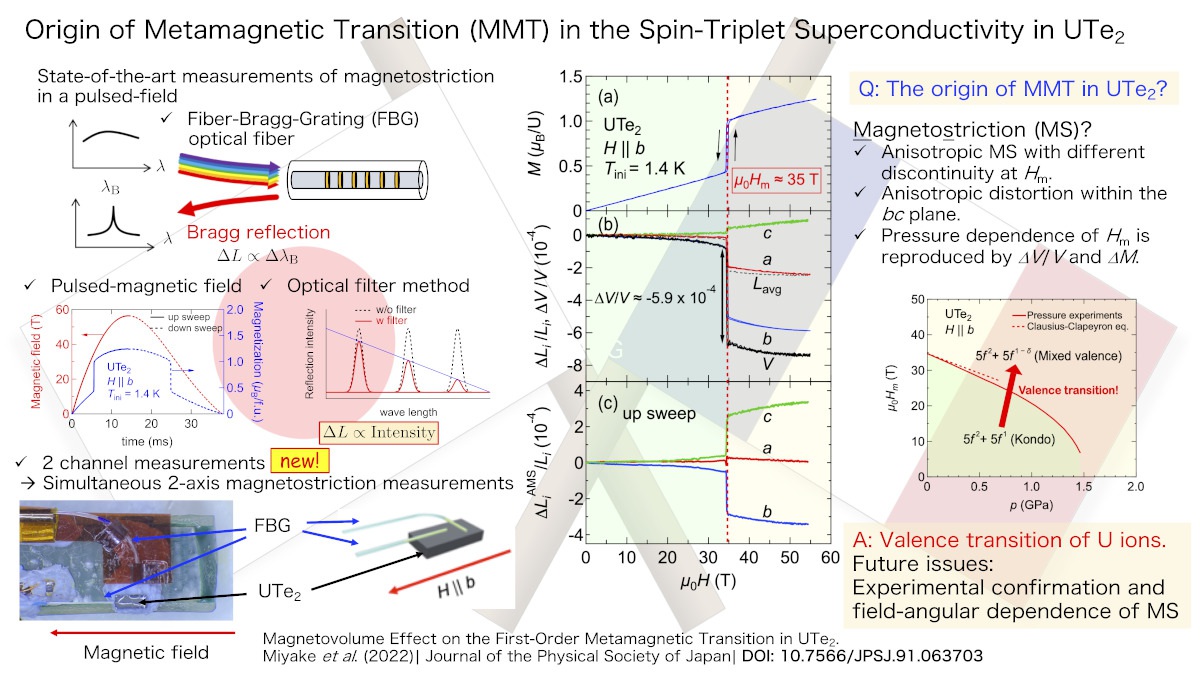
The metamagnetism realized in heavy fermion systems has been well studied to date. At the metamagnetic transition/crossover fields, magnetization increases discontinuously/non-lineally, and fluctuations develop. Consequently, the effective mass increases. Thus, the metamagnetism may induce a new quantum state, such as a superconducting transition. The uranium-based ferromagnetic superconductors have been good playgrounds to study the relationship between metamagnetism and superconductivity. Quite recently, another related system, UTe2, was discovered.
The superconductivity in a paramagnetic heavy fermion system, UTe2, became a hot topic in condensed matter physics community since the realization of the spin-triplet state, which is expected for use in quantum computing. The external stimuli, such as pressure, magnetic field, and its applied direction, make UTe2 more attractive. The most remarkable feature is the magnetic-field-direction controlled superconductivity. For H || baxis, superconductivity is reinforced by increasing the fields but is killed at the metamagnetic field Hm~ 35 T, where a first-order metamagnetic transition takes place. However, the field applied near the orthorhombic [011] direction induces another superconducting phase above Hm. Because experimental probes usable under such extreme conditions were limited, the role of metamagnetic transition in the appearance/disappearance of superconductivity is far from complete understanding. Moreover, the metamagnetism in UTe2must be more clarified. These still remain a big challenge for experimentalists.
Magnetostriction, that is, the length/volume change with magnetic field, should offer hints at the aforementioned issues. The authors have developed magnetostriction measurements combining the fiber Bragg grating fiber optics and optical filter method that cover a wide range of ultra-high-magnetic fields beyond 100 T. A new attempt demonstrated in this article is simultaneous magnetostriction measurements up to 55 T. We obtained the linear magnetostriction along the two principal axes within a one-field scan; thus, we could perform measurements efficiently. This improvement also enables us to confirm the reliability and reproducibility of the magnetostriction measurements. Using a single crystal of UTe2, we revealed the magnetostrictions along all principal axes and the volume change at Hm.
Across Hm approaching from the lower fields, the volume shrinks discontinuously. This volume discontinuity well explains the pressure dependence of Hm and magnetic susceptibility reported earlier. Furthermore, we revealed that the metamagnetic transition in UTe2 involves anisotropic lattice deformation. Considering the localized and itinerant duality nature of uranium ions, we proposed that the uranium valence transition is the origin of metamagnetism. We also discussed the singular behavior in UTe2by comparing it with the other heavy fermion systems. Our findings deepen the understanding of the fascinated physics realized in UTe2.
(The figure has been replaced as of July 19, 2022)
(Written by A. Miyake on behalf of all authors)
Magnetovolume Effect on the First-Order Metamagnetic Transition in UTe2
(JPSJ Editors' Choice)
J. Phys. Soc. Jpn.
91,
063703
(2022)
.
Share this topic


Fields
Related Articles
-
Peculiar Magnet Pointing Against an Applied Magnetic Field
Cross-disciplinary physics and related areas of science and technology
Magnetic properties in condensed matter
2026-7-1
TbNiC2 exhibits negative magnetization. A new mechanism, based on the coupling between the charge density wave and the antiferromagnetic order, is proposed to account for this peculiar phenomenon.
-
Magnetic-Field Driven Switching of Multipolar Order in an f-Electron System
Magnetic properties in condensed matter
2026-5-22
This study investigates high-rank multipole physics in f-electron systems, providing the first clear experimental evidence for field-induced switching of ferro-quadrupole order in a non-Kramer ion system, along with a new conceptual framework
-
Unveiling the Nodal Topology of the Spin-Triplet Superconductor Candidate UTe2
Structure and mechanical and thermal properties in condensed matter
Superconductivity
2026-4-13
Using high-quality UTe2 (Tc = 2.1 K), we identify its nodal gap structure. Field-angle‑resolved specific‑heat reveals a b-axis singularity, supporting spin-triplet superconductivity with nodes along the b axis.
-
Toward Clarification of Physical Properties of Quasicrystals: Noncollinear Magnetic Orders in Icosahedral Approximants
Cross-disciplinary physics and related areas of science and technology
Electronic transport in condensed matter
Magnetic properties in condensed matter
2026-4-6
An effective model based on magnetic anisotropy arising from a crystalline electric field is constructed for icosahedral approximants, which not only explains measured ferromagnets and antiferromagnets but also reveals new types of noncollinear magnetic orders.
-
Definitive Momentum and Spin Imaging Resolves 20-Year Debate on Gold Surface Spin
Electronic structure and electrical properties of surfaces and nanostructures
Magnetic properties in condensed matter
2026-4-1
Researchers at the Institute for Molecular Science (IMS) have utilized a cutting-edge Photoelectron Momentum Microscope (PMM) at the UVSOR Synchrotron Facility to settle a two-decade-long controversy concerning the direction of electron spin on the Au(111) surface. This study provides a definitive, full-map, comprehensive reference for quantum imaging that is essential for advancing spintronics technology.