

New Classification Theory for Topological Gapless Superconducting Nodes
© The Physical Society of Japan
This article is on
Topological gapless points in superconductors: From the viewpoint of symmetry
(PTEP Editors' Choice)
Prog. Theor. Exp. Phys.
https://doi.org/10.1093/ptep/ptab124, .
A new classification theory on topological superconducting gap nodes predicts two new gap structures emerging from a nonsymmorphic crystal symmetry and angular momentum.
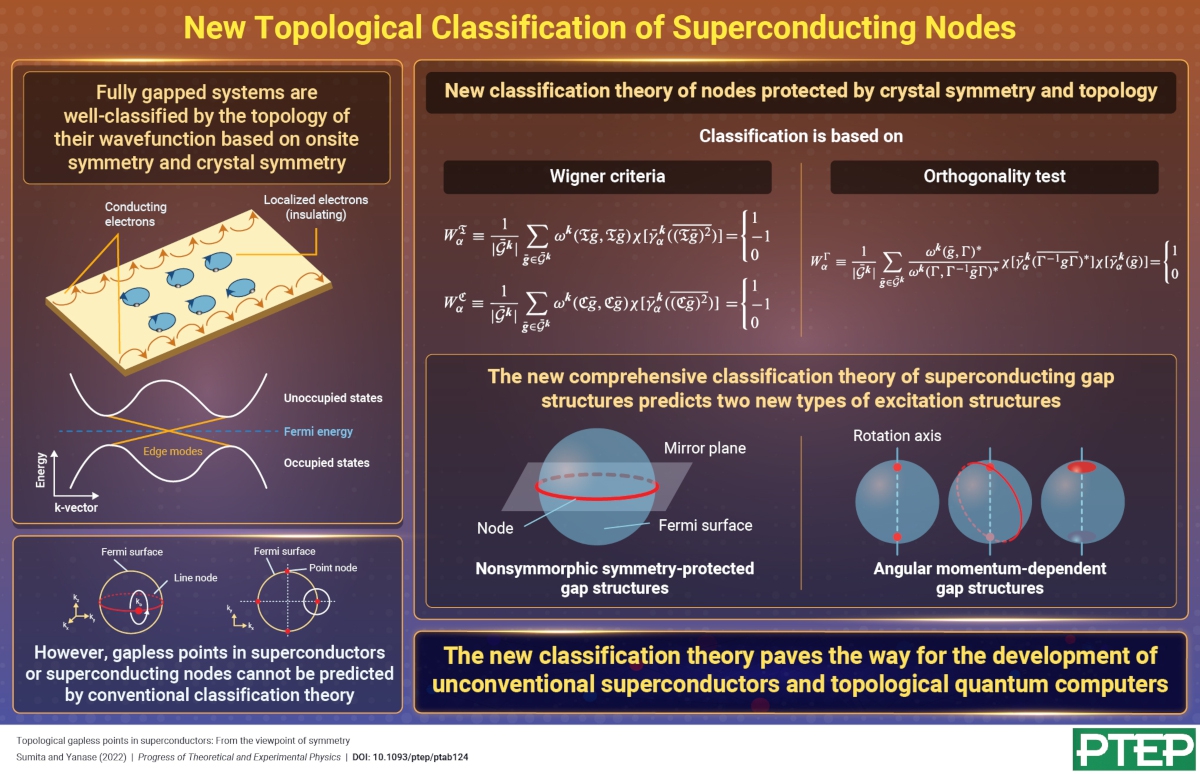
Topological phases of matter, such as topological insulators, semimetals, and superconductors, have garnered much attention in condensed matter physics. These are strange materials characterized by the presence of conduction states on the surface while the bulk remains insulating. Moreover, the surface states are protected by certain symmetries against physical deformations or defects.
It turns out that such systems can be classified by a “topological invariant” or a topological number such that two systems with the same topological number are equivalent. The topological invariant is classified by the symmetry and dimensionality of the system and is well-defined for gapped Hamiltonian systems. A well-known classification scheme is based on onsite symmetries, such as time-reversal symmetry, particle-hole symmetry, and chiral symmetry. However, recent schemes involve both crystal symmetry and onsite symmetry.
Interestingly, topological superconductors often have gapless points called “superconducting nodes” that are characterized by topological invariants, even though topology for the wavefunction can only be defined for gapped Hamiltonians. While there exist some classification theories for the superconducting order parameter predicting such nodes, they are sometimes incompatible with the actual superconducting gap structure and do not account for space group symmetry and higher-spin states.
In this paper, we present a new classification theory for superconducting nodes to resolve these two problems. We constructed this theory based on arguments from group theory and topology. An earlier topological classification theory focused on the d-dimensional Brillouin zone (BZ). However, since a band gap cannot exist in a whole d-dimensional BZ in nodal superconductors, we instead considered a p-dimensional (p < d) sphere surrounding nodes in the BZ.
We fixed a specific k point in the BZ and then developed the classification theory on the high-symmetry points using the Wigner criteria and the orthogonality test. Our results predicted two new types of excitation structures, i.e., unconventional superconducting nodes protected by crystal symmetry and topology.
By performing classification on high-symmetry planes, we predicted nontrivial gap structures appearing from nonsymmorphic space group symmetry, which can be decomposed into a product of non-primitive lattice translation and a point group operation. Meanwhile, performing classification on high-symmetry lines helped predict nontrivial gap structures dependent on the angular momentum of the normal Bloch state.
Because these classification structures are determined only by symmetry, they can be universally applied to many candidate superconductors, potentially leading to the discovery of superconductors hosting unconventional nodes.
Topological gapless points in superconductors: From the viewpoint of symmetry
(PTEP Editors' Choice)
Prog. Theor. Exp. Phys.
https://doi.org/10.1093/ptep/ptab124,
.
Share this topic


Fields
Related Articles
-
Unveiling the Nodal Topology of the Spin-Triplet Superconductor Candidate UTe2
Structure and mechanical and thermal properties in condensed matter
Superconductivity
2026-4-13
Using high-quality UTe2 (Tc = 2.1 K), we identify its nodal gap structure. Field-angle‑resolved specific‑heat reveals a b-axis singularity, supporting spin-triplet superconductivity with nodes along the b axis.
-
Do Superconductors Dream of Tsunamis?
— A Cross-disciplinary Journey of Solitons —
Mathematical methods, classical and quantum physics, relativity, gravitation, numerical simulation, computational modeling
Superconductivity
2026-2-10
Tsunami-like solitons propagating over rocky-desert-like disordered backgrounds have been identified in a novel soliton equation derived from the theory of parity-mixed superconductivity.
-
A Novel Type of Magnetic Band Splitting in a Fe Spin Ladder System
Dielectric, optical, and other properties in condensed matter
Magnetic properties in condensed matter
Superconductivity
2026-1-22
An investigation of a Fe spin ladder system using angle-resolved photoemission spectroscopy revealed a novel type of magnetic band splitting resembling that in altermagnets.
-
Advances in Photoemission Study of Functional Molecular Materials
Dielectric, optical, and other properties in condensed matter
Superconductivity
2025-11-25
This work provides the first observation of the superconducting gap in molecular superconductors and their gap symmetry using photoemission spectroscopy, which will significantly accelerate the study of molecular conductors.
-
Exotic Superconductivity in Altermagnets with Rashba Spin–Orbit Coupling
Superconductivity
2025-8-6
We theoretically demonstrate the emergence of finite-momentum superconductivity in a two-dimensional altermagnet with Rashba-type spin–orbit coupling (RSOC), where anisotropic deformations of the Fermi surfaces stabilize this unconventional superconducting state.