

A Two-step Creation of Phonon Entanglement with Quantized Light
© The Physical Society of Japan
This article is on
Two-step Dynamics of Photoinduced Phonon Entanglement Generation between Remote Electron-Phonon Systems
(JPSJ Editors' Choice)
J. Phys. Soc. Jpn.
90,
104714
(2021)
.
Dynamics of photoinduced quantum entanglement generation between phonons is theoretically revealed. The results contribute to the study of fundamental theoretical problems within quantum dynamics of photoinduced phase transitions and quantum information science.
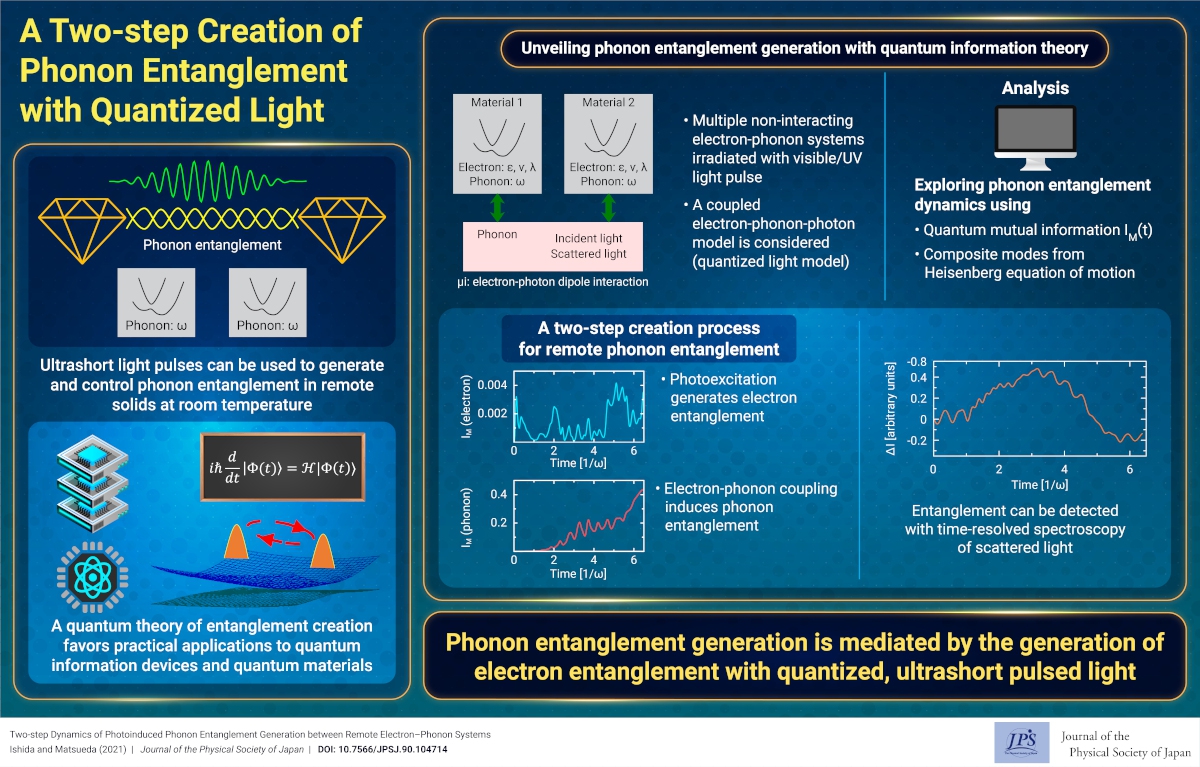
Photoinduced phase transition is the cooperative change of the electronic states and/or the crystal structures of a material induced by ultrashort laser pulses. Its mechanism is closely related to the dynamics of elementary excitations which modulate the quantum-mechanical states of strongly correlated electron systems and/or strongly coupled electron-phonon systems in a coherent regime. As slight fluctuations trigger the macroscopic change of the system in phase transitions, the transient dynamics of light-induced fluctuations play an important role in controlling the photoinduced phase transitions. It has been theoretically revealed that the generation dynamics of photoinduced quantum entanglement causes the aforementioned fluctuations.
A model of remote electron-phonon systems which is not directly interacting with each other was selected. The manner in which the entanglement between the phonons of these systems appears as photoirradiation proceeds was calculated. When two systems are sufficiently separated in space, there is no direct quantum-mechanical correlation between them, and the quantum entanglement is generated between them when “quantized light” is irradiated. The problem that requires the quantum nature of light has not been raised frequently although the relationship between the nonequilibrium state and the entanglement is considered a fundamental problem of physics. The results of this study elucidate the role of light quantization on the transient dynamics of condensed matter.
The results of this study will be extended to the study of photoinduced fluctuations leading to macroscopic change of the physical properties or phase transitions. Simultaneously, it is expected to be closely related to the research in the field of quantum information as the proposed theoretical framework is similar to the one for the fundamental problem of quantum information. Specifically, the photoinduced entanglement generation between the remote qubits can be used as a quantum memory. The results of this study show that a large degree of freedom of phonon states will enable a larger quantum entanglement between phonons than qubits, and that an effective quantum entanglement storage/memory is expected. The quantum many-body problems regarding the electrons and bosons (phonons and photons) have a long history, and it is expected that further detailed studies will continue in the future.
(Written by K. Ishida on behalf of all the authors)
Two-step Dynamics of Photoinduced Phonon Entanglement Generation between Remote Electron-Phonon Systems
(JPSJ Editors' Choice)
J. Phys. Soc. Jpn.
90,
104714
(2021)
.
Share this topic


Fields
Related Articles
-
Giant Brute-Force Simulation to Reveal Nucleation and Growth of Ultrasonic Cavitation Bubbles
Electromagnetism, optics, acoustics, heat transfer, and classical and fluid mechanics
Statistical physics and thermodynamics
2026-7-27
This study reveals the early-stage dynamics of ultrasonic cavitation using a record 100-billion-atom simulation to capture bubble nucleation, growth, clustering, and periodic splitting under nonequilibrium conditions.
-
Monitored Quantum Systems and Quantum Trajectories
General and Mathematical Physics
Mathematical methods, classical and quantum physics, relativity, gravitation, numerical simulation, computational modeling
Statistical physics and thermodynamics
2026-7-21
This review in Progress of Theoretical and Experimental Physics introduces monitored quantum systems and quantum trajectories, emphasizing their spectral properties, typical behaviors such as ergodicity and purification, and measurement-induced phases.
-
Path Towards Experimental Exploration of Quantum Gravity
Mathematical methods, classical and quantum physics, relativity, gravitation, numerical simulation, computational modeling
2026-6-15
This study presents a novel route for experimentally realizing the Sachdev–Ye–Kitaev (SYK) model, considered holographically dual to charged black holes, offering the first step towards experimental studies of quantum gravity.
-
Negative Apparent Viscosity in Liquid Crystals
Cross-disciplinary physics and related areas of science and technology
Electromagnetism, optics, acoustics, heat transfer, and classical and fluid mechanics
Structure and mechanical and thermal properties in condensed matter
2026-6-8
Electrically driven liquid-crystal turbulence generates self-sustained flow and negative apparent viscosity. The fluorinated, chemically robust nematic PPDFB shows a substantially larger negative-viscosity effect than Schiff-base nematics.
-
Enhancing Accuracy and Reliability Bayesian Framework for Analysis of AR-HAXPES of Hard X-ray Photoelectron Spectroscopy
Dielectric, optical, and other properties in condensed matter
Electronic structure and electrical properties of surfaces and nanostructures
Measurement, instrumentation, and techniques
2026-4-28
We present a Bayesian framework for angle-resolved hard X-ray photoelectron spectroscopy (AR-HAXPES), combining Replica Exchange Monte Carlo with hierarchical integration to objectively and precisely estimate thin-film thickness.