

Understanding Skyrmion Crystal Formation in EuPtSi
© The Physical Society of Japan
This article is on
Field-Direction Sensitive Skyrmion Crystals in Cubic Chiral Systems: Implication to 4f-Electron Compound EuPtSi
(JPSJ Editors' Choice)
J. Phys. Soc. Jpn.
90,
073705
(2021)
.
We theoretically demonstrate that the interplay between the spin-charge and spin-orbit couplings in itinerant magnets stabilizes field-direction sensitive, short-period skyrmions. Our results can aid in engineering short-period skyrmions.
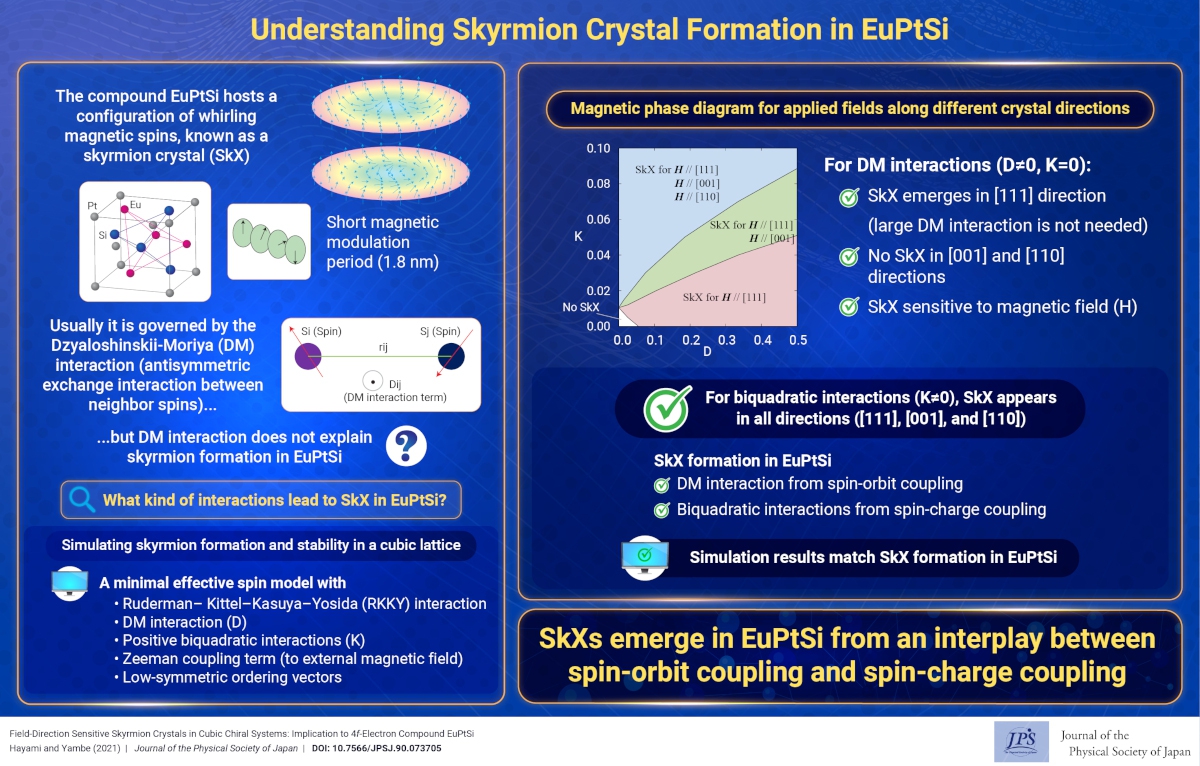
Magnetic skyrmions with swirling topological spin textures are of significant interest owing to their peculiar magnetic, transport, and optical properties. In magnetic materials, skyrmions usually appear in a periodically ordered state, which is referred to as the skyrmion crystal (SkX). The SkX can be considered as a multiple-qorder described by the superposition of multiple spiral waves. The SkX was originally discovered in 2009 in d-electron compounds like MnSi, where the Dzyaloshinskii–Moriya interaction plays an important role. Recently, SkXs have been observed in centrosymmetric magnets via other mechanisms, such as frustrated exchange interactions and/or multiple-spin interactions in itinerant magnets. The resulting difference due to the individual origins appears in the magnetic modulation period of the SkXs, with the original mechanism usually leading to much longer magnetic periods than those of the latter ones. Specifically, a small skyrmion induces a large emergent magnetic field, and hence engineering small skyrmions is relevant for future spintronics applications, as they may potentially aid in realizing energy-efficient devices based on high density topological objects.
The itinerant chiral antiferromagnet EuPtSi is the first f-electron compound with a noncentrosymmetric lattice structure found to host a SkX with a small magnetic period. The origin of the SkX in EuPtSi is not explained by the conventional mechanism based on the Dzyaloshinskii–Moriya interaction, as the magnetic periods and the magnetic-field-direction dependencies of the SkXs are different from those found in other noncentrosymmetric magnets. Therefore, we need to consider other mechanisms that have not yet been theoretically clarified. Understanding the origin of short-period SkXs in noncentrosymmetric itinerant magnets found in EuPtSi is crucial in enabling small skyrmion engineering for practical applications.
In this study, we theoretically investigated the origin of SkXs in f-electron compounds by constructing a new model based on EuPtSi. We discovered the following two important elements in inducing a field-direction sensitive SkX with a small magnetic period: (1) the multiple-q superpositions of the spirals with low-symmetric ordering vectors and (2) the synergy between the long-range Dzyaloshinskii–Moriya interaction arising from the spin-orbit coupling and the biquadratic interaction arising from the spin-charge coupling in itinerant magnets. We demonstrated that the theoretical model which satisfies the two conditions accurately describes the SkX physics in EuPtSi through unbiased annealing simulations. Our study provides a reference for both engineering short-period SkXs and for exploring further skyrmion-hosting materials in noncentrosymmetric itinerant magnets.
(Written by Satoru Hayami on behalf of all authors.)
Field-Direction Sensitive Skyrmion Crystals in Cubic Chiral Systems: Implication to 4f-Electron Compound EuPtSi
(JPSJ Editors' Choice)
J. Phys. Soc. Jpn.
90,
073705
(2021)
.
Share this topic


Fields
Related Articles
-
Peculiar Magnet Pointing Against an Applied Magnetic Field
Cross-disciplinary physics and related areas of science and technology
Magnetic properties in condensed matter
2026-7-1
TbNiC2 exhibits negative magnetization. A new mechanism, based on the coupling between the charge density wave and the antiferromagnetic order, is proposed to account for this peculiar phenomenon.
-
Magnetic-Field Driven Switching of Multipolar Order in an f-Electron System
Magnetic properties in condensed matter
2026-5-22
This study investigates high-rank multipole physics in f-electron systems, providing the first clear experimental evidence for field-induced switching of ferro-quadrupole order in a non-Kramer ion system, along with a new conceptual framework
-
Toward Clarification of Physical Properties of Quasicrystals: Noncollinear Magnetic Orders in Icosahedral Approximants
Cross-disciplinary physics and related areas of science and technology
Electronic transport in condensed matter
Magnetic properties in condensed matter
2026-4-6
An effective model based on magnetic anisotropy arising from a crystalline electric field is constructed for icosahedral approximants, which not only explains measured ferromagnets and antiferromagnets but also reveals new types of noncollinear magnetic orders.
-
Definitive Momentum and Spin Imaging Resolves 20-Year Debate on Gold Surface Spin
Electronic structure and electrical properties of surfaces and nanostructures
Magnetic properties in condensed matter
2026-4-1
Researchers at the Institute for Molecular Science (IMS) have utilized a cutting-edge Photoelectron Momentum Microscope (PMM) at the UVSOR Synchrotron Facility to settle a two-decade-long controversy concerning the direction of electron spin on the Au(111) surface. This study provides a definitive, full-map, comprehensive reference for quantum imaging that is essential for advancing spintronics technology.
-
Topological Hall Effect in Praseodymium Diantimonide
Magnetic properties in condensed matter
2026-2-27
The discovery of the topological Hall effect in a praseodymium-based compound is significant because its magnetism is not limited to a simple spin-only configuration as in many previous rare-earth systems.