

Exotic Superconducting States in Transition Metal Tellurides
© The Physical Society of Japan
This article is on
Superconductivity in Nb2Pd3Te5 and Chemically-Doped Ta2Pd3Te5
(JPSJ Editors' Choice)
J. Phys. Soc. Jpn.
90,
063705
(2021)
.
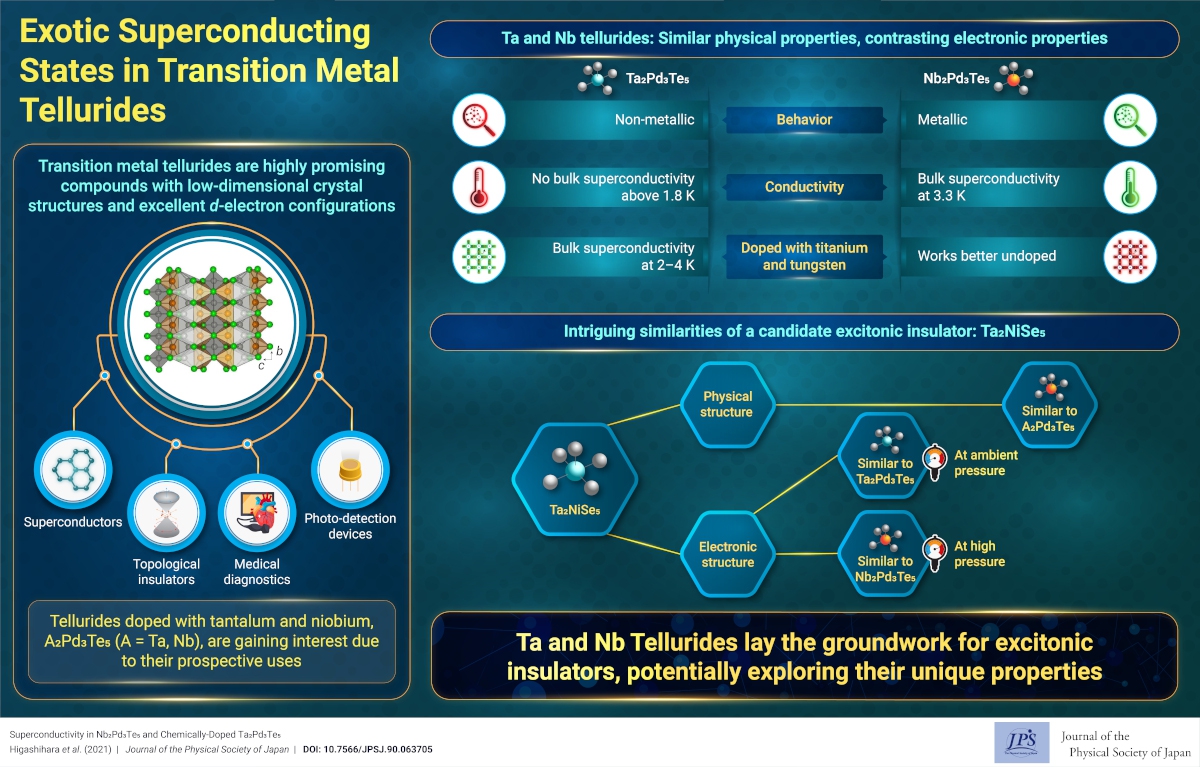
Nb2Pd3Te5 was found to show bulk superconductivity at 3.3 K. In contrast, Ta2Pd3Te5, a 5d analogue of Nb2Pd3Te5, showed nonmetallic electronic conduction, which was changed to show bulk superconductivity by chemical doping.
Superconductivity in Nb2Pd3Te5 and Chemically-Doped Ta2Pd3Te5
(JPSJ Editors' Choice)
J. Phys. Soc. Jpn.
90,
063705
(2021)
.
Share this topic


Fields
Related Articles
-
Unveiling the Nodal Topology of the Spin-Triplet Superconductor Candidate UTe2
Structure and mechanical and thermal properties in condensed matter
Superconductivity
2026-4-13
Using high-quality UTe2 (Tc = 2.1 K), we identify its nodal gap structure. Field-angle‑resolved specific‑heat reveals a b-axis singularity, supporting spin-triplet superconductivity with nodes along the b axis.
-
Do Superconductors Dream of Tsunamis?
— A Cross-disciplinary Journey of Solitons —
Mathematical methods, classical and quantum physics, relativity, gravitation, numerical simulation, computational modeling
Superconductivity
2026-2-10
Tsunami-like solitons propagating over rocky-desert-like disordered backgrounds have been identified in a novel soliton equation derived from the theory of parity-mixed superconductivity.
-
A Novel Type of Magnetic Band Splitting in a Fe Spin Ladder System
Dielectric, optical, and other properties in condensed matter
Magnetic properties in condensed matter
Superconductivity
2026-1-22
An investigation of a Fe spin ladder system using angle-resolved photoemission spectroscopy revealed a novel type of magnetic band splitting resembling that in altermagnets.
-
Advances in Photoemission Study of Functional Molecular Materials
Dielectric, optical, and other properties in condensed matter
Superconductivity
2025-11-25
This work provides the first observation of the superconducting gap in molecular superconductors and their gap symmetry using photoemission spectroscopy, which will significantly accelerate the study of molecular conductors.
-
Exotic Superconductivity in Altermagnets with Rashba Spin–Orbit Coupling
Superconductivity
2025-8-6
We theoretically demonstrate the emergence of finite-momentum superconductivity in a two-dimensional altermagnet with Rashba-type spin–orbit coupling (RSOC), where anisotropic deformations of the Fermi surfaces stabilize this unconventional superconducting state.