

A Solvent Viscosity-dependent Thermoelectric Conversion Efficiency
© The Physical Society of Japan
This article is on
Scaling Relation between Electrochemical Seebeck Coefficient for Fe2+/Fe3+ in Organic Solvent and Its Viscosity
(JPSJ Editors' Choice)
J. Phys. Soc. Jpn.
90,
033602
(2021)
.
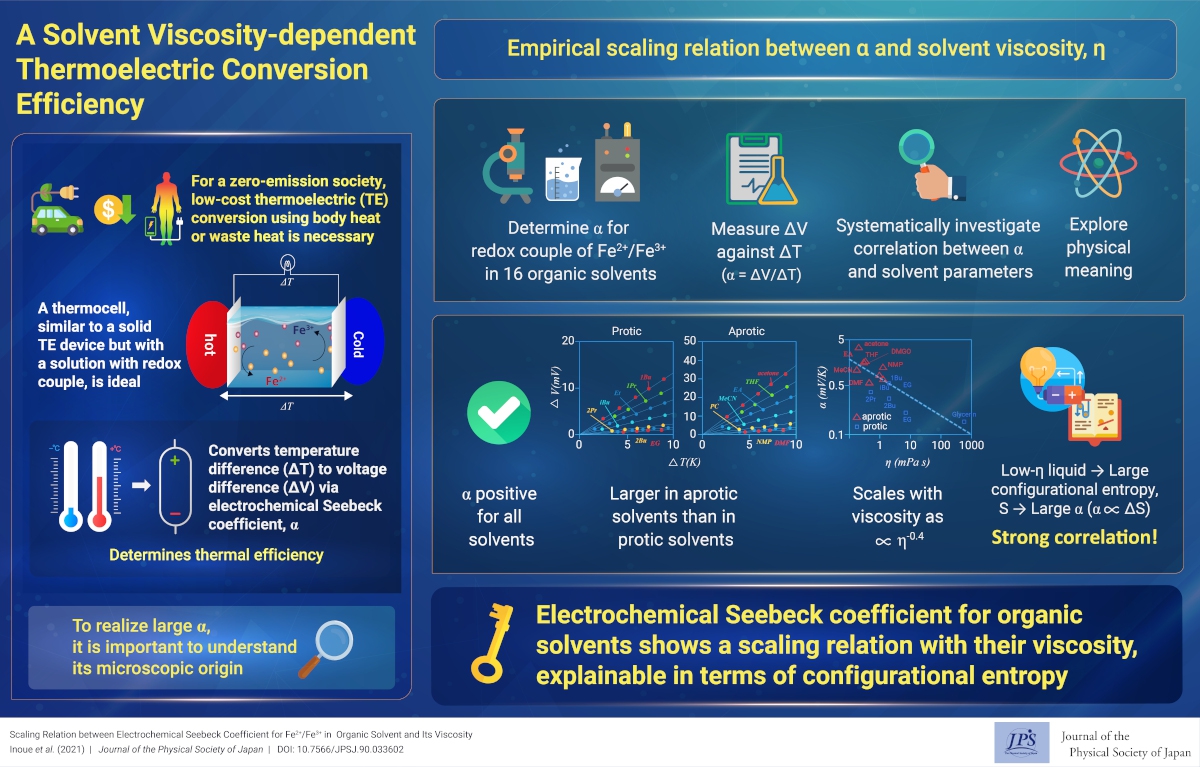
We found a beautiful empirical rule (α ∝ η-0.4) between the electrochemical Seebeck coefficient α for Fe2+/Fe3+ redox pair and viscosity coefficient η of the organic solvent.
Scaling Relation between Electrochemical Seebeck Coefficient for Fe2+/Fe3+ in Organic Solvent and Its Viscosity
(JPSJ Editors' Choice)
J. Phys. Soc. Jpn.
90,
033602
(2021)
.
Share this topic


Fields
Related Articles
-
Mysterious Critical Phenomena Driven by Role Reversal in Multicomponent Systems: From Normal to Reverse RKKY — Twofold Reversal and Induced Critical Exponent
Electronic transport in condensed matter
Structure and mechanical and thermal properties in condensed matter
2026-10-5
The Reverse RKKY mechanism drives a twofold reversal, yielding an anomalous specific‑heat peak with a large, induced critical exponent.
-
Direct Observation of Piezoelectricity from Electric Toroidal Quadrupole Order
Electron states in condensed matter
Structure and mechanical and thermal properties in condensed matter
2026-9-30
This study reports the direct observation of piezoelectricity in the spin-orbit-coupled metal Cd2Re2O7. The findings reveal how electric toroidal quadrupole order drives successive inversion-symmetry-breaking transitions and anisotropic electromechanical responses.
-
Revealing Electronic Quantum Behavior Masked by Nuclear Heat
Measurement, instrumentation, and techniques
Structure and mechanical and thermal properties in condensed matter
Superconductivity
2026-9-7
The initial slope method is used to reveal intrinsic electronic specific heat by eliminating the overwhelming nuclear contributions during low-temperature calorimetry, opening a new window into quantum materials.
-
The Thermal Einstein–de Haas Effect: Theoretical Prediction and Observability in Chiral Carbon Nanotubes
Cross-disciplinary physics and related areas of science and technology
Structure and mechanical and thermal properties in condensed matter
2026-6-22
Although the Einstein–de Haas (EdH) effect describes material rotation in a magnetic field, a thermal EdH effect, driven by a temperature gradient, remains unobserved. Recently, chiral carbon nanotubes were theoretically proposed as promising candidates to observe it.
-
Negative Apparent Viscosity in Liquid Crystals
Cross-disciplinary physics and related areas of science and technology
Electromagnetism, optics, acoustics, heat transfer, and classical and fluid mechanics
Structure and mechanical and thermal properties in condensed matter
2026-6-8
Electrically driven liquid-crystal turbulence generates self-sustained flow and negative apparent viscosity. The fluorinated, chemically robust nematic PPDFB shows a substantially larger negative-viscosity effect than Schiff-base nematics.