

Nanospace-confined Helium Shows Four-dimensional Quantum Phase Transition (QPT)
© The Physical Society of Japan
This article is on
Evidence for 4D XY Quantum Criticality in 4He Confined in Nanoporous Media at Finite Temperatures
(JPSJ Editors' Choice)
J. Phys. Soc. Jpn.
90,
033601
(2021)
.
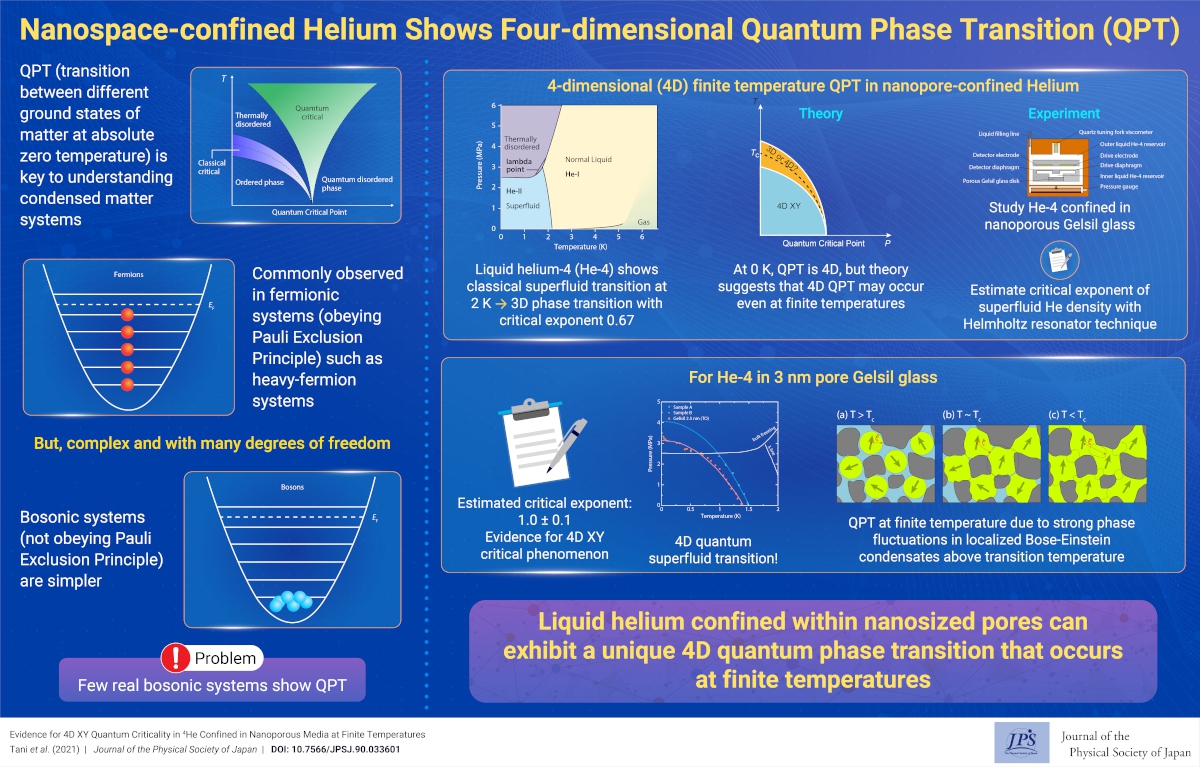
Helium confined in a nanoporous material shows a four dimensional superfluid transition. This is a unique example of four dimensional critical phenomenon caused by strong quantum fluctuation.
Evidence for 4D XY Quantum Criticality in 4He Confined in Nanoporous Media at Finite Temperatures
(JPSJ Editors' Choice)
J. Phys. Soc. Jpn.
90,
033601
(2021)
.
Share this topic


Fields
Related Articles
-
Mysterious Critical Phenomena Driven by Role Reversal in Multicomponent Systems: From Normal to Reverse RKKY — Twofold Reversal and Induced Critical Exponent
Electronic transport in condensed matter
Structure and mechanical and thermal properties in condensed matter
2026-10-5
The Reverse RKKY mechanism drives a twofold reversal, yielding an anomalous specific‑heat peak with a large, induced critical exponent.
-
Direct Observation of Piezoelectricity from Electric Toroidal Quadrupole Order
Electron states in condensed matter
Structure and mechanical and thermal properties in condensed matter
2026-9-30
This study reports the direct observation of piezoelectricity in the spin-orbit-coupled metal Cd2Re2O7. The findings reveal how electric toroidal quadrupole order drives successive inversion-symmetry-breaking transitions and anisotropic electromechanical responses.
-
Revealing Electronic Quantum Behavior Masked by Nuclear Heat
Measurement, instrumentation, and techniques
Structure and mechanical and thermal properties in condensed matter
Superconductivity
2026-9-7
The initial slope method is used to reveal intrinsic electronic specific heat by eliminating the overwhelming nuclear contributions during low-temperature calorimetry, opening a new window into quantum materials.
-
The Thermal Einstein–de Haas Effect: Theoretical Prediction and Observability in Chiral Carbon Nanotubes
Cross-disciplinary physics and related areas of science and technology
Structure and mechanical and thermal properties in condensed matter
2026-6-22
Although the Einstein–de Haas (EdH) effect describes material rotation in a magnetic field, a thermal EdH effect, driven by a temperature gradient, remains unobserved. Recently, chiral carbon nanotubes were theoretically proposed as promising candidates to observe it.
-
Negative Apparent Viscosity in Liquid Crystals
Cross-disciplinary physics and related areas of science and technology
Electromagnetism, optics, acoustics, heat transfer, and classical and fluid mechanics
Structure and mechanical and thermal properties in condensed matter
2026-6-8
Electrically driven liquid-crystal turbulence generates self-sustained flow and negative apparent viscosity. The fluorinated, chemically robust nematic PPDFB shows a substantially larger negative-viscosity effect than Schiff-base nematics.