

Clockwise or Anticlockwise, That is the Question: Phonons with Angular Momentum in Chiral Crystals
© The Physical Society of Japan
This article is on
Theory of Energy Dispersion of Chiral Phonons
(JPSJ Editors' Choice)
J. Phys. Soc. Jpn.
92,
023601
(2023)
.
Chiral crystals have lattice structures with no mirror or inversion symmetries.
A few basic questions about their unique phonon excitations with intrinsic angular momentum are answered.
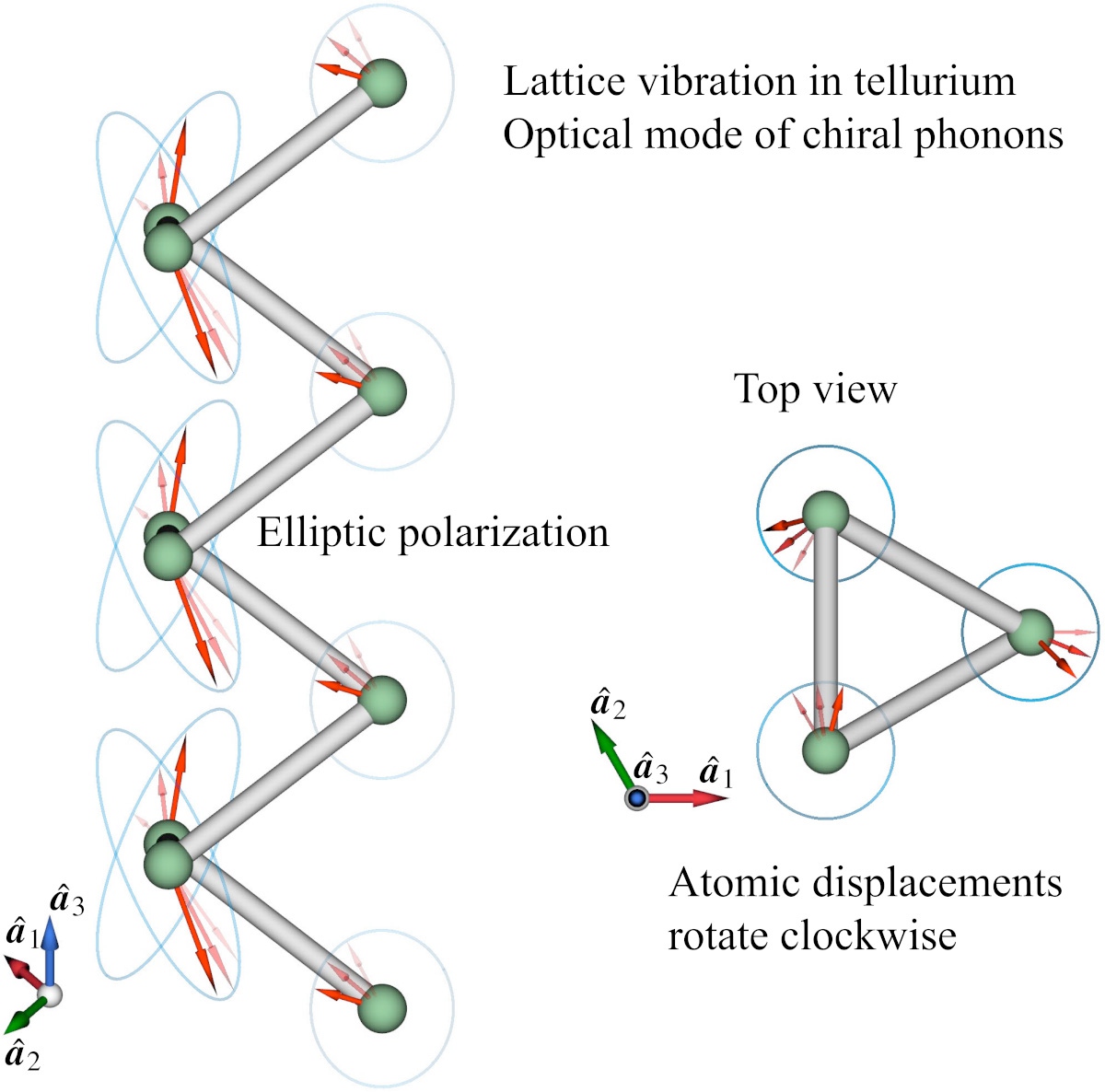
Propagating lattice vibration in crystals resembles light, and atomic displacement corresponds to the electric or magnetic field. One can easily control light by using a waveplate to convert its polarization from linear to circular and vice versa without changing the frequency of light. However, this type of conversion is not possible for lattice vibrations in chiral crystals, such as quartz and tellurium. This is because some vibration modes must have a distorted circular (i.e., elliptic) polarization, and their eigenfrequency depends on whether displacements rotate clockwise or anticlockwise in contrast to the behavior of ordinary light. The quanta of these vibration modes are called chiral phonons, and the corresponding eigenfrequency determines their energy. Chiral crystals have a structure with definite handedness. The mirror image of the structure is not identical to the original, as the right-handed screw differs from the mirror-reflected left-handed screw. The abovementioned split of the chiral phonon energy is an important consequence of the chiral lattice structure.
The crystals have multiple branches of lattice vibrations, i.e., phonons; three are acoustic branches, while the others are optical. One crucial question is which branch is most sensitive to the chiral structure. By studying a chiral model with a screw structure, the authors have shown that the optical branches are considerably more sensitive than the acoustic branches and obtained a simple formula for the energy splitting between chiral phonons rotating oppositely. The splitting is proportional to the product of the phonon’s linear momentum and the intrinsic angular momentum representing the rotation direction. The proportionality constant Γ is an important order parameter characterizing the system’s chirality, and its explicit form has been obtained in this work as a function of microscopic material parameters. As the chiral systems lack mirror and related inversion symmetries, polar vectors such as linear momentum can directly couple to axial vectors such as angular momentum, and their coupling constants have the symmetry of pseudoscalar. The nonvanishing value of the obtained Γ demonstrates this situation and is related to the electric toroidal monopole G0. As for the chiral acoustic branches, there has been an argument that they may have different sound velocity values depending on the phonon’s angular momentum. The authors have proved that these sound velocities should be identical under general conditions. They have also obtained conditions for microscopic models, which are expected to be useful for model building based on the first-principle calculations.
(written by H. Tsunetsugu on behalf of all the authors.)
Theory of Energy Dispersion of Chiral Phonons
(JPSJ Editors' Choice)
J. Phys. Soc. Jpn.
92,
023601
(2023)
.
Share this topic


Fields
Related Articles
-
The Thermal Einstein–de Haas Effect: Theoretical Prediction and Observability in Chiral Carbon Nanotubes
Cross-disciplinary physics and related areas of science and technology
Structure and mechanical and thermal properties in condensed matter
2026-6-22
Although the Einstein–de Haas (EdH) effect describes material rotation in a magnetic field, a thermal EdH effect, driven by a temperature gradient, remains unobserved. Recently, chiral carbon nanotubes were theoretically proposed as promising candidates to observe it.
-
Negative Apparent Viscosity in Liquid Crystals
Cross-disciplinary physics and related areas of science and technology
Electromagnetism, optics, acoustics, heat transfer, and classical and fluid mechanics
Structure and mechanical and thermal properties in condensed matter
2026-6-8
Electrically driven liquid-crystal turbulence generates self-sustained flow and negative apparent viscosity. The fluorinated, chemically robust nematic PPDFB shows a substantially larger negative-viscosity effect than Schiff-base nematics.
-
Role of the Diffusion Layer in Energy Devices
Cross-disciplinary physics and related areas of science and technology
Structure and mechanical and thermal properties in condensed matter
2026-5-1
In many energy devices, electron transfer occurs between ions dissolved in the electrolyte and the electrodes. For keep current flowing, new ions must be supplied continuously to the electrode surface from the bulk region. The diffusion layer’s role in diffusive mass transfer was clarified using the rotating disk electrode method.
-
Unveiling the Nodal Topology of the Spin-Triplet Superconductor Candidate UTe2
Structure and mechanical and thermal properties in condensed matter
Superconductivity
2026-4-13
Using high-quality UTe2 (Tc = 2.1 K), we identify its nodal gap structure. Field-angle‑resolved specific‑heat reveals a b-axis singularity, supporting spin-triplet superconductivity with nodes along the b axis.
-
Creation of Chiral Phonons−How Lattice Chirality Imparts Angular Momentum to Phonons?
Structure and mechanical and thermal properties in condensed matter
2026-3-2
Chiral crystals host phonons with intrinsic angular momentum, whose quantization and energy splitting reflect the lattice chirality and reveal the microscopic features of interatomic interactions.