

Why Does Magnetization Lose its Motion? - Magnetic Damping from Low Temperatures to the Curie Point -
© The Physical Society of Japan
This article is on
A Consideration on the Temperature Dependence of Damping Behavior in FMR of Itinerant Electron Ferromagnets
J. Phys. Soc. Jpn.
95,
104713
(2026)
.
A unified physical outlook of magnetic damping is presented, explaining how the relaxation of magnetization changes from low to Curie temperatures by combining the microscopic spin relaxation and magnetic response.
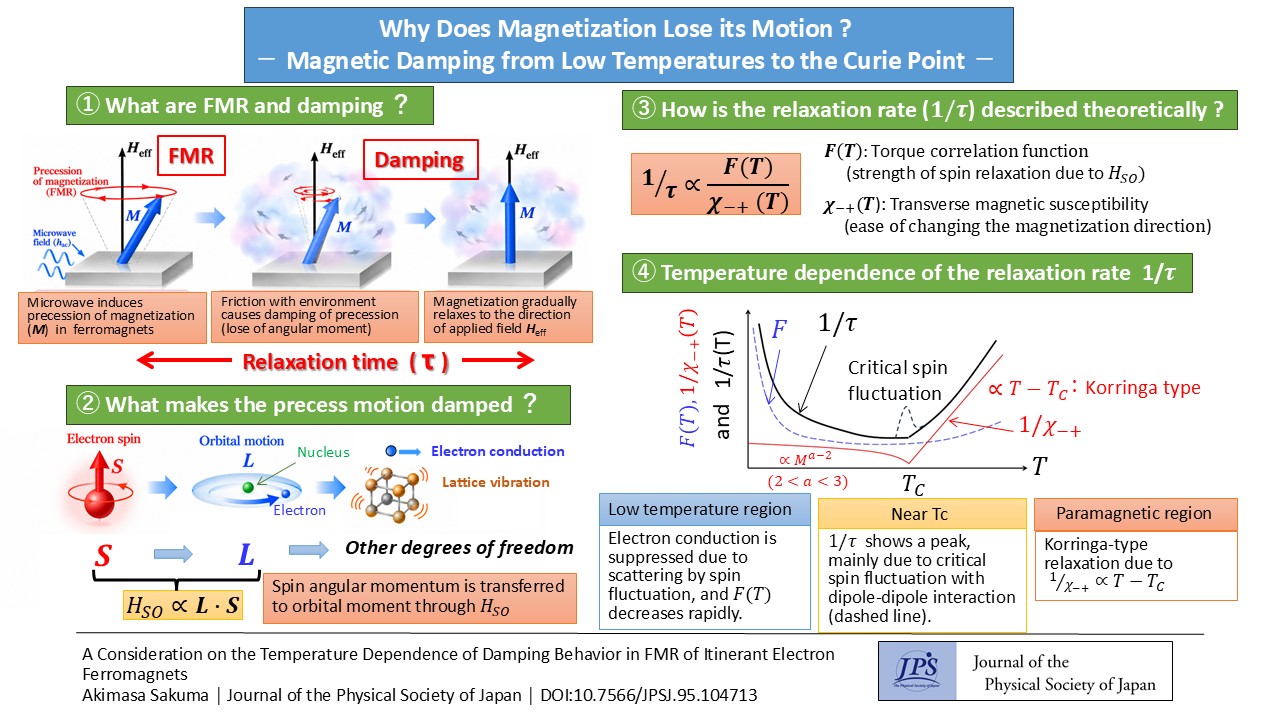
When the magnetization of a ferromagnet tilts away from its equilibrium direction, it precesses around the effective magnetic field. This motion can be observed as ferromagnetic resonance (FMR). Similar to a spinning top, the precession of magnetization decays with time owing to friction. This phenomenon, known as magnetic damping, occurs because the spin system transfers energy and angular momentum to its surroundings.
What is the cause of this damping? Spin–orbit coupling (SOC) plays an essential role in metallic ferromagnets. It couples the spin of an electron to its orbital motion, allowing the spin angular momentum to be transferred to other degrees of freedom, such as lattice vibrations. Consequently, the precession of the magnetization gradually relaxes toward the direction of the effective magnetic field.
An important question is how the magnetic damping changes with temperature. At low temperatures, the damping can be very strong and decreases rapidly as the temperature increases, reflecting the effects of electron scattering. This behavior is understood in terms of the electronic transitions associated with the SOC. However, the situation becomes more complicated near the Curie temperature (Tc), where the spontaneous magnetization disappears and strong spin fluctuations develop. How can the damping behavior at low temperatures be connected to that near and above Tc?
In this study, this question was examined using the general theory of spin dynamics. The key idea is that the relaxation rate (1/τ) that quantifies how rapidly the precession decays, is determined by the ratio of two quantities: the torque correlation function (F(T)), representing microscopic spin relaxation, and the transverse magnetic susceptibility (χ_+) (T)), describing how easily the magnetization responds to a transverse magnetic field. This framework clarifies how the conventional microscopic theory of magnetic damping at low temperatures relates to a more general description of spin relaxation.
At low temperatures, the relaxation rate decreases rapidly with increasing temperature because electron scattering suppresses the contribution of electronic transitions within the same energy band. Below Tc, where the temperature dependence of F(T) is weak, the relaxation rate is approximately governed by 1/τ ∝ Mα-2(2 < α < 3). Near Tc, qualitative analysis suggests that SOC alone may not produce a pronounced critical peak, whereas magnetic dipole–dipole interactions can enhance damping through critical spin fluctuations. Above Tc , a Korringa-type behavior, whereby 1/τ ∝ T –Tc, is expected theoreticaally.
Thus, the present study provides a unified physical outlook of magnetic damping over a broad temperature range (low temperatures to Tc to the paramagnetic region). Clarifying the relation between microscopic electronic relaxation and the collective magnetic response explains how apparently different damping behaviors can be understood using a common theoretical framework.
(Written by Akimasa Sakuma)
A Consideration on the Temperature Dependence of Damping Behavior in FMR of Itinerant Electron Ferromagnets
J. Phys. Soc. Jpn.
95,
104713
(2026)
.
Share this topic


Fields
Related Articles
-
Frustrated Sawtooth Yb Chain Yielding Ferromagnetic Order with Reduced Magnetic Moments
Magnetic properties in condensed matter
2026-9-1
The ytterbium-based semiconductor ZnYb2S4 exhibits ferromagnetic order with contracted Yb moments, representing a novel quantum ground state attributed to competing exchange interactions in an effective spin-1/2 frustrated sawtooth chain.
-
Unlocking a 40-Year-Old Mystery: Full-gap Spin-Triplet Superconductivity Unveiled in UBe13
Magnetic properties in condensed matter
Superconductivity
2026-8-12
Recent precise NMR measurements on the heavy-fermion superconductor UBe13 provided “smoking-gun” evidence for a fully-gapped spin-triplet superconducting state, opening a new chapter in the field.
-
Peculiar Magnet Pointing Against an Applied Magnetic Field
Cross-disciplinary physics and related areas of science and technology
Magnetic properties in condensed matter
2026-7-1
TbNiC2 exhibits negative magnetization. A new mechanism, based on the coupling between the charge density wave and the antiferromagnetic order, is proposed to account for this peculiar phenomenon.
-
Magnetic-Field Driven Switching of Multipolar Order in an f-Electron System
Magnetic properties in condensed matter
2026-5-22
This study investigates high-rank multipole physics in f-electron systems, providing the first clear experimental evidence for field-induced switching of ferro-quadrupole order in a non-Kramer ion system, along with a new conceptual framework
-
Toward Clarification of Physical Properties of Quasicrystals: Noncollinear Magnetic Orders in Icosahedral Approximants
Cross-disciplinary physics and related areas of science and technology
Electronic transport in condensed matter
Magnetic properties in condensed matter
2026-4-6
An effective model based on magnetic anisotropy arising from a crystalline electric field is constructed for icosahedral approximants, which not only explains measured ferromagnets and antiferromagnets but also reveals new types of noncollinear magnetic orders.