

Mysterious Critical Phenomena Driven by Role Reversal in Multicomponent Systems: From Normal to Reverse RKKY — Twofold Reversal and Induced Critical Exponent
© The Physical Society of Japan
This article is on
Mysterious Critical Phenomena in lambda-(BETS)2FeCl4 Using the High-Accuracy Relaxation Method
J. Phys. Soc. Jpn.
95,
083602
(2026)
.
The Reverse RKKY mechanism drives a twofold reversal, yielding an anomalous specific‑heat peak with a large, induced critical exponent.
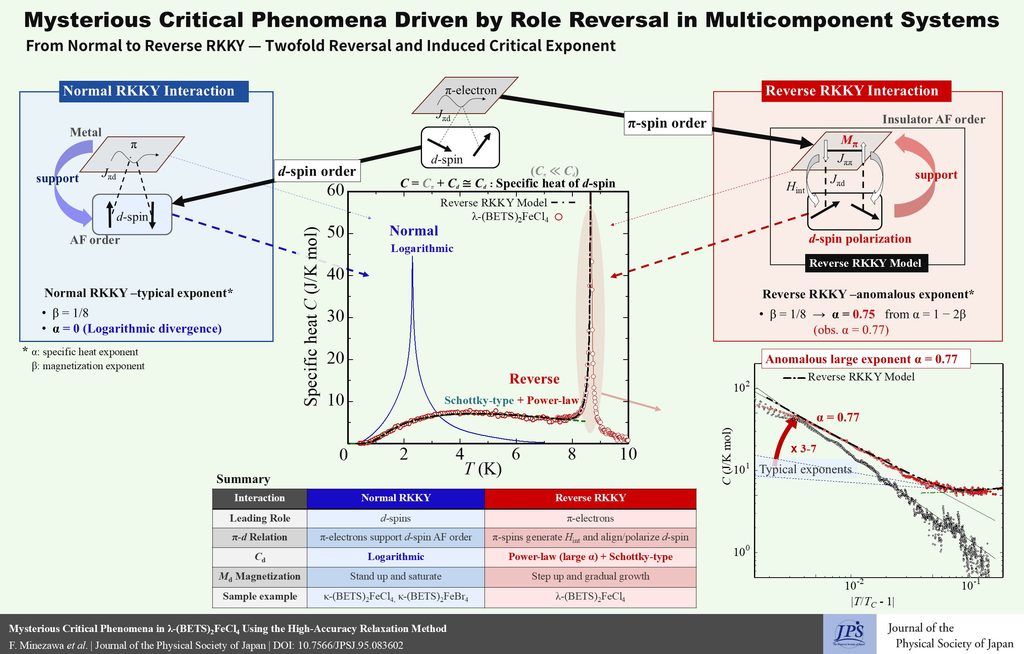
In the organic π–d hybrid conductor λ-(BETS)2FeCl4 [BETS = bis(ethylenedithio)tetraselena-fulvalene], the π-electrons and localized d-spins play roles reversed from those in conventional π–d systems, leading to anomalous critical phenomena. In normal Ruderman–Kittel–Kasuya–Yosida (RKKY) compounds, π-electrons support antiferromagnetic (AF) ordering of localized d-spins, and the specific heat exhibits the logarithmic divergence characteristic of two-dimensional (2D) AF order. In contrast, in λ-(BETS)2FeCl4, the π-electrons themselves form an AF order, generate an internal field 𝐻int, align the d-spins, and then polarize them. This first role reversal produces critical behavior far beyond what is expected in π–d coupled magnets and naturally leads to a “reverse RKKY” interaction.
The transition occurs at a relatively high temperature, and the specific heat shows a sharp peak with an anomalously large exponent 𝛼=0.77, far exceeding the logarithmic behavior of 2D AF systems. A Schottky-type shoulder appears at lower temperatures, indicating that most of the d-spin entropy remains active even after ordering. Since the π-electron system transitions from a metallic state, very little specific‑heat anomaly is expected from the π-electrons. Instead, the π-electron–induced polarization of the d-spins reduces the d-spin entropy, making the d-spins the dominant contributors to both the transition anomaly and the low-temperature specific heat. Thus, unlike conventional systems in which the component controlling the order also produces the main thermodynamic anomaly, this system exhibits a second role reversal: the π-electron system drives the AF transition, while the “supporting” d-spins provide the main thermodynamic contribution.
To examine these anomalous critical phenomena, we constructed a reverse RKKY model in which the spontaneous magnetization of the π-spin system follows 𝑀𝜋∝(𝑇𝑐−𝑇)𝛽, with 𝛽=1/8 for a 2D AF order, generating the 𝐻int that polarizes the d-spins. The model reproduces the sharp specific‑heat peak from the modest initial alignment of the d‑spins along 𝐻int at the transition, and the Schottky‑type shoulder from their gradual low‑temperature polarization. Under these reversed roles, the specific‑heat exponent naturally becomes an induced critical exponent, given by 𝛼=1−2𝛽, yielding 𝛼=0.75, in good agreement with the observed value 𝛼=0.77. This demonstrates that the anomalous exponent is a quantitative signature of the reverse RKKY interaction. The reverse RKKY mechanism may arise in multicomponent systems where low dimensionality, frustration and/or poor nesting of the Fermi surface suppress conventional magnetic order. This work shows that even within a conventional universality class, a twofold reversal between π-electrons and d-spins can induce a power‑law divergence in specific heat with an exponent not previously reported.
(Written by Yutaka Nishio on behalf of all authors.)
Mysterious Critical Phenomena in lambda-(BETS)2FeCl4 Using the High-Accuracy Relaxation Method
J. Phys. Soc. Jpn.
95,
083602
(2026)
.
Share this topic


Fields
Related Articles
-
Direct Observation of Piezoelectricity from Electric Toroidal Quadrupole Order
Electron states in condensed matter
Structure and mechanical and thermal properties in condensed matter
2026-9-30
This study reports the direct observation of piezoelectricity in the spin-orbit-coupled metal Cd2Re2O7. The findings reveal how electric toroidal quadrupole order drives successive inversion-symmetry-breaking transitions and anisotropic electromechanical responses.
-
Revealing Electronic Quantum Behavior Masked by Nuclear Heat
Measurement, instrumentation, and techniques
Structure and mechanical and thermal properties in condensed matter
Superconductivity
2026-9-7
The initial slope method is used to reveal intrinsic electronic specific heat by eliminating the overwhelming nuclear contributions during low-temperature calorimetry, opening a new window into quantum materials.
-
The Thermal Einstein–de Haas Effect: Theoretical Prediction and Observability in Chiral Carbon Nanotubes
Cross-disciplinary physics and related areas of science and technology
Structure and mechanical and thermal properties in condensed matter
2026-6-22
Although the Einstein–de Haas (EdH) effect describes material rotation in a magnetic field, a thermal EdH effect, driven by a temperature gradient, remains unobserved. Recently, chiral carbon nanotubes were theoretically proposed as promising candidates to observe it.
-
Negative Apparent Viscosity in Liquid Crystals
Cross-disciplinary physics and related areas of science and technology
Electromagnetism, optics, acoustics, heat transfer, and classical and fluid mechanics
Structure and mechanical and thermal properties in condensed matter
2026-6-8
Electrically driven liquid-crystal turbulence generates self-sustained flow and negative apparent viscosity. The fluorinated, chemically robust nematic PPDFB shows a substantially larger negative-viscosity effect than Schiff-base nematics.
-
Role of the Diffusion Layer in Energy Devices
Cross-disciplinary physics and related areas of science and technology
Structure and mechanical and thermal properties in condensed matter
2026-5-1
In many energy devices, electron transfer occurs between ions dissolved in the electrolyte and the electrodes. For keep current flowing, new ions must be supplied continuously to the electrode surface from the bulk region. The diffusion layer’s role in diffusive mass transfer was clarified using the rotating disk electrode method.