

Holonomy Reveals Hidden Strain Incompatibilities in Birefringence Imaging
© The Physical Society of Japan
This article is on
Holonomy-based Diagnostic of Strain Compatibility in Birefringence Imaging of Stress-induced Ferroelectric SrTiO3
J. Phys. Soc. Jpn.
95,
063704
(2026)
.
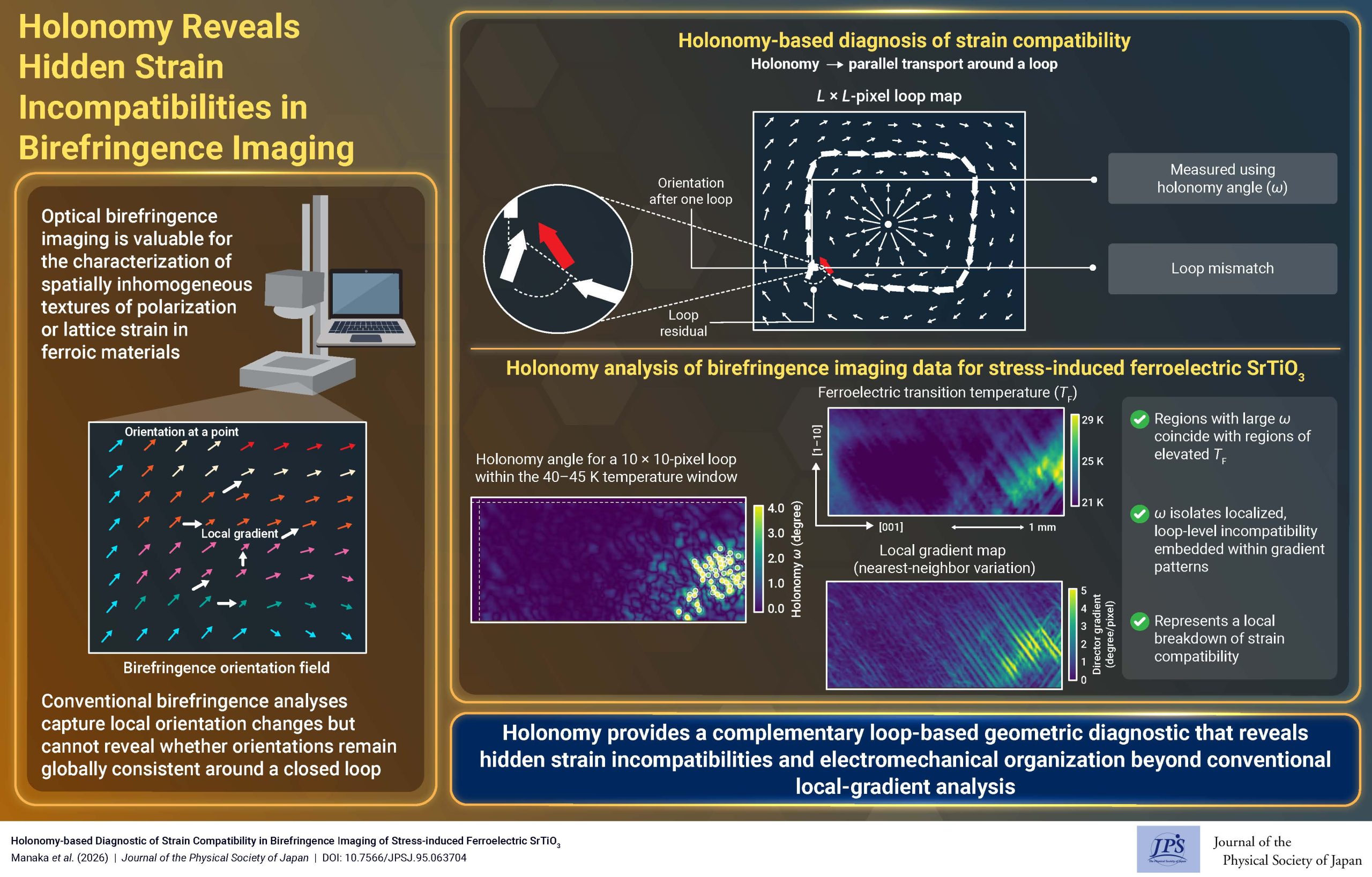
Holonomy measures how local optical directions fail to return to their original orientation after a closed loop, revealing hidden electromechanical structures in stress-induced ferroelectric SrTiO3.
Modern imaging techniques can map physical properties across a material with very high spatial resolution. However, understanding materials often requires more than identifying where a signal is strong or weak. Equally important is understanding how neighboring regions are connected, especially when strain, stress, and electromechanical responses vary from place to place.
In this study, we investigated stress-induced ferroelectric SrTiO3 using birefringence imaging. This technique measures both the strength of the optical response and a local optical direction at each pixel. The optical direction is influenced by how strain and stress are arranged locally, but examining individual pixels provides only local information. To understand the overall organization of the material, it is necessary to study how these directions are connected across the entire image.
One way to do this is to follow the optical direction from pixel to pixel along a closed loop. If the directional changes cancel around the loop, the optical direction returns to its original orientation. However, in practice, many small directional changes can accumulate, producing a residual rotation. Consequently, the final orientation depends on the path taken through the image. This path-dependent residual rotation is known as holonomy.
Holonomy is important because it cannot be determined from a single pixel. If the optical directions represented only smooth local distortions, the directional changes would cancel after completing a loop. A nonzero holonomy indicates that the optical directions form a more complex geometric structure extending across the image. Thus, holonomy reflects a collective property of the directional pattern over a finite region of the image.
Applying this approach to stress-induced ferroelectric SrTiO3 revealed localized regions with unusually large holonomy. These regions were found near areas of concentrated stress and were associated with an enhanced ferroelectric transition temperature. This suggests that large holonomy identifies regions where strain-related electromechanical fields are organized in an unusual manner. Such regions may also contain nonuniform polarization and associated bound-charge effects. Although holonomy does not directly image electric charge, it provides a geometric method for locating regions where hidden electromechanical activity may occur.
More broadly, this work demonstrates that experimental images contain not only local information but also geometric information encoded in the connections between neighboring directions. Holonomy provides a way to extract this hidden information and may become a useful tool for studying complex materials with spatially varying strain, order, and anisotropy.
(Written by Hirotaka MANAKA on behalf of all authors.)
Holonomy-based Diagnostic of Strain Compatibility in Birefringence Imaging of Stress-induced Ferroelectric SrTiO3
J. Phys. Soc. Jpn.
95,
063704
(2026)
.
Share this topic


Fields
Related Articles
-
Revealing Electronic Quantum Behavior Masked by Nuclear Heat
Measurement, instrumentation, and techniques
Structure and mechanical and thermal properties in condensed matter
Superconductivity
2026-9-7
The initial slope method is used to reveal intrinsic electronic specific heat by eliminating the overwhelming nuclear contributions during low-temperature calorimetry, opening a new window into quantum materials.
-
Enhancing Accuracy and Reliability Bayesian Framework for Analysis of AR-HAXPES of Hard X-ray Photoelectron Spectroscopy
Dielectric, optical, and other properties in condensed matter
Electronic structure and electrical properties of surfaces and nanostructures
Measurement, instrumentation, and techniques
2026-4-28
We present a Bayesian framework for angle-resolved hard X-ray photoelectron spectroscopy (AR-HAXPES), combining Replica Exchange Monte Carlo with hierarchical integration to objectively and precisely estimate thin-film thickness.
-
A Novel Type of Magnetic Band Splitting in a Fe Spin Ladder System
Dielectric, optical, and other properties in condensed matter
Magnetic properties in condensed matter
Superconductivity
2026-1-22
An investigation of a Fe spin ladder system using angle-resolved photoemission spectroscopy revealed a novel type of magnetic band splitting resembling that in altermagnets.
-
Imaging Micron-Scale Pressure Landscapes with NV Nanodiamonds
Dielectric, optical, and other properties in condensed matter
Magnetic properties in condensed matter
2025-12-22
Nanodiamonds containing nitrogen-vacancy centers can be used to map pressure and nonhydrostatic stress inside diamond anvil cells to obtain micron-scale pressure landscapes that clarify local conditions affecting high-pressure materials research.
-
The Physics of Light-Spin Interactions: Advances in Photodriven Quantum Spin Systems
Dielectric, optical, and other properties in condensed matter
Electromagnetism, optics, acoustics, heat transfer, and classical and fluid mechanics
Electronic transport in condensed matter
Magnetic properties in condensed matter
Statistical physics and thermodynamics
2025-12-17
This Special Topics edition of the Journal of the Physical Society of Japan discusses the recent progress and future directions for the rapidly progressing field of photodriven quantum spin systems.