

A Journey into Nuclear Diversity: Discovery of 22 New Exotic Isotopes Using an Intense 208Pb Beam
© The Physical Society of Japan
This article is on
First Observation of Twenty-two Exotic Isotopes Using a 208Pb Primary Beam at RIBF
(PTEP Editors' Choice)
Prog. Theor. Exp. Phys.
2026, (2026)
.
Using a newly developed intense 208Pb beam at the RIKEN RI Beam Factory (RIBF), we discovered 22 new proton- and neutron-rich isotopes, which significantly expand the nuclear chart.
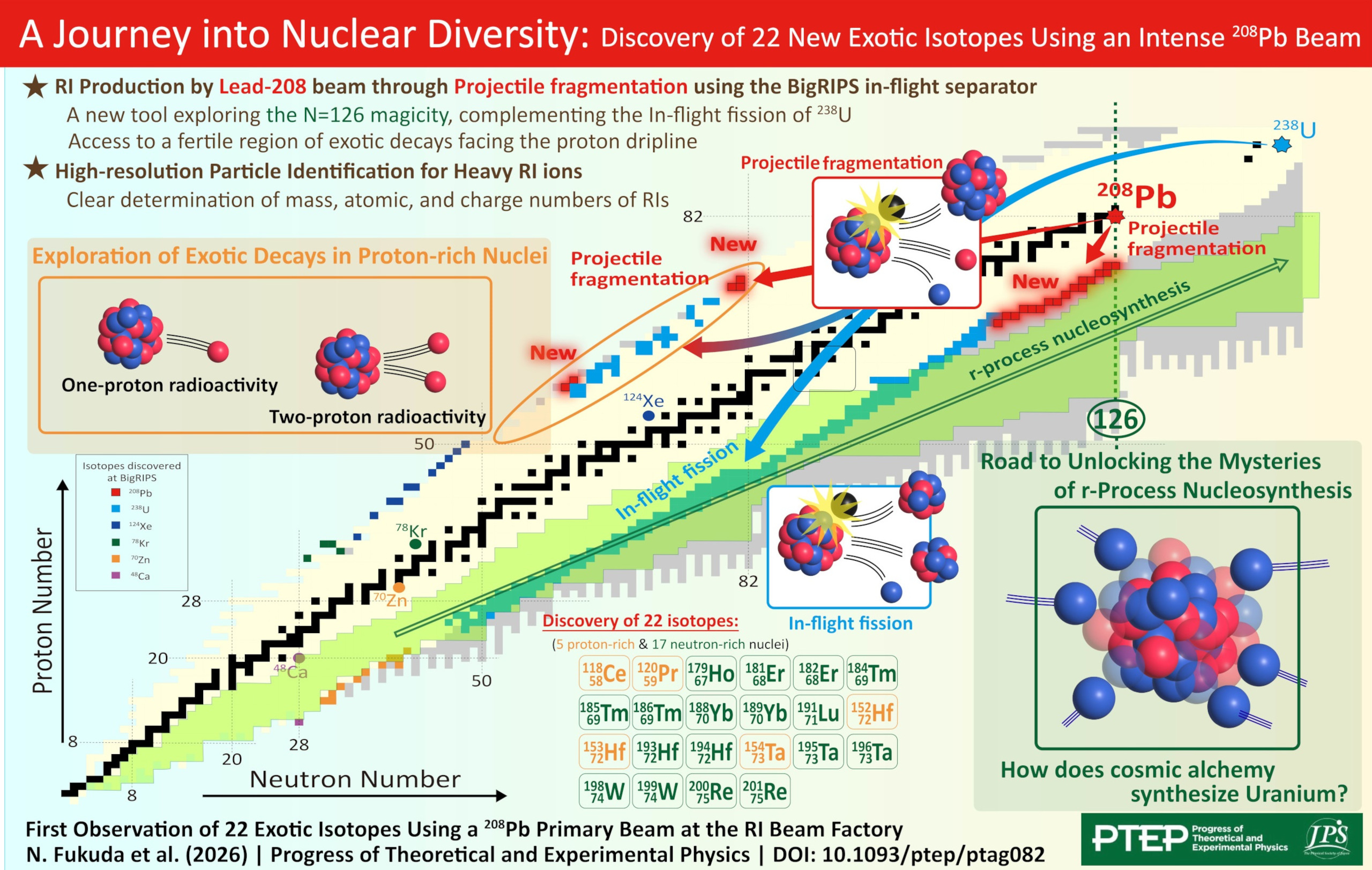
Atomic nuclei, which are quantum many-body systems bound by the strong interaction, exhibit rich and complex diversity. While stable isotopes form the world around us, unstable radioactive isotopes (RIs) decay with finite lifetimes. Although theoretical models predict the existence of over 7,000 nuclides, only approximately 3,500 nuclei have been experimentally confirmed, leaving more than half undiscovered. To address the fundamental question of what combinations of protons and neutrons can exist as nuclei, international RI facilities are competing fiercely. In the paper introduced here, we report the discovery of 22 new exotic isotopes, marking a critical milestone in mapping the known boundaries of nuclear existence.
The experiment was conducted at the RIKEN RI Beam Factory using the BigRIPS in-flight separator. The accelerator complex delivered a highly intense, 345-MeV/nucleon primary beam of 208Pb to induce projectile fragmentation on a beryllium target. An advantage of using a 208Pb primary beam over a conventional 238U beam is the absence of fission product contamination, allowing the production of high-purity secondary beams for rare isotopes of interest. Incorporating state-of-the-art detectors to measure time-of-flight, magnetic rigidity, and energy loss, we achieved clear particle identification for both atomic numbers and mass-to-charge ratios with greater than 3s. This robust analysis successfully confirmed 17 neutron-rich isotopes (179Ho, 181,182Er, 184-186Tm, 188,189Yb, 191Lu, 193,194Hf, 195,196Ta, 198,199W, 200,201Re) and 5 proton-rich isotopes (118Ce, 120Pr, 152,153Hf, 154Ta).
These discoveries carry profound physical implications for both frontiers of the nuclear chart. On the neutron-rich side, the newly identified isotopes are located close to the predicted path of the r-process (rapid neutron-capture process), which is responsible for synthesizing elements heavier than iron in explosive stellar environments such as supernovae and/or neutron star mergers. Crucially, our successful synthesis of 201Re and neighboring nuclei near the neutron magic number N=126 accelerates our quantitative understanding of how the third elemental abundance peak is formed in the universe. On the proton-rich side, the discovered isotopes lie near or beyond the proton drip line, where the valence protons are unbound. The ability to access these nuclei using the in-flight RI production method has established a new framework for investigating exotic decay modes, including single- or two-proton radioactivity.
Unlocking the mysteries of nucleosynthesis in the universe and constructing a unified nuclear model are long-standing challenges in modern physics. The advancement of RI beam production techniques, as demonstrated by this 208Pb beam experiment, represents a definitive step forward. The event-by-event-tagged high-intensity RI beams will serve as powerful instruments for future reaction studies and continue to expand the frontiers of nuclear physics.
(Written by S. Michimasa on behalf of all authors.)
First Observation of Twenty-two Exotic Isotopes Using a 208Pb Primary Beam at RIBF
(PTEP Editors' Choice)
Prog. Theor. Exp. Phys.
2026, (2026)
.
Share this topic


Fields
Related Articles
-
Verification of Magnetic Structure Observation at the Atomic Scale
Atomic and molecular physics
Cross-disciplinary physics and related areas of science and technology
Nuclear physics
2026-6-2
Magnetic neutron scattering holography (MNH) were performed on a Fe0.08Co0.92 single crystal. The resulting holograms provided the first experimental evidence that MNH is sensitive to magnetic signals.
-
Seven New Pieces of the Nuclear Landscape Puzzle Uncovered Near Cerium-159
Nuclear physics
2026-3-13
RIKEN discovered seven neutron-rich isotopes in the rare-earth region, pushing the nuclear landscape frontier toward an astrophysical r-process path. RIKEN discovered over 200 isotopes using in-flight separation.
-
Probing New Routes to the Synthesis of Superheavy Elements with Intense Titanium-50 Isotopic Beam
Nuclear physics
2025-9-24
Discovery of new superheavy elements require beams beyond the emblematic Calcium-48. Intense titanium-50 beams open a new route used in the present tentative synthesis of oganesson (Z=118).
-
Deriving Mean Square Radius of Neutron Distribution and Neutron Skin Thickness using Electron Scattering
Nuclear physics
2025-8-14
This study demonstrates that the fourth moment of nuclear charge density obtained from electron scattering helps estimate neutron distributions—enabling reliable neutron-skin thickness measurement relevant to nuclear physics and astrophysics.
-
Into the Frontier of Nuclear Chart at RI Beam Factory, RIKEN: Discovery of 98Sn
Nuclear physics
2025-5-15
The most neutron-deficient tin isotope of 98Sn has been discovered beyond the double-magic nuclide 100Sn. It is produced by the projectile fragmentation of a 124Xe beam and identified in the BigRIPS separator.