

Role of the Diffusion Layer in Energy Devices
© The Physical Society of Japan
This article is on
Convection Effect on Resistance Components in Liquid Thermoelectric Converter
(JPSJ Editors' Choice)
J. Phys. Soc. Jpn.
95,
044601
(2026)
.
In many energy devices, electron transfer occurs between ions dissolved in the electrolyte and the electrodes. For keep current flowing, new ions must be supplied continuously to the electrode surface from the bulk region. The diffusion layer’s role in diffusive mass transfer was clarified using the rotating disk electrode method.
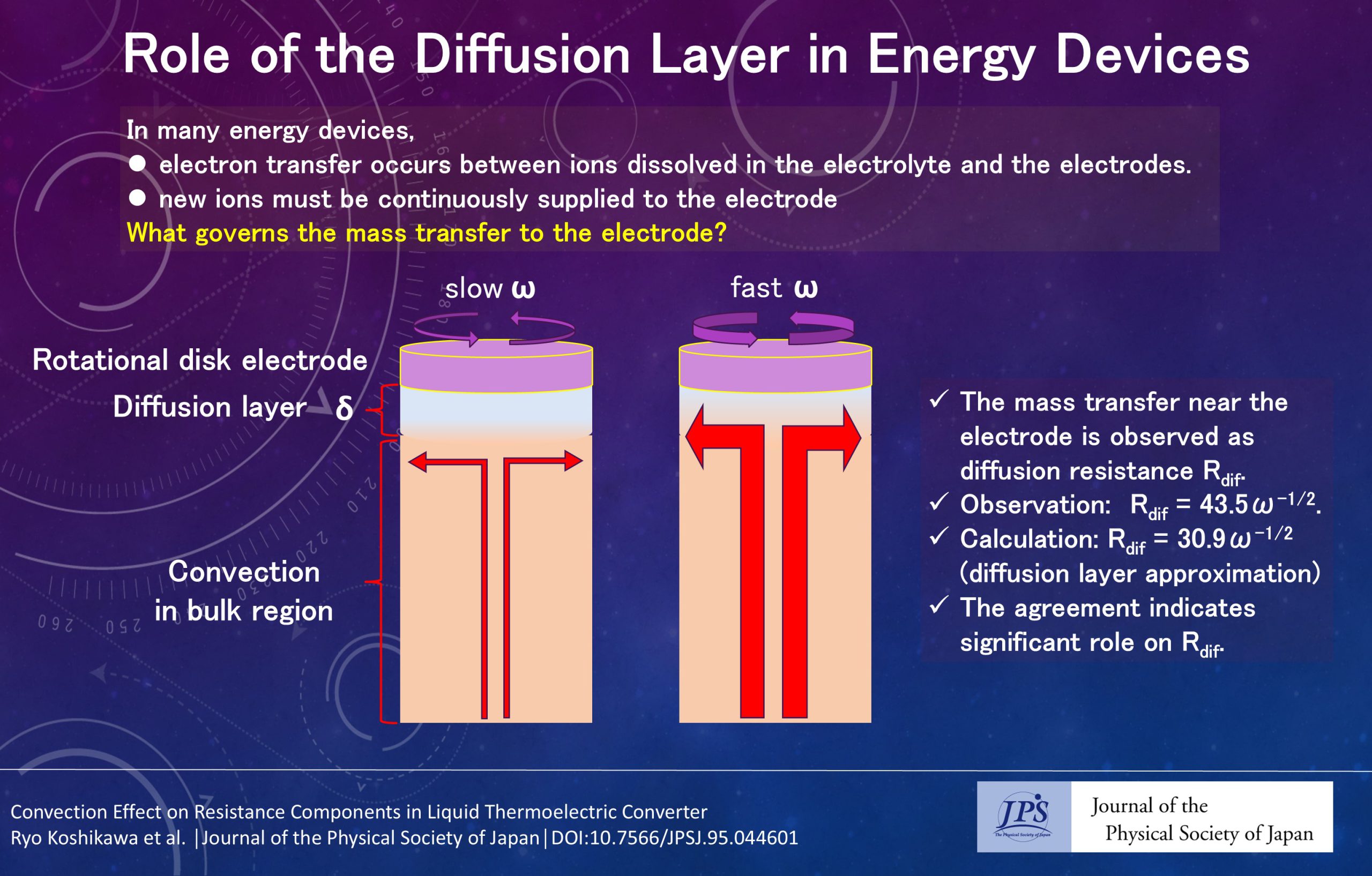
In energy devices, such as batteries and liquid thermoelectric converters, electron transfer occurs between ions dissolved in the electrolyte and the electrodes. For current to continue flowing in such devices, new ions must be supplied continuously to the electrode surface from the bulk region of the electrolyte. This is because ions that have undergone electron transfer cannot undergo further electron transfer. The driving force for mass transfer is the concentration difference ΔC between the electrode surface and the bulk region.
When an electric current I is passed through the electrolyte, ions are consumed at the electrode surface; hence, the ion concentration at the electrode surface decreases compared with the bulk region. The resulting concentration difference ΔC drives the diffusion of new ions to the electrode surface. Eventually, the concentration distribution near the electrode reaches a steady state. The concentration distribution at the steady state is usually approximated with a linear function (diffusion layer approximation), i.e., the concentration increases proportionally with distance from the electrode surface and becomes constant when it reaches the value of the bulk region. The distance δ at which the concentration reaches the bulk value is called the “thickness” of the diffusion layer. In the steady state, the current (= AFDΔC/δ, where A, F, and D are electrode area, Faraday constant, and diffusion constant, respectively.) caused by diffusive mass transfer matches I. The mass transfer is observed as diffusion resistance Rdif. Rdif can be considered the equilibrium potential shift resulting from ΔC divided by I. If ΔC/C (C is the concentration in the bulk region) is sufficiently small, Rdif becomes 2kBT/eI ×ΔC/C, where kB and T are the Boltzmann constant and temperature, respectively.
In this study, the relationship between the diffusive mass transfer and the diffusion layer was clarified using the rotating disk electrode method, in which centrifugal force causes the electrolyte near the electrode to flow outward, and convection occurs from the bulk region toward the electrode to compensate for this. With increasing angular velocity ω of the rotating electrode, the flow velocity toward the electrode increases. It was found that Rdif decreased sharply with increasing ω. Detailed analysis revealed that Rdif is proportional to ω-1/2 with a proportionality constant of 43.5 Ωs-1/2. In the diffusion layer approximation, δ in the rotational electrode method is proportional to ω-1/2. Then, Rdif (= 2kBTδ/eAFDC) is expected to be proportional to ω-1/2. From the parameters of the electrolyte and electrodes, the proportionality constant is calculated as 30.9 Ωs-1/2. The calculated value showed good agreement with the observed value, demonstrating that Rdif can be understood quantitatively in terms of the diffusion layer.
(Written by Yutaka Moritomo on behalf of all authors.)
Convection Effect on Resistance Components in Liquid Thermoelectric Converter
(JPSJ Editors' Choice)
J. Phys. Soc. Jpn.
95,
044601
(2026)
.
Share this topic


Fields
Related Articles
-
Only Certain Angles Allow Layer-by-Layer Stacking of Corrugated Rods
Cross-disciplinary physics and related areas of science and technology
2026-10-13
Rods with periodic surface corrugations stack helicoidally at only a discrete set of pitch angles. This rule opens a route for programming the fiber-stacking angle based on fiber surface texture.
-
Mysterious Critical Phenomena Driven by Role Reversal in Multicomponent Systems: From Normal to Reverse RKKY — Twofold Reversal and Induced Critical Exponent
Electronic transport in condensed matter
Structure and mechanical and thermal properties in condensed matter
2026-10-5
The Reverse RKKY mechanism drives a twofold reversal, yielding an anomalous specific‑heat peak with a large, induced critical exponent.
-
Direct Observation of Piezoelectricity from Electric Toroidal Quadrupole Order
Electron states in condensed matter
Structure and mechanical and thermal properties in condensed matter
2026-9-30
This study reports the direct observation of piezoelectricity in the spin-orbit-coupled metal Cd2Re2O7. The findings reveal how electric toroidal quadrupole order drives successive inversion-symmetry-breaking transitions and anisotropic electromechanical responses.
-
Revealing Electronic Quantum Behavior Masked by Nuclear Heat
Measurement, instrumentation, and techniques
Structure and mechanical and thermal properties in condensed matter
Superconductivity
2026-9-7
The initial slope method is used to reveal intrinsic electronic specific heat by eliminating the overwhelming nuclear contributions during low-temperature calorimetry, opening a new window into quantum materials.
-
How Heart Cells Come to Beat Together through an Elastic Substrate
Cross-disciplinary physics and related areas of science and technology
Statistical physics and thermodynamics
2026-8-24
Two isolated cardiomyocytes (heart muscle cells) can synchronize through deformations of a soft substrate. A dynamical theory explains geometry-dependent phase-locking and synchronization time.