

Towards Uncovering the Hidden Order of URu2Si2 Phase Transition
© The Physical Society of Japan
This article is on
Chiral Charge as Hidden Order Parameter in URu2Si2
(JPSJ Editors' Choice)
J. Phys. Soc. Jpn.
92,
113704
(2023)
.
We propose a chiral charge as the hidden order parameter in URu2Si2 and present experiments to detect it by focusing on breakings of mirror and inversion symmetries at the local uranium ion.
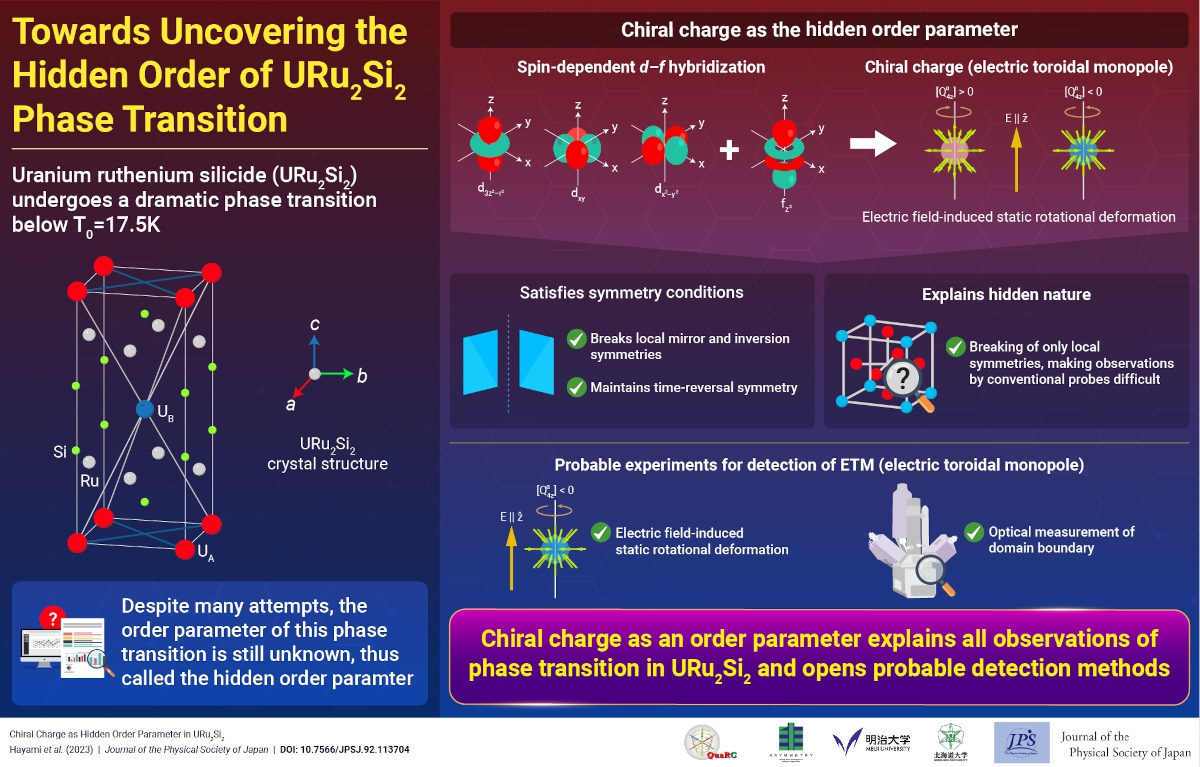
In condensed matter physics, various types of phase transitions have been observed and their nature has been clarified by intensive experimental and theoretical studies. However, the order parameter of the phase below critical temperature T0 = 17.5 K in URu2Si2 has still been uncovered since its discovery in 1985 despite many efforts by several researchers. With the latest and high-resolution experiments, such as nuclear magnetic resonance, muon spin relaxation, and resonant X-ray scattering measurements, the symmetry of local environment of ions has been narrowed down. This enigmatic ordered phase is called the hidden order. Meanwhile, the candidate order parameter compatible with known experimental facts has recently been clarified from the symmetry aspect by Kambe et al. [Phys. Rev. B 97, 235142 (2018)], although its microscopic object and experimental identification have still been unclear.
In the present study, we theoretically propose that a staggered alignment of chiral charge, that appears in association with electron motion in crystals, corresponds to the hidden order parameter in URu2Si2, satisfying all the symmetry conditions accumulated by many experiments. The chiral charge represents composite degrees of freedom consisting of a spin and a hybridization between orbitals with different orbital angular momenta that can be regarded as a pseudoscalar monopole distinct from conventional electric and magnetic monopoles. Because it only locally breaks the mirror and inversion symmetries, the observation using microscopic probes is difficult; therefore, the order parameter is still hidden. By considering the minimal effective d-f hybridized model on the itinerant picture, we propose the methods to observe the hidden order parameter in experiments. One is an electric-field-induced static rotational deformation in bulk. The other is the observation of states at the surface or domain boundary that can be detected by state-of-the-art experimental methods such as nuclear quadrupole resonance and scanning transmission electron microscopy combined with convergent-beam electron diffraction under an electric field and circularly polarized second harmonic generation microscopy. Our result may provide the last information to resolve the hidden order parameter in URu2Si2.
(Written by Satoru Hayami on behalf of all authors.)
Chiral Charge as Hidden Order Parameter in URu2Si2
(JPSJ Editors' Choice)
J. Phys. Soc. Jpn.
92,
113704
(2023)
.
Share this topic


Fields
Related Articles
-
Peculiar Magnet Pointing Against an Applied Magnetic Field
Cross-disciplinary physics and related areas of science and technology
Magnetic properties in condensed matter
2026-7-1
TbNiC2 exhibits negative magnetization. A new mechanism, based on the coupling between the charge density wave and the antiferromagnetic order, is proposed to account for this peculiar phenomenon.
-
Magnetic-Field Driven Switching of Multipolar Order in an f-Electron System
Magnetic properties in condensed matter
2026-5-22
This study investigates high-rank multipole physics in f-electron systems, providing the first clear experimental evidence for field-induced switching of ferro-quadrupole order in a non-Kramer ion system, along with a new conceptual framework
-
Enhancing Accuracy and Reliability Bayesian Framework for Analysis of AR-HAXPES of Hard X-ray Photoelectron Spectroscopy
Dielectric, optical, and other properties in condensed matter
Electronic structure and electrical properties of surfaces and nanostructures
Measurement, instrumentation, and techniques
2026-4-28
We present a Bayesian framework for angle-resolved hard X-ray photoelectron spectroscopy (AR-HAXPES), combining Replica Exchange Monte Carlo with hierarchical integration to objectively and precisely estimate thin-film thickness.
-
Toward Clarification of Physical Properties of Quasicrystals: Noncollinear Magnetic Orders in Icosahedral Approximants
Cross-disciplinary physics and related areas of science and technology
Electronic transport in condensed matter
Magnetic properties in condensed matter
2026-4-6
An effective model based on magnetic anisotropy arising from a crystalline electric field is constructed for icosahedral approximants, which not only explains measured ferromagnets and antiferromagnets but also reveals new types of noncollinear magnetic orders.
-
Definitive Momentum and Spin Imaging Resolves 20-Year Debate on Gold Surface Spin
Electronic structure and electrical properties of surfaces and nanostructures
Magnetic properties in condensed matter
2026-4-1
Researchers at the Institute for Molecular Science (IMS) have utilized a cutting-edge Photoelectron Momentum Microscope (PMM) at the UVSOR Synchrotron Facility to settle a two-decade-long controversy concerning the direction of electron spin on the Au(111) surface. This study provides a definitive, full-map, comprehensive reference for quantum imaging that is essential for advancing spintronics technology.