

Qualitative Changes in Kinetic Pathways Driven by Hydrodynamic Interactions in Dense Colloidal Suspensions
© The Physical Society of Japan
This article is on
Impact of Hydrodynamic Interactions on Structural Relaxations in Dense Colloidal Suspensions: Helping the Cage Breakage
(JPSJ Editors' Choice)
J. Phys. Soc. Jpn.
94,
023801
(2025)
.
Even in dense colloidal suspensions, where long-range hydrodynamic interactions are screened, near-field hydrodynamic interactions qualitatively influence the selection of kinetic pathways.
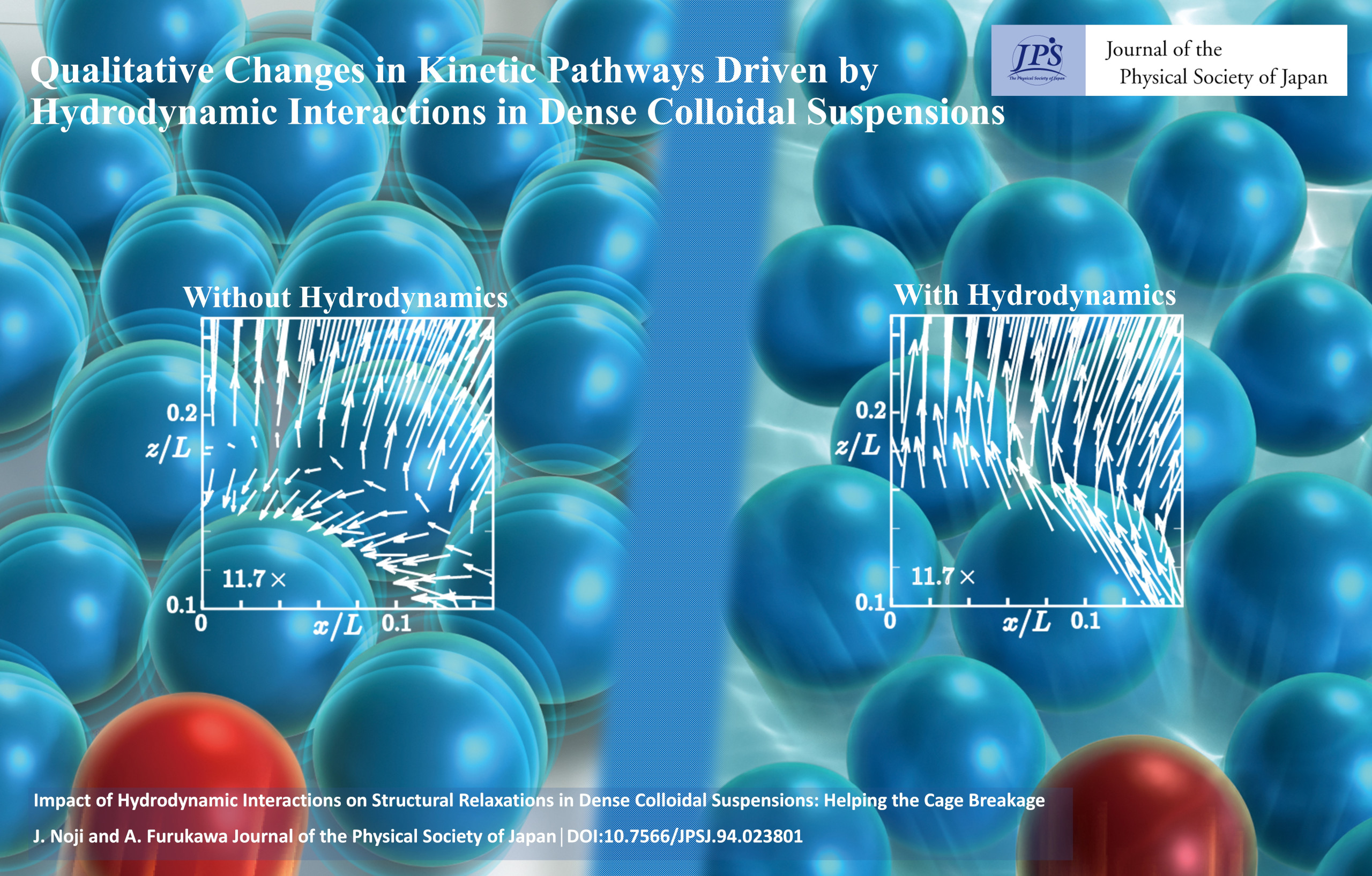
Colloidal suspensions, in which particles ranging from tens of nanometers to a few microns are dispersed in a liquid, are the basis of many industrial applications, including paints, foods, cosmetics, and pharmaceuticals. Their macroscopic dynamic behavior, especially under external flows or stresses, is strongly influenced by the microscopic motion of the suspended particles and the interactions among them. Hydrodynamic interactions (HIs), which are mediated by solvent flows, often play a crucial role.
In dilute suspensions, HIs are well described by the Oseen tensor, which captures long-range interactions that decay as 1/r,where r is the interparticle distance. However, as the concentration increases, particle crowding progressively screens these long-range interactions. Therefore, based on the longstanding assumption that HIs can be effectively neglected in sufficiently dense systems, Brownian dynamic simulations that ignore solvent-mediated hydrodynamic effects have been used to model the dynamics of concentrated suspensions. However, the assumption has not been sufficiently validated.
In this study, comparative numerical simulations were conducted for a densely packed colloidal suspension, almost in the supercooled regime, with and without HIs. The inclusion of HIs significantly accelerated relaxation dynamics, representing not only a quantitative shift in the timescale but also a qualitative change in the underlying kinetic pathways.
In highly concentrated systems, particles are confined in “cages” formed by neighboring particles, undergoing extended localized rattling. Without HIs, a probe particle attempting to move forward directly pushes against its nearest neighbors (ahead of the probe), which then pushes the next layer of particles. In turn, the outer particles exert pushback forces on the inner layers, and subsequently on the probe particle. These interactions induce an elastic response that restores the particle to its original position, reinforcing the cage effect.
In contrast, with HIs, the motion of the probe particle first pushes the surrounding solvent, generating solvent flows that induce motion in neighboring particles via lubrication forces. These neighbors, in turn, further drive the solvent flows, producing a consecutive propagation of flow-induced motion. This solvent-mediated pathway suppresses the elastic restoration response and weakens the cage confinement, thereby facilitating more cooperative particle rearrangements and accelerating structural relaxation. These results demonstrate that near-field HIs can propagate their influence over substantial distances through dynamic coupling between the particles and solvent. Thus, HIs can play a crucial role even in highly dense systems.
This study re-examines the longstanding assumption that HIs are effectively negligible in dense suspensions and highlights their substantial impact on dynamic behavior. This emphasizes the need to reconsider solvent-mediated HIs, particularly when designing materials and technologies based on dense colloidal suspensions.
(written by Akira Furukawa on behalf of all authors)
Impact of Hydrodynamic Interactions on Structural Relaxations in Dense Colloidal Suspensions: Helping the Cage Breakage
(JPSJ Editors' Choice)
J. Phys. Soc. Jpn.
94,
023801
(2025)
.
Share this topic


Fields
Related Articles
-
Topological Defects as Seeds of Phase Separation: Insights from a Minimal Lattice Model
Cross-disciplinary physics and related areas of science and technology
Statistical physics and thermodynamics
2026-7-13
A minimal lattice model revealed that topological defects with winding number +1 serve as nucleation sites for phase separation in active matter systems.
-
A Deep Dive Into AI-Driven Materials Science
Cross-disciplinary physics and related areas of science and technology
2026-7-6
This review from the Journal of the Physical Society of Japan examines how artificial intelligence overcomes traditional materials science bottlenecks, highlighting the shift from intuition-based discovery to data-driven innovation.
-
Peculiar Magnet Pointing Against an Applied Magnetic Field
Cross-disciplinary physics and related areas of science and technology
Magnetic properties in condensed matter
2026-7-1
TbNiC2 exhibits negative magnetization. A new mechanism, based on the coupling between the charge density wave and the antiferromagnetic order, is proposed to account for this peculiar phenomenon.
-
The Thermal Einstein–de Haas Effect: Theoretical Prediction and Observability in Chiral Carbon Nanotubes
Cross-disciplinary physics and related areas of science and technology
Structure and mechanical and thermal properties in condensed matter
2026-6-22
Although the Einstein–de Haas (EdH) effect describes material rotation in a magnetic field, a thermal EdH effect, driven by a temperature gradient, remains unobserved. Recently, chiral carbon nanotubes were theoretically proposed as promising candidates to observe it.
-
Negative Apparent Viscosity in Liquid Crystals
Cross-disciplinary physics and related areas of science and technology
Electromagnetism, optics, acoustics, heat transfer, and classical and fluid mechanics
Structure and mechanical and thermal properties in condensed matter
2026-6-8
Electrically driven liquid-crystal turbulence generates self-sustained flow and negative apparent viscosity. The fluorinated, chemically robust nematic PPDFB shows a substantially larger negative-viscosity effect than Schiff-base nematics.