

Magnetic Excitation in S = 1/2 Antiferromagnetic Chain CsCoCl3 with Ising-Like Exchange Interaction
© The Physical Society of Japan
This article is on
Magnetic Excitation in the S = 1/2 Ising-like Antiferromagnetic Chain CsCoCl3 in Longitudinal Magnetic Fields Studied by High-field ESR Measurementss
(JPSJ Editors' Choice)
J. Phys. Soc. Jpn.
92,
094701
(2023)
.
The results of high-field electron spin resonance measurements in the millimeter-wave to terahertz region reveal unconventional magnetic excitation in S = 1/2 one-dimensional antiferromagnets.
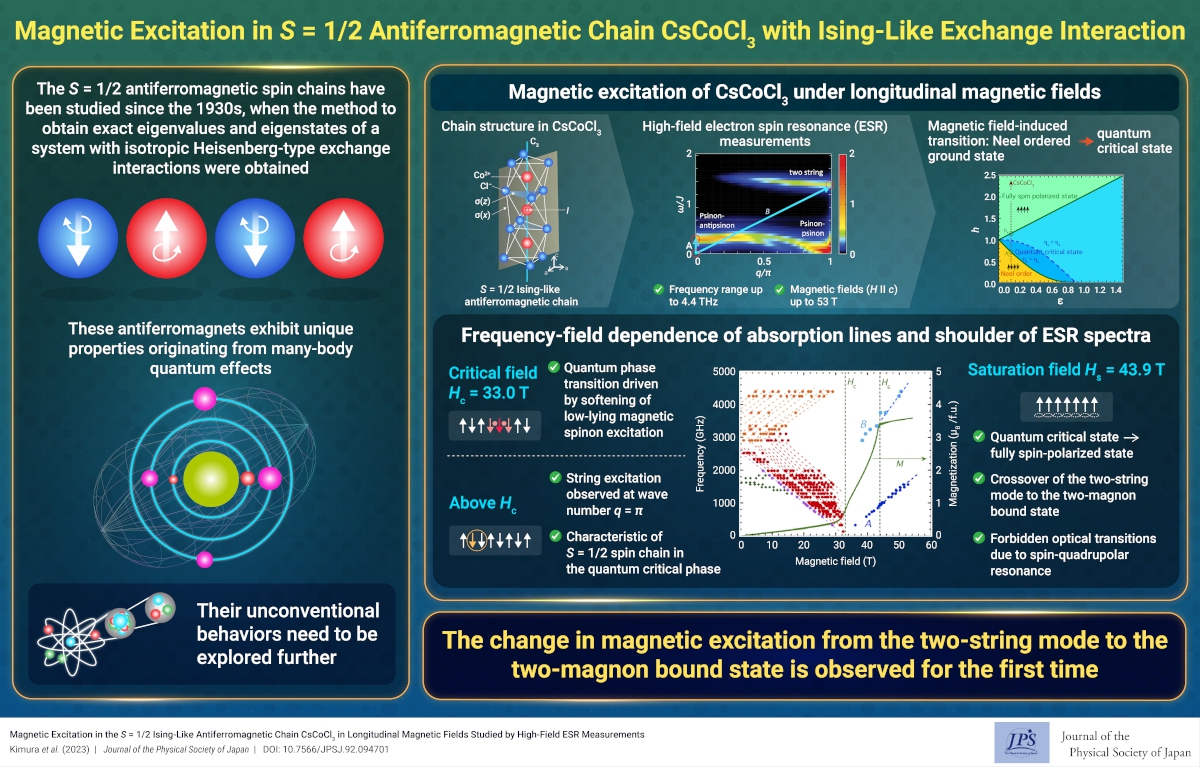
The one-dimensional antiferromagnet with spin S = 1/2 has been studied since 1931 when H. Bethe proposed a method to obtain the exact eigenvalues and eigenstates of a system with isotropic Heisenberg-type exchange interactions. Research has revealed that the simple S = 1/2 one-dimensional antiferromagnet exhibits rich and exotic properties originating from the many-body quantum effects. In the case of the most-investigated system with isotropic Heisenberg-type interactions, the quantum fluctuations destroy the long-range order, leading to a quantum critical state with algebraic decay of the spin correlation function. The magnetic excitation from this fluctuating ground state exhibits a marked contrast from that of the classical spin wave. The lowest-energy excitation in the S = 1/2 one-dimensional antiferromagnet is a pair excitation of quasi-particles called spinons, which are mobile domain walls created by flipping the spins from its ground state. Under external magnetic fields, the magnetic excitation becomes gapless at incommensurate wave numbers in the reciprocal lattice space. In addition, recent theory has indicated that the string states, which are characterized by complex rapidities in the Bethe-anzats calculations, change asymptotically to multimagnon bound states upon increasing the field, significantly contributing to the excitation spectrum.
We investigated the magnetic excitation in the S = 1/2 one-dimensional antiferromagnet with Ising-like anisotropy CsCoCl3 through high-field electron spin resonance (ESR) spectroscopy in a wide frequency region from 130 GHz to 4.4 THz under pulsed magnetic fields up to 53 T. In contrast to the Heisenberg-type system, the antiferromagnetic order is maintained in the ground state of the S = 1/2 Ising-like one-dimensional antiferromagnet at zero magnetic field, owing to magnetic anisotropy. However, by applying the magnetic field along the magnetic easy axis, the system transitions into the quantum critical state. Our ESR results demonstrate that the softening of the spinon by the external magnetic field drives this field-induced transition. This result suggests that the antiferromagnetic order is destroyed by the propagating domain walls induced in the ground state by the longitudinal magnetic field. Thereby, the spin chain is brought into the quantum-critical state with no long-range order. In the quantum critical state, we observe the appearance of a two-string state in the terahertz region above 2.9 THz. By increasing the magnetic fields further, to the saturation field, we can successfully observe the change in the magnetic excitation from the two-string to the two-magnon bound state, for the first time.
(Written by Shojiro Kimura on behalf of all the authors)
Magnetic Excitation in the S = 1/2 Ising-like Antiferromagnetic Chain CsCoCl3 in Longitudinal Magnetic Fields Studied by High-field ESR Measurementss
(JPSJ Editors' Choice)
J. Phys. Soc. Jpn.
92,
094701
(2023)
.
Share this topic


Fields
Related Articles
-
Frustrated Sawtooth Yb Chain Yielding Ferromagnetic Order with Reduced Magnetic Moments
Magnetic properties in condensed matter
2026-9-1
The ytterbium-based semiconductor ZnYb2S4 exhibits ferromagnetic order with contracted Yb moments, representing a novel quantum ground state attributed to competing exchange interactions in an effective spin-1/2 frustrated sawtooth chain.
-
Unlocking a 40-Year-Old Mystery: Full-gap Spin-Triplet Superconductivity Unveiled in UBe13
Magnetic properties in condensed matter
Superconductivity
2026-8-12
Recent precise NMR measurements on the heavy-fermion superconductor UBe13 provided “smoking-gun” evidence for a fully-gapped spin-triplet superconducting state, opening a new chapter in the field.
-
Peculiar Magnet Pointing Against an Applied Magnetic Field
Cross-disciplinary physics and related areas of science and technology
Magnetic properties in condensed matter
2026-7-1
TbNiC2 exhibits negative magnetization. A new mechanism, based on the coupling between the charge density wave and the antiferromagnetic order, is proposed to account for this peculiar phenomenon.
-
Magnetic-Field Driven Switching of Multipolar Order in an f-Electron System
Magnetic properties in condensed matter
2026-5-22
This study investigates high-rank multipole physics in f-electron systems, providing the first clear experimental evidence for field-induced switching of ferro-quadrupole order in a non-Kramer ion system, along with a new conceptual framework
-
Toward Clarification of Physical Properties of Quasicrystals: Noncollinear Magnetic Orders in Icosahedral Approximants
Cross-disciplinary physics and related areas of science and technology
Electronic transport in condensed matter
Magnetic properties in condensed matter
2026-4-6
An effective model based on magnetic anisotropy arising from a crystalline electric field is constructed for icosahedral approximants, which not only explains measured ferromagnets and antiferromagnets but also reveals new types of noncollinear magnetic orders.