

Discovering a Local Fluctuation Theorem with Machine Learning
© The Physical Society of Japan
This article is on
Machine learning a time-local fluctuation theorem for nonequilibrium steady states
(PTEP Editors' Choice)
Prog. Theor. Exp. Phys.
2023,
083A01
(2023)
.
A groundbreaking study reveals a new time-local fluctuation theorem using machine learning, revolutionizing our understanding of deterministic nonequilibrium steady state systems.
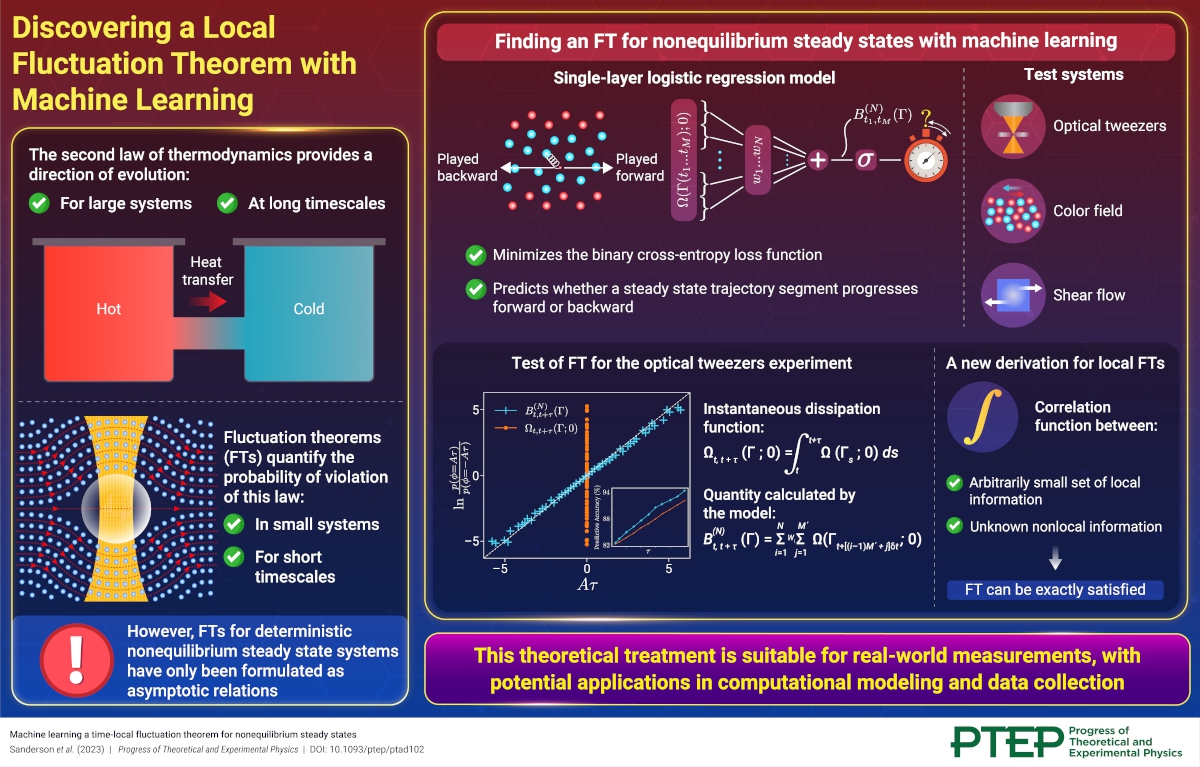
The second law of thermodynamics states that for large systems, there is a direction associated with their evolution over large time scales. However, in the realm of nonequilibrium dynamics, especially where a system is driven far from equilibrium, understanding and quantifying thermodynamic relations is challenging.
In this regard, fluctuation theorems (FTs), which quantify the thermodynamic reversibility of a system in terms of a dissipation function, have emerged as an essential tool for characterizing the probability of observing events in small systems during short timescales that violate the second law of thermodynamics. However, these theorems have only been formulated for a limited class of systems.
Consequently, our understanding of deterministic nonequilibrium steady states—a system with unknown phase space distribution for which only asymptotic FTs hold— remains limited. This is because all attempts to evaluate their dissipation function require either the trajectory segment of interest to be relatively long or information about the entire trajectory around that segment.
In this study, we addressed this long-standing problem in statistical mechanics by utilizing a simple machine learning model. The model was trained to minimize the binary cross-entropy loss function and discern whether a segment of a steady state trajectory progresses forward or backward in time. This yielded a function that satisfied an FT and relied only upon the information within the segment of interest.
Remarkably, this time-local FT is applicable even to extremely short trajectory segments and holds true for systems far from equilibrium as well as for various nonequilibrium dynamics, surpassing all previously known theoretical approximations.
We further demonstrated that any model reaching the global minimum of the binary cross-entropy loss function must be a well-calibrated predictor of time’s arrow and satisfy an FT. This leads us to a new derivation for local-time FTs: an FT can be exactly satisfied for an arbitrarily small set of local information provided the correlation function between that information and the unknown, non-local information is known.
Since our theoretical treatment is applicable to feasible real-world measurements, which only capture information from a local region and for a finite duration, it could potentially have wide-ranging applications in computational modeling as well as real-world data collection.
Consequently, this study could eventually lead to an enhanced understanding of nonequilibrium steady state systems across diverse fields, including fluid dynamics, heat transfer, semiconductor operation, ion transport, biology, and climate modeling.
Machine learning a time-local fluctuation theorem for nonequilibrium steady states
(PTEP Editors' Choice)
Prog. Theor. Exp. Phys.
2023,
083A01
(2023)
.
Share this topic


Fields
Related Articles
-
Monitored Quantum Systems and Quantum Trajectories
General and Mathematical Physics
Mathematical methods, classical and quantum physics, relativity, gravitation, numerical simulation, computational modeling
Statistical physics and thermodynamics
2026-7-21
This review in Progress of Theoretical and Experimental Physics introduces monitored quantum systems and quantum trajectories, emphasizing their spectral properties, typical behaviors such as ergodicity and purification, and measurement-induced phases.
-
Topological Defects as Seeds of Phase Separation: Insights from a Minimal Lattice Model
Cross-disciplinary physics and related areas of science and technology
Statistical physics and thermodynamics
2026-7-13
A minimal lattice model revealed that topological defects with winding number +1 serve as nucleation sites for phase separation in active matter systems.
-
Enhancing Accuracy and Reliability Bayesian Framework for Analysis of AR-HAXPES of Hard X-ray Photoelectron Spectroscopy
Dielectric, optical, and other properties in condensed matter
Electronic structure and electrical properties of surfaces and nanostructures
Measurement, instrumentation, and techniques
2026-4-28
We present a Bayesian framework for angle-resolved hard X-ray photoelectron spectroscopy (AR-HAXPES), combining Replica Exchange Monte Carlo with hierarchical integration to objectively and precisely estimate thin-film thickness.
-
Rethinking Replica Analysis of Learning
Cross-disciplinary physics and related areas of science and technology
Statistical physics and thermodynamics
2026-1-19
The statistical physics analysis of learning parametric models was revisited by combining the replica method with a grand canonical ensemble and variational approach, enabling prediction error estimation for learning systems with real data.
-
The Physics of Light-Spin Interactions: Advances in Photodriven Quantum Spin Systems
Dielectric, optical, and other properties in condensed matter
Electromagnetism, optics, acoustics, heat transfer, and classical and fluid mechanics
Electronic transport in condensed matter
Magnetic properties in condensed matter
Statistical physics and thermodynamics
2025-12-17
This Special Topics edition of the Journal of the Physical Society of Japan discusses the recent progress and future directions for the rapidly progressing field of photodriven quantum spin systems.