

Heavy Fermion Meets Antiferromagnetic Sea
© The Physical Society of Japan
This article is on
Possible Heavy-Fermion State in PT-Symmetric Antiferromagnet CeMnSi
(JPSJ Editors' Choice)
J. Phys. Soc. Jpn.
92,
044703
(2023)
.
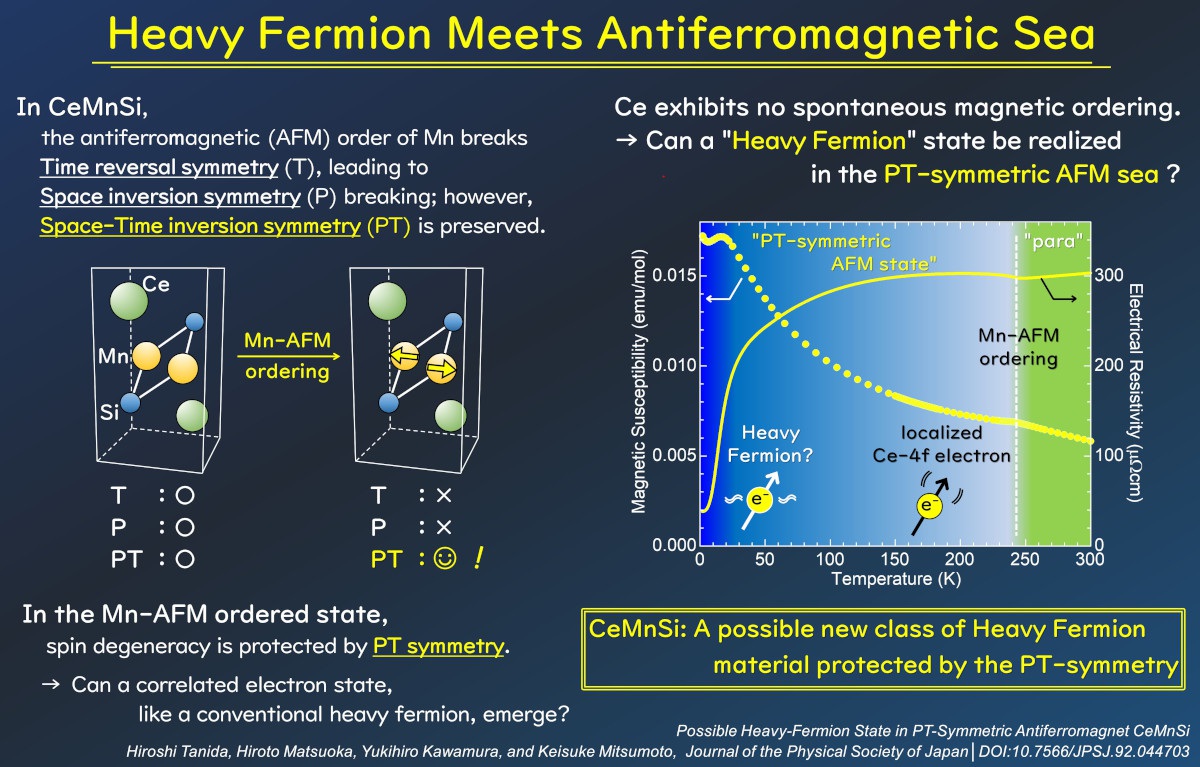
CeMnSi exhibits heavy fermion behaviors in an antiferromagnetically ordered state of Mn.
The space-time inversion symmetry inherent in the ordered state is key for the unique electron state.
Symmetries are widespread in nature. For instance, planetary motion is related to the conservation of angular momentum owing to rotational symmetry. In general, symmetries have important implications for physics, and new concepts based on symmetries open up new frontiers of research.
Crystals are one of the research objects in condensed matter physics, and have innumerable atoms arranged periodically with symmetries, including rotation, mirror, and inversion. Space-inversion (P) symmetry is of importance for physical properties; however, it is not always present in crystals. Magnetic ordering, a familiar example of spontaneous symmetry breaking in electron systems, may break P-symmetry depending on the spatial arrangement of electron spins even if the symmetry is innately given. Magnetic ordering itself also breaks time-reversal (T) symmetry owing to the nature of electron spin, as in the Zeeman effect. We investigate how electrons behave in crystal, and thereby know which symmetries are broken.
CeMnSi is a tetragonal intermetallic compound with P-symmetry, and has two magnetic elements: Ce and Mn. The spin degrees of freedom of their unpaired electrons must be frozen at low temperatures in some way according to a thermodynamic requirement. As for Mn, the way is an antiferromagnetic (AFM) ordering with an antiparallel spin arrangement. Consequently, the innate P-symmetry is broken, while the space-time inversion (PT) symmetry, a combination of P and T symmetries, is preserved. Hence, CeMnSi is classified as a PT-symmetric antiferromagnet.
As for Ce, there is no spontaneous magnetic ordering. However, this is not so surprising for Ce-based intermetallics because they have another way for the freezing, the Kondo coupling with conduction electrons. In this case, unpaired Ce-4f electrons become nonmagnetic below a characteristic temperature, and a correlated electron state called the heavy fermion state is realized. The most salient feature of the heavy fermion state in CeMnSi is the presence of the Mn-AFM ordering; heavy fermion states normally appear in paramagnetic state. In other words, CeMnSi provides a place where heavy fermion meets an “AFM sea”. The spin degeneracy protected by the PT-symmetry inherent in the Mn-AFM ordering would be crucial for the unique heavy fermion state in CeMnSi beyond the usual heavy fermion picture. The microscopic mechanisms need to be clarified by theoretical and further experimental studies.
(written by H. Tanida on behalf of all authors.)
Possible Heavy-Fermion State in PT-Symmetric Antiferromagnet CeMnSi
(JPSJ Editors' Choice)
J. Phys. Soc. Jpn.
92,
044703
(2023)
.
Share this topic


Fields
Related Articles
-
Peculiar Magnet Pointing Against an Applied Magnetic Field
Cross-disciplinary physics and related areas of science and technology
Magnetic properties in condensed matter
2026-7-1
TbNiC2 exhibits negative magnetization. A new mechanism, based on the coupling between the charge density wave and the antiferromagnetic order, is proposed to account for this peculiar phenomenon.
-
Magnetic-Field Driven Switching of Multipolar Order in an f-Electron System
Magnetic properties in condensed matter
2026-5-22
This study investigates high-rank multipole physics in f-electron systems, providing the first clear experimental evidence for field-induced switching of ferro-quadrupole order in a non-Kramer ion system, along with a new conceptual framework
-
Toward Clarification of Physical Properties of Quasicrystals: Noncollinear Magnetic Orders in Icosahedral Approximants
Cross-disciplinary physics and related areas of science and technology
Electronic transport in condensed matter
Magnetic properties in condensed matter
2026-4-6
An effective model based on magnetic anisotropy arising from a crystalline electric field is constructed for icosahedral approximants, which not only explains measured ferromagnets and antiferromagnets but also reveals new types of noncollinear magnetic orders.
-
Definitive Momentum and Spin Imaging Resolves 20-Year Debate on Gold Surface Spin
Electronic structure and electrical properties of surfaces and nanostructures
Magnetic properties in condensed matter
2026-4-1
Researchers at the Institute for Molecular Science (IMS) have utilized a cutting-edge Photoelectron Momentum Microscope (PMM) at the UVSOR Synchrotron Facility to settle a two-decade-long controversy concerning the direction of electron spin on the Au(111) surface. This study provides a definitive, full-map, comprehensive reference for quantum imaging that is essential for advancing spintronics technology.
-
Topological Hall Effect in Praseodymium Diantimonide
Magnetic properties in condensed matter
2026-2-27
The discovery of the topological Hall effect in a praseodymium-based compound is significant because its magnetism is not limited to a simple spin-only configuration as in many previous rare-earth systems.