

Hidden Magnetoelectric Phase Transition by Emergent Staggered Magnetic Field
© The Physical Society of Japan
This article is on
Magnetic-Field-Induced Antiferromagnetic–Antiferromagnetic Phase Transition in Quasi-Two-Dimensional Multiferroic Material Ba2FeSi2O7
J. Phys. Soc. Jpn.
92,
014701
(2023)
.
Emergent staggered magnetic fields induce phase transition in the multiferroic material Ba2FeSi2O7.
This study established a design principle utilizing emergent staggered magnetic fields to obtain an enhanced physical response.
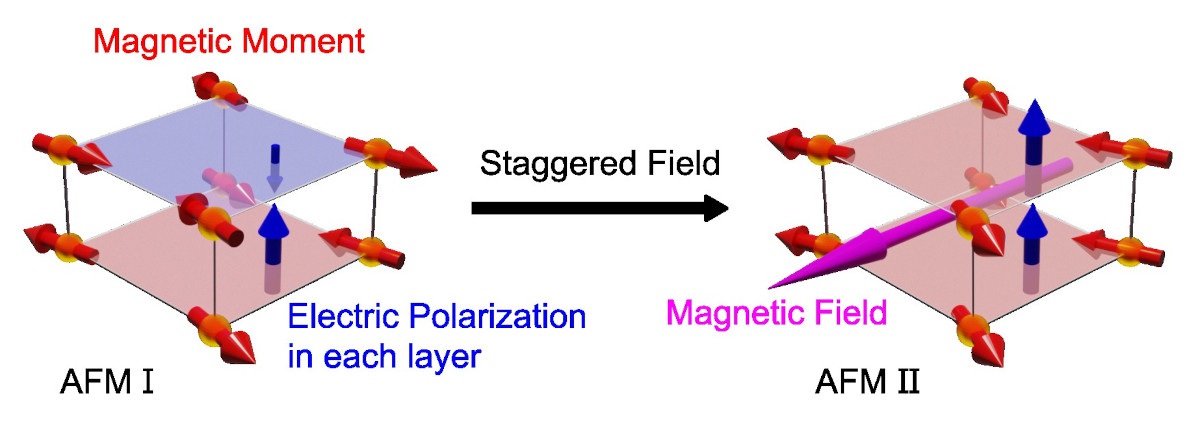
Magnetic fields are among the most fundamental external fields for manipulating the physical property of magnetic materials. Uniform magnetic fields induce phase transitions to obtain a gain from Zeeman energy, resulting in a metamagnetism characterized by transitions from antiferromagnets (AFMs) to ferromagnets. However, staggered magnetic fields, whose directions are antiparallel between neighboring magnetic atoms, remain relatively unexplored. In contrast to uniform magnetic fields, staggered magnetic fields potentially induce a phase transition between two distinct AFM phases, which is expected to accompany a jump in staggered magnetization.
An interesting application of this new type of phase transition is its usage as a knob for controlling composite order parameters in multiferroics. Multiferroics are a group of materials wherein multiple degrees of freedom, such as spin, charge, and lattice, are mutually coupled. They are considered a promising platform for realizing cost-effective next-generation devices. In multiferroics, unconventional spin degrees of freedom are known to be relevant to describe their unusual behavior. Certain types of staggered magnetic moments are considered to be responsible for ferroelectricity. However, the direct application of a staggered magnetic field in an experimental setup is challenging; this hinders the development of their functionality.
In this study, we observed a magnetic field-induced phase transition from a zero-field AFM phase to another AFM phase in the multiferroic material Ba2FeSi2O7. Consequently, the hidden role of the emergent staggered magnetic field was identified. A key ingredient is the Dzyaloshinskii–Moriya (DM) interaction of relativistic spin-orbit coupling origin, which exists in non-centrosymmetric materials, and facilitates effective conversion of the uniform magnetic field into a staggered magnetic field.
We measured the magnetic field dependence of magnetization and electric polarization of a single crystal Ba2FeSi2O7 and observed a phase transition accompanying electric polarization changes. Using a newly established spin model, the experimental observation was reproduced through mean-field numerical simulations. The simulation results indicate the jump in staggered magnetization at the phase transition, thus validating the proposed scenario. In other words, the phase transition is induced by the emergent staggered magnetic field converted from the applied uniform magnetic field through DM interaction. The fragile nature of the zero-field AFM structure against the emergent staggered magnetic field originates from the low dimensionality of this material, which enables the competition between exchange interaction and relatively weak DM interaction. Thus, our study demonstrated the utilization of the field-induced emergent staggered field to manipulate AFM phases and a design principle of materials.
(written by Y. Watanabe on behalf of all the authors.)
Magnetic-Field-Induced Antiferromagnetic–Antiferromagnetic Phase Transition in Quasi-Two-Dimensional Multiferroic Material Ba2FeSi2O7
J. Phys. Soc. Jpn.
92,
014701
(2023)
.
Share this topic


Fields
Related Articles
-
Frustrated Sawtooth Yb Chain Yielding Ferromagnetic Order with Reduced Magnetic Moments
Magnetic properties in condensed matter
2026-9-1
The ytterbium-based semiconductor ZnYb2S4 exhibits ferromagnetic order with contracted Yb moments, representing a novel quantum ground state attributed to competing exchange interactions in an effective spin-1/2 frustrated sawtooth chain.
-
Unlocking a 40-Year-Old Mystery: Full-gap Spin-Triplet Superconductivity Unveiled in UBe13
Magnetic properties in condensed matter
Superconductivity
2026-8-12
Recent precise NMR measurements on the heavy-fermion superconductor UBe13 provided “smoking-gun” evidence for a fully-gapped spin-triplet superconducting state, opening a new chapter in the field.
-
Peculiar Magnet Pointing Against an Applied Magnetic Field
Cross-disciplinary physics and related areas of science and technology
Magnetic properties in condensed matter
2026-7-1
TbNiC2 exhibits negative magnetization. A new mechanism, based on the coupling between the charge density wave and the antiferromagnetic order, is proposed to account for this peculiar phenomenon.
-
Magnetic-Field Driven Switching of Multipolar Order in an f-Electron System
Magnetic properties in condensed matter
2026-5-22
This study investigates high-rank multipole physics in f-electron systems, providing the first clear experimental evidence for field-induced switching of ferro-quadrupole order in a non-Kramer ion system, along with a new conceptual framework
-
Toward Clarification of Physical Properties of Quasicrystals: Noncollinear Magnetic Orders in Icosahedral Approximants
Cross-disciplinary physics and related areas of science and technology
Electronic transport in condensed matter
Magnetic properties in condensed matter
2026-4-6
An effective model based on magnetic anisotropy arising from a crystalline electric field is constructed for icosahedral approximants, which not only explains measured ferromagnets and antiferromagnets but also reveals new types of noncollinear magnetic orders.