

Phase Transition and Its Universality Class for a Quantum Spin Chain
© The Physical Society of Japan
This article is on
Universality Class around the SU(3) Symmetric Point of the Dimer–Trimer Spin-1 Chain
(JPSJ Editors' Choice)
J. Phys. Soc. Jpn.
90,
024005
(2021)
.
We numerically diagonalize the Dimer-Trimer (DT) model Hamiltonian around the SU(3) symmetric point. As a result, we discover the phase transition at this point which belongs to the Berezinskii-Kosterlitz-Thouless (BKT)-like universality class.
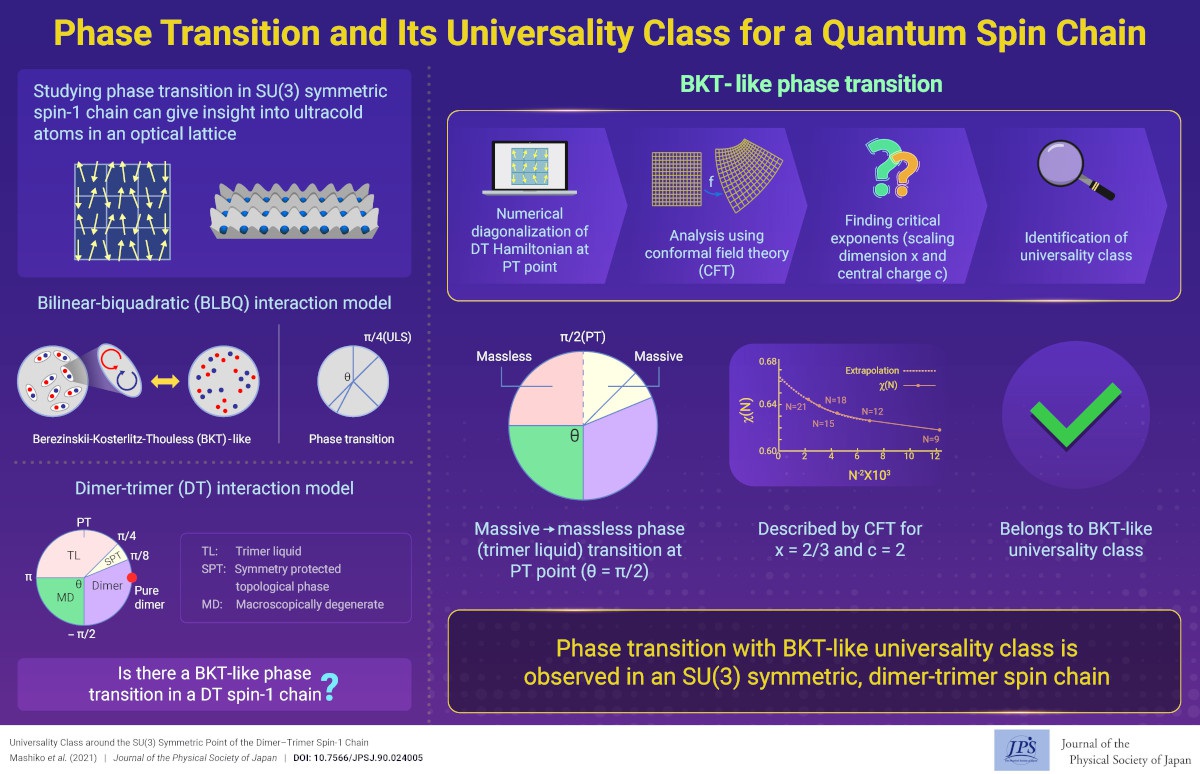
Universality Class around the SU(3) Symmetric Point of the Dimer–Trimer Spin-1 Chain
(JPSJ Editors' Choice)
J. Phys. Soc. Jpn.
90,
024005
(2021)
.
Share this topic


Fields
Related Articles
-
Giant Brute-Force Simulation to Reveal Nucleation and Growth of Ultrasonic Cavitation Bubbles
Electromagnetism, optics, acoustics, heat transfer, and classical and fluid mechanics
Statistical physics and thermodynamics
2026-7-27
This study reveals the early-stage dynamics of ultrasonic cavitation using a record 100-billion-atom simulation to capture bubble nucleation, growth, clustering, and periodic splitting under nonequilibrium conditions.
-
Monitored Quantum Systems and Quantum Trajectories
General and Mathematical Physics
Mathematical methods, classical and quantum physics, relativity, gravitation, numerical simulation, computational modeling
Statistical physics and thermodynamics
2026-7-21
This review in Progress of Theoretical and Experimental Physics introduces monitored quantum systems and quantum trajectories, emphasizing their spectral properties, typical behaviors such as ergodicity and purification, and measurement-induced phases.
-
Topological Defects as Seeds of Phase Separation: Insights from a Minimal Lattice Model
Cross-disciplinary physics and related areas of science and technology
Statistical physics and thermodynamics
2026-7-13
A minimal lattice model revealed that topological defects with winding number +1 serve as nucleation sites for phase separation in active matter systems.
-
Peculiar Magnet Pointing Against an Applied Magnetic Field
Cross-disciplinary physics and related areas of science and technology
Magnetic properties in condensed matter
2026-7-1
TbNiC2 exhibits negative magnetization. A new mechanism, based on the coupling between the charge density wave and the antiferromagnetic order, is proposed to account for this peculiar phenomenon.
-
Magnetic-Field Driven Switching of Multipolar Order in an f-Electron System
Magnetic properties in condensed matter
2026-5-22
This study investigates high-rank multipole physics in f-electron systems, providing the first clear experimental evidence for field-induced switching of ferro-quadrupole order in a non-Kramer ion system, along with a new conceptual framework