

ERG on Multiply Connected Configuration Spaces
© The Physical Society of Japan
This article is on
ERG Kernels on Multiply Connected Configuration Spaces
(PTEP Editors' Choice)
Prog. Theor. Exp. Phys.
2026,
093B01
(2026)
.
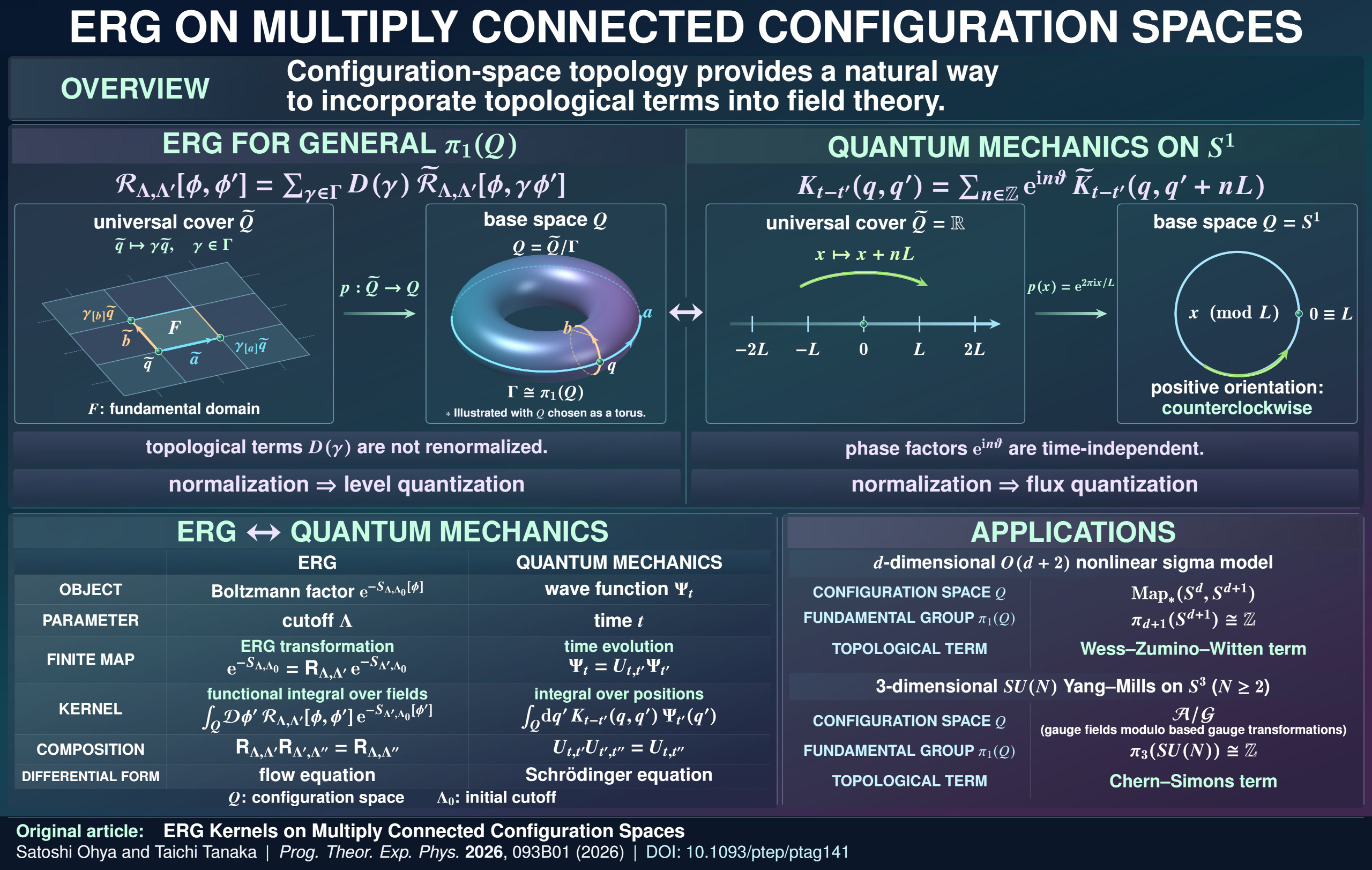
We construct ERG kernels on multiply connected configuration spaces and show the nonrenormalization of topological weights, as well as the relationship between ERG normalization and level quantization.
The renormalization group describes the change in a physical system as the energy scale decreases from high to low. In quantum field theory, the exact renormalization group (ERG)—formulated by Wilson and Polchinski—follows a cutoff-dependent Wilson action by integrating high-energy degrees of freedom.
Earlier ERG studies primarily used differential flow equations to describe infinitesimal changes in the cutoff scale. However, these equations are local differential equations on the configuration space  the space of all field configurations—and thus cannot adequately describing the global topology. This is particularly crucial when the configuration space is multiply connected with a nontrivial fundamental group
 , as such topologies are closely related to topological terms in field theory.
In this study, we focus on a functional integral kernel that describes a finite ERG transformation, which we term the ERG kernel. The basic observation is that ERG transformations in field theory exhibit a structure corresponding to time evolution in quantum mechanics. In quantum mechanics, infinitesimal time evolution is described by the Schrödinger equation, whereas finite evolution is described by an integral kernel. Similarly, infinitesimal ERG transformations are described by flow equations, whereas finite ERG transformations are represented by ERG kernels.
For quantum mechanics on a multiply connected configuration space, the time-evolution kernel can be constructed by lifting the problem to the universal covering space and summing over the elements of the fundamental group with weight factors  . This construction yields a natural formulation of finite ERG transformations that incorporates the global topology of the configuration space.
Based on the algebraic properties required of the ERG kernel, we obtain two important results. First, the composition law of ERG transformations dictates that the weights are independent of the cutoff scale. This establishes a nonrenormalization theorem for topological terms originating from . Second, the normalization condition that preserves the partition function results in a quantization condition. In nonlinear sigma models, this condition is equivalent to the level quantization of the Wess–Zumino–Witten term.
Results show that the level quantization and nonrenormalization of topological terms follow nonperturbatively from the algebraic and geometric structures of finite ERG transformations. Additionally, the formulation is expected to be applicable to other field theories with topological terms, including the Chern–Simons term in the three-dimensional Yang–Mills theory.
(written by Taichi Tanaka on behalf of all authors.)
ERG Kernels on Multiply Connected Configuration Spaces
(PTEP Editors' Choice)
Prog. Theor. Exp. Phys.
2026,
093B01
(2026)
.
Share this topic


Fields
Related Articles
-
New Crosscap States: Modular Bootstrap on Unorientable Manifolds
Theoretical Particle Physics
2026-5-11
We derive a generalized modular bootstrap equation for conformal field theories on unorientable manifolds in the presence of symmetry defects and identify new crosscap states labeled by noninvertible symmetries.
-
Solving Sign Problem: Phase-Structure Analysis of a Lattice Model with a Topological θ Term Using Tensor Renormalization Group Approach
Theoretical Particle Physics
2026-3-23
This study clarifies the phase structure of the two-dimensional lattice CP(1) model with a θ term by employing the tensor renormalization group method and conformal field theory, thus enabling the circumvention of the sign problem and logarithmic corrections.
-
A Look at the Legacy of Kobayashi–Maskawa Theory
Elementary particles, fields, and strings
Theoretical Particle Physics
2025-10-24
This special topics edition of the Progress of Theoretical and Experimental Physics covers a symposium celebrating the 50-year history of the Kobayashi–Maskawa Theory, highlighting its impact from theoretical and experimental perspectives.
-
Understanding Global Inconsistency and ’t Hooft Anomaly Using Simple Quantum Mechanics
Theoretical Particle Physics
2025-2-21
This study explores the implications of global inconsistency and ’t Hooft anomalies for analyzing quantum field theories, using simple quantum mechanical models to provide valuable insights into these complex phenomena.
-
Understanding Non-Invertible Symmetries in Higher Dimensions Using Topological Defects
Theoretical Particle Physics
2024-9-27
By constructing Kramers-Wannier-Wegner duality and Z2 duality defects and deriving their crossing relations, this study presents the first examples of codimension one non-invertible symmetries in four-dimensional quantum field theories.