

Only Certain Angles Allow Layer-by-Layer Stacking of Corrugated Rods
© The Physical Society of Japan
This article is on
Discrete Pitch-Angle Conditions for Helicoidal Stacking of Periodically Corrugated Rods (JPSJ Editors' Choice)
J. Phys. Soc. Jpn.
95,
104801
(2026)
.
Rods with periodic surface corrugations stack helicoidally at only a discrete set of pitch angles. This rule opens a route for programming the fiber-stacking angle based on fiber surface texture.
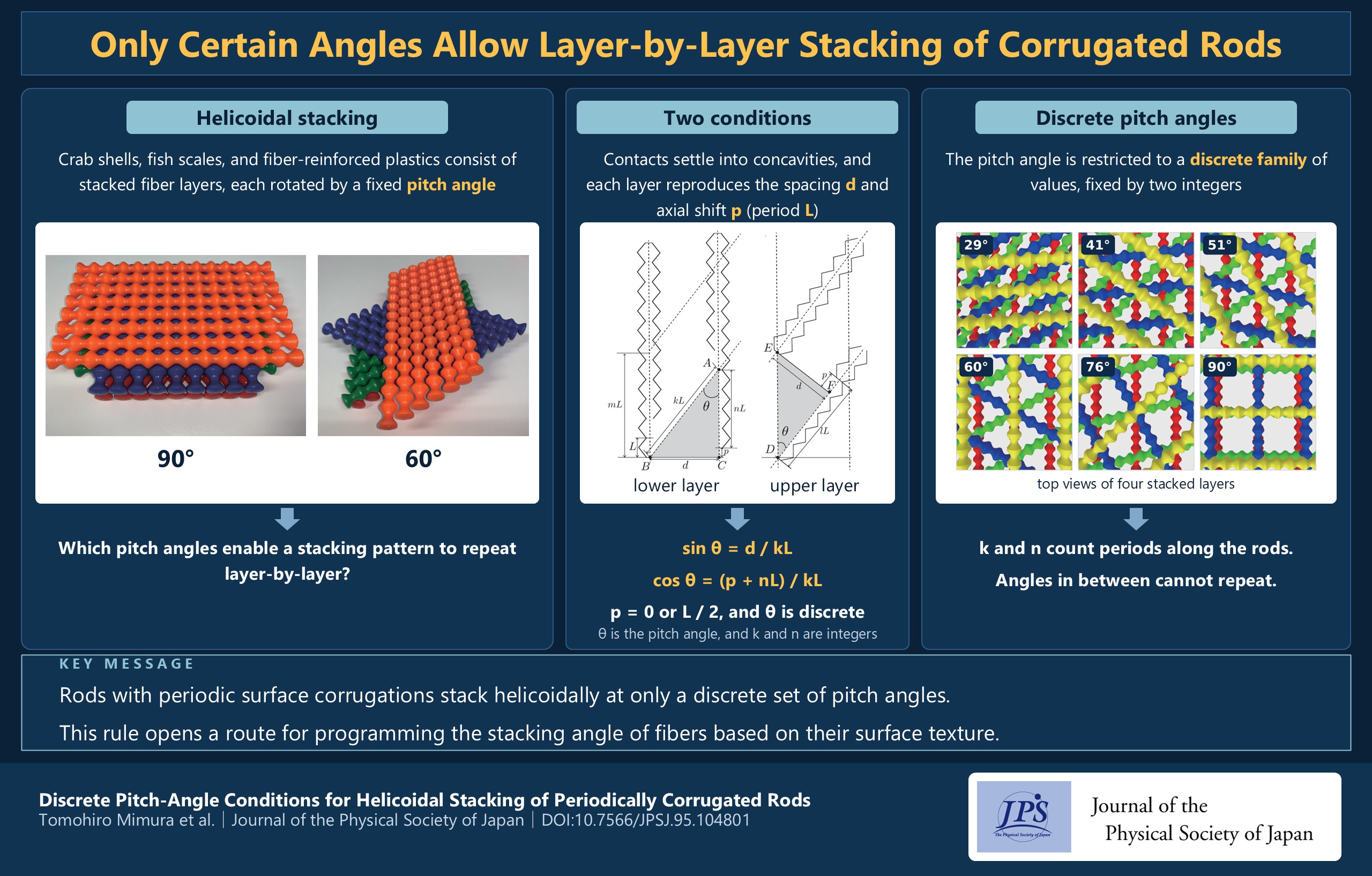
Many tough biological materials are composed of layers of aligned fibers, in which each layer rotates by a fixed angle relative to the adjacent layer. This angle is known as the pitch angle, and the resulting architecture is called the Bouligand structure. Crab shells, fish scales, and beetle cuticles are formed in this manner, and fiber-reinforced plastics share the same motif. Whereas most studies on such laminates focus on how they fracture, this study aims to answer a different question. If the fibers are rigid rods whose surfaces carry periodic corrugations that must nest into one another, which pitch angles enable such stacking patterns to repeat layer-by-layer?
As a minimal model, this study used Playstix, a construction toy of rods whose corrugations repeat at fixed periods. Three parameters describe a stack: the spacing between neighboring rods in a layer, their axial shift, and the pitch angle between layers. For the stack to repeat, two conditions must hold: every contact point must settle into a concavity, and each layer must reproduce the spacing and axial shift.
Consequently, the pitch angle is restricted to a discrete family of values fixed by two integers that count the periods along the rods. The two simulations confirmed this rule. First, the predicted spacing and shift bring the two layers closer together at each pitch angle. Second, rods settling under gravity hold their arrangement at large pitch angles but lose it as the angle decreases.
Stacking and toughness favor opposite angles. A large pitch angle makes it easy to build and maintain the stack. A small angle is better for toughness because a crack must then twist gradually through the thickness. The two need not conflict because the geometric conditions apply to rigid rods, whereas real fibrils bend and twist. However, this difference raises the question of how organisms assemble and maintain their small-pitch architectures. More broadly, the results provided a simple rule that links the surface pattern of a rod to the angles at which it will stack. Fibers or fiber bundles with corrugations designed based on this principle could lock into a prescribed pitch angle simply by stacking, offering a geometric route to helicoidal materials whose layer angles are encoded directly into the fibers themselves.
(Written by Tomohiro Mimura on behalf of all authors.)
Discrete Pitch-Angle Conditions for Helicoidal Stacking of Periodically Corrugated Rods (JPSJ Editors' Choice)
J. Phys. Soc. Jpn.
95,
104801
(2026)
.
Share this topic


Fields
Related Articles
-
How Heart Cells Come to Beat Together through an Elastic Substrate
Cross-disciplinary physics and related areas of science and technology
Statistical physics and thermodynamics
2026-8-24
Two isolated cardiomyocytes (heart muscle cells) can synchronize through deformations of a soft substrate. A dynamical theory explains geometry-dependent phase-locking and synchronization time.
-
Rumors Spread Wider Despite Low Transmissibility
Cross-disciplinary physics and related areas of science and technology
2026-8-7
This study proposes an SIS competition model that integrates rumor spread and opinion changes. This analysis reveals novel mechanisms for conflicting rumor coexistence, thus demonstrating that rumors paradoxically survive through low transmissibility.
-
Topological Defects as Seeds of Phase Separation: Insights from a Minimal Lattice Model
Cross-disciplinary physics and related areas of science and technology
Statistical physics and thermodynamics
2026-7-13
A minimal lattice model revealed that topological defects with winding number +1 serve as nucleation sites for phase separation in active matter systems.
-
A Deep Dive Into AI-Driven Materials Science
Cross-disciplinary physics and related areas of science and technology
2026-7-6
This review from the Journal of the Physical Society of Japan examines how artificial intelligence overcomes traditional materials science bottlenecks, highlighting the shift from intuition-based discovery to data-driven innovation.
-
Peculiar Magnet Pointing Against an Applied Magnetic Field
Cross-disciplinary physics and related areas of science and technology
Magnetic properties in condensed matter
2026-7-1
TbNiC2 exhibits negative magnetization. A new mechanism, based on the coupling between the charge density wave and the antiferromagnetic order, is proposed to account for this peculiar phenomenon.