

The Thermal Einstein–de Haas Effect: Theoretical Prediction and Observability in Chiral Carbon Nanotubes
© The Physical Society of Japan
This article is on
Thermal Einstein–de Haas Effect Induced by Chiral Phonons in Carbon Nanotubes
(JPSJ Editors' Choice)
J. Phys. Soc. Jpn.
95,
033801
(2026)
.
Although the Einstein–de Haas (EdH) effect describes material rotation in a magnetic field, a thermal EdH effect, driven by a temperature gradient, remains unobserved. Recently, chiral carbon nanotubes were theoretically proposed as promising candidates to observe it.
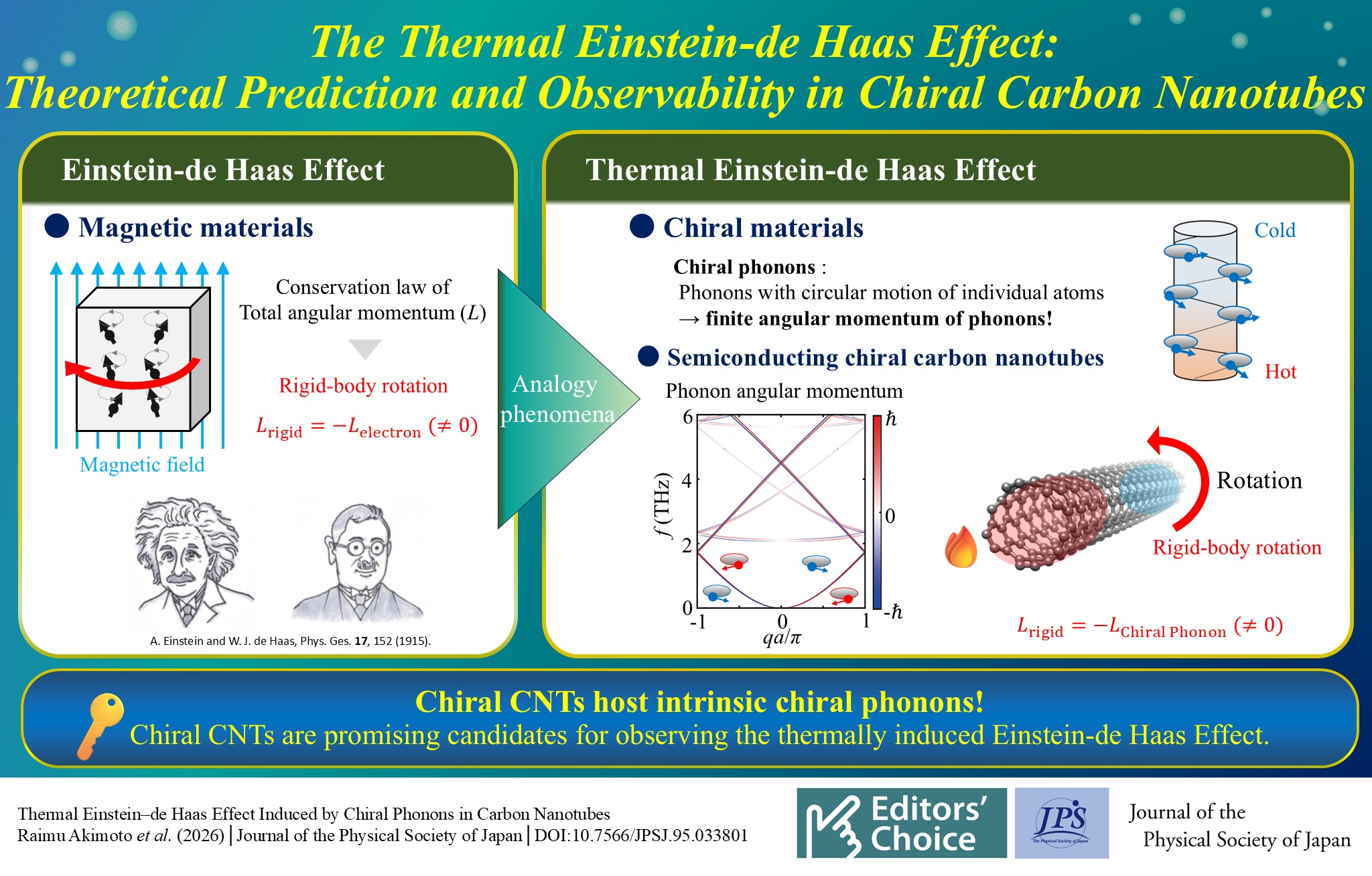
The development of functional materials by thermal management is expected to be a crucial technology for solving modern societal problems, such as the efficient use of energy. Recently, chiral materials, in which atoms are arranged in a helical pattern, have been studied as new functional materials because they exhibit unique lattice vibrations with circular motion of atoms, called “chiral phonons.” When a temperature gradient is applied to chiral materials, the angular momentum caused by the chiral phonons induces macroscopic mechanical rotation by conserving the total angular momentum. This phenomenon, the thermal Einstein–de Haas (EdH) effect, has recently garnered attention as a novel functional property made possible by thermal management.
The conventional EdH effect, which was the subject of the only experiment Einstein performed, occurs when a magnetic field is applied to magnetic materials. This is well known as an important experiment that directly proved the conservation of angular momentum in materials. By contrast, the thermal EdH effect has not yet been clearly observed in experiments. The main reason for this is that no suitable chiral materials have been proposed for its observation.
Carbon nanotubes (CNTs), which are one-dimensional cylindrical structures, are broadly classified into three distinct structural types (zigzag, armchair, and chiral). The phonon properties of achiral CNTs, namely zigzag and armchair CNTs, have been investigated extensively. In this letter, it is demonstrated theoretically that chiral CNTs possess chiral phonons, such as transverse acoustic phonon modes and certain optical phonon modes, which are split into two branches carrying opposite signs of angular momentum. In addition, it is revealed that angular momentum is most efficiently generated in small-diameter nanotubes with intermediate chiral angles.
The crystal structure of chiral materials has a specific handedness based on its helical twist (right and left handedness). Generally, controlling this handedness in standard inorganic crystals is extremely difficult. However, recent research on CNTs has led to major advances in chiral separation technology. Methods for controlling the length and diameter of CNTs are also well established. Owing to such technological advances, experimental observation of the thermal EdH effect using chiral CNTs is expected.
(Written by Raimu Akimoto, Hiroyasu Matsuura, and Takahiro Yamamoto.)
Thermal Einstein–de Haas Effect Induced by Chiral Phonons in Carbon Nanotubes
(JPSJ Editors' Choice)
J. Phys. Soc. Jpn.
95,
033801
(2026)
.
Share this topic


Fields
Related Articles
-
Only Certain Angles Allow Layer-by-Layer Stacking of Corrugated Rods
Cross-disciplinary physics and related areas of science and technology
2026-10-13
Rods with periodic surface corrugations stack helicoidally at only a discrete set of pitch angles. This rule opens a route for programming the fiber-stacking angle based on fiber surface texture.
-
Mysterious Critical Phenomena Driven by Role Reversal in Multicomponent Systems: From Normal to Reverse RKKY — Twofold Reversal and Induced Critical Exponent
Electronic transport in condensed matter
Structure and mechanical and thermal properties in condensed matter
2026-10-5
The Reverse RKKY mechanism drives a twofold reversal, yielding an anomalous specific‑heat peak with a large, induced critical exponent.
-
Direct Observation of Piezoelectricity from Electric Toroidal Quadrupole Order
Electron states in condensed matter
Structure and mechanical and thermal properties in condensed matter
2026-9-30
This study reports the direct observation of piezoelectricity in the spin-orbit-coupled metal Cd2Re2O7. The findings reveal how electric toroidal quadrupole order drives successive inversion-symmetry-breaking transitions and anisotropic electromechanical responses.
-
Revealing Electronic Quantum Behavior Masked by Nuclear Heat
Measurement, instrumentation, and techniques
Structure and mechanical and thermal properties in condensed matter
Superconductivity
2026-9-7
The initial slope method is used to reveal intrinsic electronic specific heat by eliminating the overwhelming nuclear contributions during low-temperature calorimetry, opening a new window into quantum materials.
-
How Heart Cells Come to Beat Together through an Elastic Substrate
Cross-disciplinary physics and related areas of science and technology
Statistical physics and thermodynamics
2026-8-24
Two isolated cardiomyocytes (heart muscle cells) can synchronize through deformations of a soft substrate. A dynamical theory explains geometry-dependent phase-locking and synchronization time.