

Towards Radionuclide Cancer Therapy with High Purity 177Lu from Enriched 176Yb Samples
© The Physical Society of Japan
This article is on
Estimated Isotopic Compositions of Yb in Enriched 176Yb for Producing 177Lu with High Radionuclide Purity by 176Yb(d,x)177Lu
(JPSJ Editors' Choice)
J. Phys. Soc. Jpn.
91,
044201
(2022)
.
A method was developed to estimate the isotopic compositions of enriched 176Yb sample required for producing radionuclide 177Lu used for cancer therapy, with high radionuclide purity in accelerators.
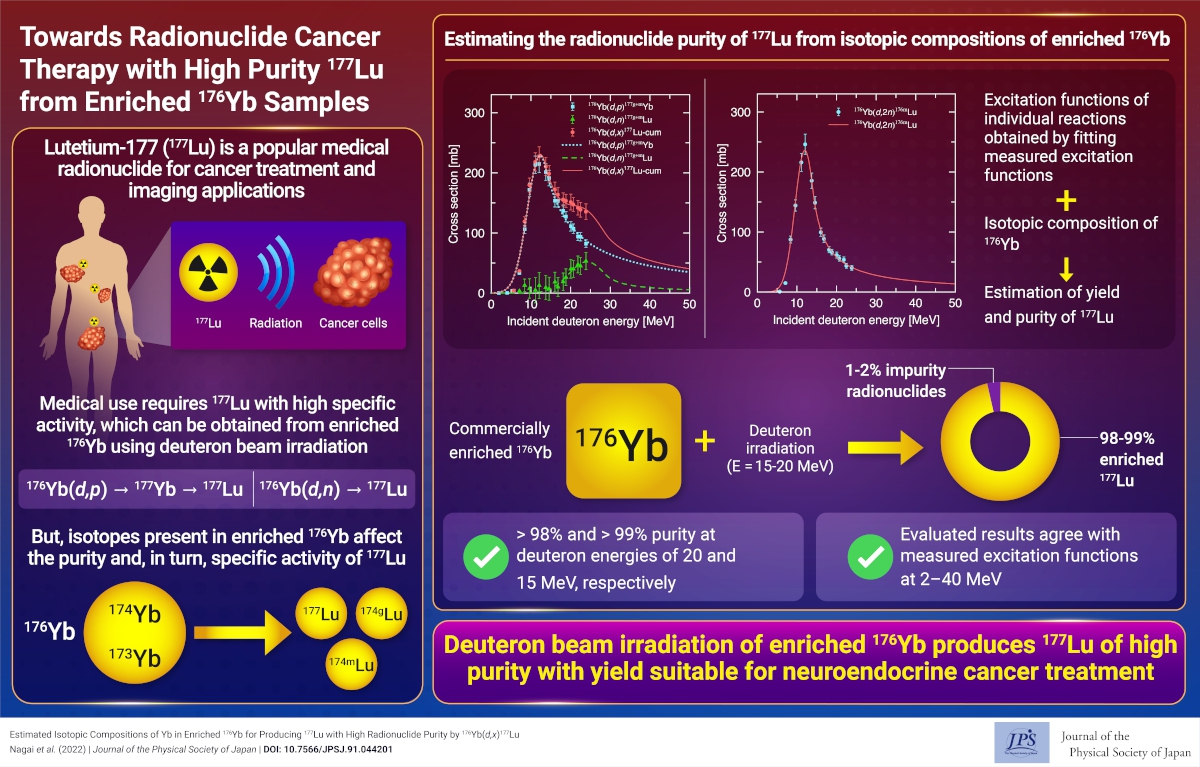
Radiopharmaceuticals labelled with radionuclides of high radionuclide purity in nuclear medicine that emit gamma-rays and beta-rays have been used for diagnosis imaging of diseases and therapy in cancer treatments, respectively. Internal radiation therapy is performed using radiation doses to kill cancer cells and shrink tumors. A personalized medicine treatment that combines diagnosis and therapy has become important for a patient, in which information about the patient’s genes is used. A personalized medicine treatment is performed using radionuclide pairs appropriate for both diagnosis and therapy in the same patients, requiring us to develop a variety of radionuclides.
Recently, significant interest has arisen in 177Lu, currently produced in reactors, owing to successful treatments in patients with neuroendocrine tumors, which appear everywhere in the body, using 177Lu-labelled radiopharmaceuticals; this success encourages further study of 177Lu production in accelerators toward widespread medical applications of 177Lu. Indeed, the excitation functions of the 176Yb(d,p)177Yb®177Lu and 176Yb(d,n)177Lu (hereafter 176Yb(d,x)177Lu) reaction have been measured using a natural Yb (natYb) sample but not an enriched 176Yb sample. Hence, radionuclide purity of 177Lu radionuclide is low because of many impurity radionuclides of Lu arising from seven stable isotopes, 168Yb-176Yb, present in natYb. Even with the use of highly enriched samples, no radionuclide sample is 100% pure and all contain some impurity radionuclides resulting from the production process by nuclear reactions.
A method was developed to estimate the isotopic compositions of enriched 176Yb samples required to produce 177Lu with a high radionuclide purity using the 176Yb(d,x)177Lu reaction. First, the estimation was done by deriving excitation functions of individual reactions for producing all aforementioned impurity Lu radionuclides that were obtained by fitting the measured excitation functions of the natYb(d,x)Lu reactions with an appropriate function form (see Fig. 1). Second, the yields of all Lu radionuclides that were produced by irradiating enriched 176Yb samples with several isotopic compositions of Yb present in enriched 176Yb samples with deuteron beams were estimated. The 177Lu radionuclide purity for the 99.90% and 97.60% enriched 176Yb samples at 2.5 days after the end of irradiation was estimated to be high, that is, > 98% and > 99% at the deuteron energy of 20 and 15 MeV, respectively. The resultant radionuclide 177Lu would play an important role in promoting its widespread use for a variety of therapeutic applications. This finding to utilize measured excitation functions of nuclear reactions with natural samples would play an important role in producing a variety of medical radionuclides with a high radionuclide purity.
(written by Yasuki Nagai on behalf of all authors)
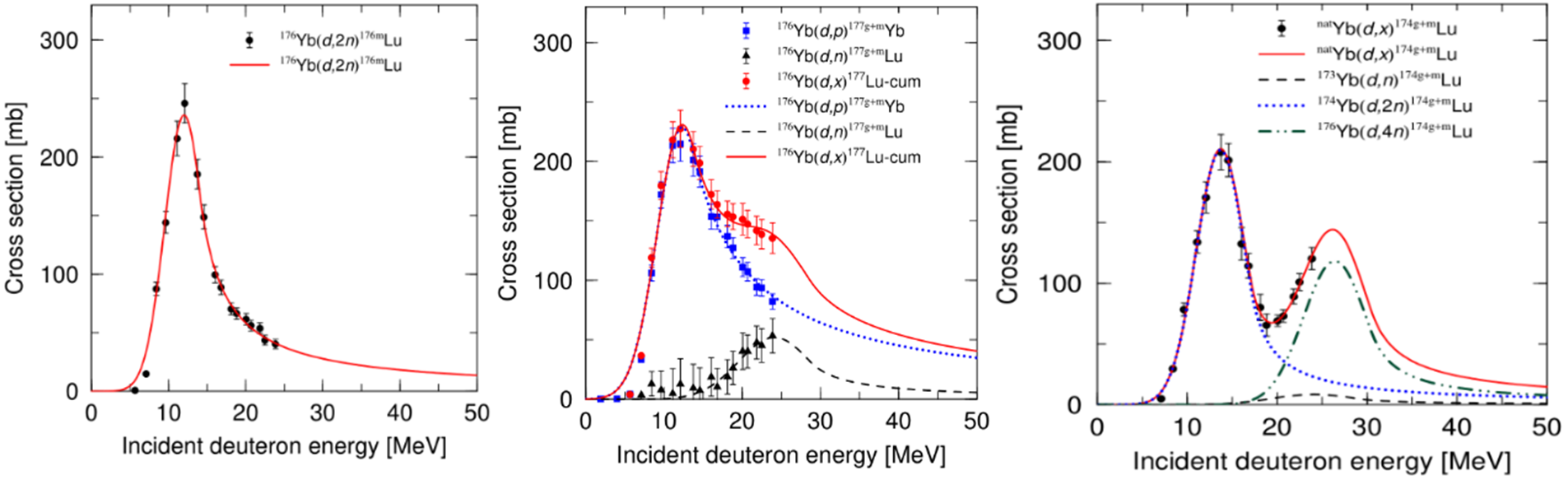
Fig.1.
(Left) Measured and fitted excitation functions of the 176Yb(d,2n)176mLu reaction. (Middle) Measured excitation functions of the 176Yb(d,p)177g+mYb (filled squares), 176Yb(d,n)177Lu (filled triangle), and 176Yb(d,x)177Lu (cumulative. filled circles) reactions. The fitted excitation functions of the reactions are shown by the solid, dotted, and dashed lines.
(Right) Measured (filled circles) and fitted (solid, dotted, and dashed lines) excitation function of the natYb(d,x)174g+mLu reaction.
Estimated Isotopic Compositions of Yb in Enriched 176Yb for Producing 177Lu with High Radionuclide Purity by 176Yb(d,x)177Lu
(JPSJ Editors' Choice)
J. Phys. Soc. Jpn.
91,
044201
(2022)
.
Share this topic


Fields
Related Articles
-
Topological Defects as Seeds of Phase Separation: Insights from a Minimal Lattice Model
Cross-disciplinary physics and related areas of science and technology
Statistical physics and thermodynamics
2026-7-13
A minimal lattice model revealed that topological defects with winding number +1 serve as nucleation sites for phase separation in active matter systems.
-
A Deep Dive Into AI-Driven Materials Science
Cross-disciplinary physics and related areas of science and technology
2026-7-6
This review from the Journal of the Physical Society of Japan examines how artificial intelligence overcomes traditional materials science bottlenecks, highlighting the shift from intuition-based discovery to data-driven innovation.
-
Peculiar Magnet Pointing Against an Applied Magnetic Field
Cross-disciplinary physics and related areas of science and technology
Magnetic properties in condensed matter
2026-7-1
TbNiC2 exhibits negative magnetization. A new mechanism, based on the coupling between the charge density wave and the antiferromagnetic order, is proposed to account for this peculiar phenomenon.
-
The Thermal Einstein–de Haas Effect: Theoretical Prediction and Observability in Chiral Carbon Nanotubes
Cross-disciplinary physics and related areas of science and technology
Structure and mechanical and thermal properties in condensed matter
2026-6-22
Although the Einstein–de Haas (EdH) effect describes material rotation in a magnetic field, a thermal EdH effect, driven by a temperature gradient, remains unobserved. Recently, chiral carbon nanotubes were theoretically proposed as promising candidates to observe it.
-
Negative Apparent Viscosity in Liquid Crystals
Cross-disciplinary physics and related areas of science and technology
Electromagnetism, optics, acoustics, heat transfer, and classical and fluid mechanics
Structure and mechanical and thermal properties in condensed matter
2026-6-8
Electrically driven liquid-crystal turbulence generates self-sustained flow and negative apparent viscosity. The fluorinated, chemically robust nematic PPDFB shows a substantially larger negative-viscosity effect than Schiff-base nematics.