

Exploring Materials without Data Exposure: A Bayesian Optimizer using Secure Computation
© The Physical Society of Japan
This article is on
Materials Secure Computation with Secret Sharing: A Bayesian Optimization Scheme and Its Performance
J. Phys. Soc. Jpn.
94,
013801
(2025)
.
Secure computation allows the manipulation of material data without exposing them, thereby offering an alternative to traditional open/closed data management. We recently reported the development of an application that performs Bayesian optimization using secure computation.
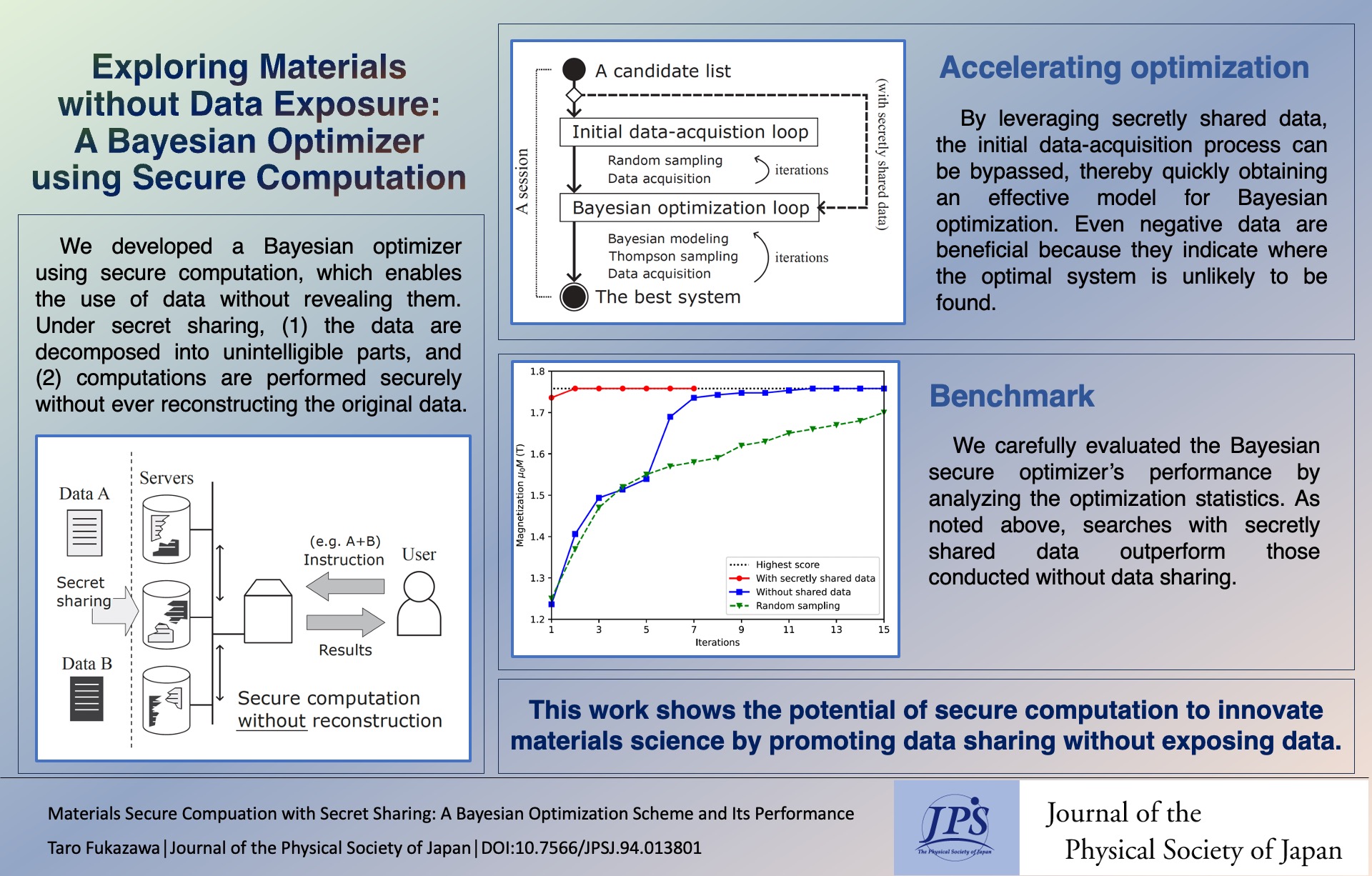
Researchers in the field of materials science are applying informatics methods to optimize the properties of materials. To accelerate their search, they need to gather data; however, they face the dilemma of whether to reveal or conceal their data. Secure computation offers an alternative; it allows the use of data without exposing them. We recently reported the development of an application that performs Bayesian optimization using secure computation. A statistical benchmark revealed its advantages even when only negative data were used.
We adopted a secure computation scheme using secret sharing, in which the data were decomposed into unintelligible shares. For example, consider the value of a physical property, say 137, and its decomposition into two unintelligible values: 137 = 878 + (-741). These unintelligible values, 878 and -741, are called shares. By distributing shares to two different servers, the value cannot be reconstructed unless both shares are obtained. Arithmetic operations can also be performed without the need for data reconstruction. In principle, a combination of these methods enables any type of calculation, albeit at the expense of additional computations and communication.
The aim of this study was to implement a practical method by devising an efficient approximation that can accelerate the search without compromising its efficiency. Although researchers have discussed efficient algorithms for Bayesian optimization using secure computation, there have been no reports on the implementation of a secure Bayesian optimizer.
In this study, we developed a practical and secure Bayesian optimizer. We demonstrated that the secure optimizer compares favorably with an ordinary optimizer in terms of the number of data acquisitions required. Sharing data has also been shown to significantly accelerate searches. Even if sharing is limited to negative data, it is beneficial for the search because it provides information about where the optimal system is unlikely to be found. We believe that this study demonstrates the potential of secure computation to open a new path in materials science and promote data sharing without exposing data.
(Written by Taro Fukazawa on behalf of all the authors)
Materials Secure Computation with Secret Sharing: A Bayesian Optimization Scheme and Its Performance
J. Phys. Soc. Jpn.
94,
013801
(2025)
.
Share this topic


Fields
Related Articles
-
Topological Defects as Seeds of Phase Separation: Insights from a Minimal Lattice Model
Cross-disciplinary physics and related areas of science and technology
Statistical physics and thermodynamics
2026-7-13
A minimal lattice model revealed that topological defects with winding number +1 serve as nucleation sites for phase separation in active matter systems.
-
A Deep Dive Into AI-Driven Materials Science
Cross-disciplinary physics and related areas of science and technology
2026-7-6
This review from the Journal of the Physical Society of Japan examines how artificial intelligence overcomes traditional materials science bottlenecks, highlighting the shift from intuition-based discovery to data-driven innovation.
-
Peculiar Magnet Pointing Against an Applied Magnetic Field
Cross-disciplinary physics and related areas of science and technology
Magnetic properties in condensed matter
2026-7-1
TbNiC2 exhibits negative magnetization. A new mechanism, based on the coupling between the charge density wave and the antiferromagnetic order, is proposed to account for this peculiar phenomenon.
-
The Thermal Einstein–de Haas Effect: Theoretical Prediction and Observability in Chiral Carbon Nanotubes
Cross-disciplinary physics and related areas of science and technology
Structure and mechanical and thermal properties in condensed matter
2026-6-22
Although the Einstein–de Haas (EdH) effect describes material rotation in a magnetic field, a thermal EdH effect, driven by a temperature gradient, remains unobserved. Recently, chiral carbon nanotubes were theoretically proposed as promising candidates to observe it.
-
Negative Apparent Viscosity in Liquid Crystals
Cross-disciplinary physics and related areas of science and technology
Electromagnetism, optics, acoustics, heat transfer, and classical and fluid mechanics
Structure and mechanical and thermal properties in condensed matter
2026-6-8
Electrically driven liquid-crystal turbulence generates self-sustained flow and negative apparent viscosity. The fluorinated, chemically robust nematic PPDFB shows a substantially larger negative-viscosity effect than Schiff-base nematics.