

Hyperuniform and Multifractal States in Bosonic Quasicrystalline Systems
© The Physical Society of Japan
This article is on
Multifractality and Hyperuniformity in Quasicrystalline Bose-Hubbard Models with and without Disorder
(JPSJ Editors' Choice)
J. Phys. Soc. Jpn.
93,
114005
(2024)
.
Quantum states can be categorized as hyperuniform or multifractal based on electronic characteristics. This study demonstrates that bosonic quasicrystalline systems exhibit hyperuniform or multifractal quantum states.
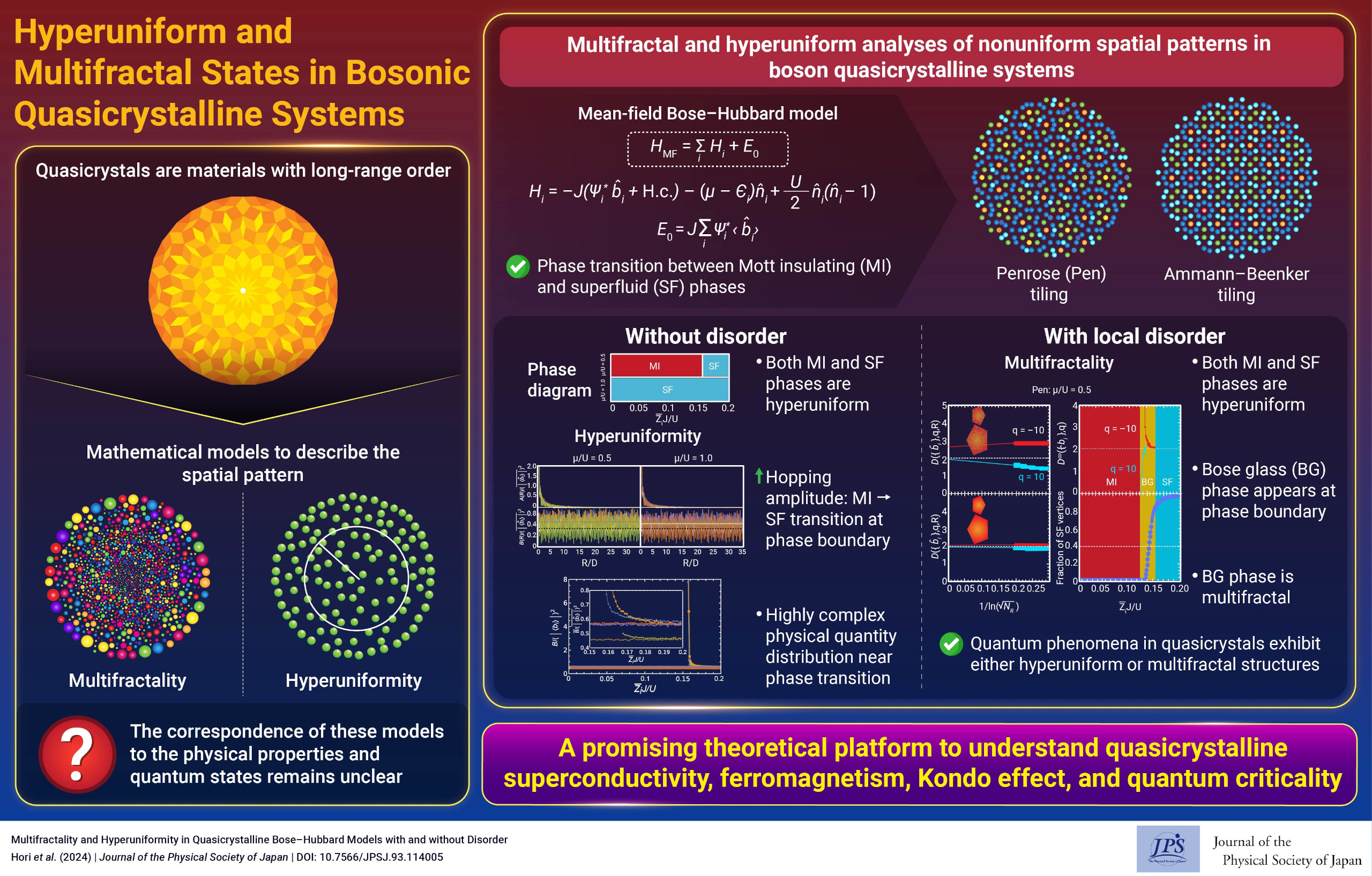
The atomic arrangement of materials significantly influences their physical properties, requiring precise analysis of these structures. Atomic arrangements are classified into crystals, amorphous solids, and quasicrystals. The crystal exhibits periodic atomic patterns, while amorphous solids are characterized by disordered arrangements. However, quasicrystals lack periodicity but exhibit long-range order.
Multifractality and hyperuniformity are two mathematical frameworks used to characterize the spatial patterns of atomic arrangements. The atomic structure of quasicrystals demonstrates multifractal properties, often referred to as self-similarity, while their global structure exhibits hyperuniformity. Fractal atomic arrangements are typically associated with disordered systems, such as amorphous solids, while uniformity characterizes periodic structures like crystals. The coexistence of these features in quasicrystals raises fundamental questions regarding their physical properties and quantum states.
Recent experimental advancements have developed bosonic quasicrystalline systems using ultracold atoms, motivating further theoretical analysis. This study employed the Bose-Hubbard model, which describes a phase transition between Mott insulating and superfluid phases. Introducing local disorders, such as impurities, at the phase boundary leads to a novel quantum phase termed Bose glass. Hyperuniform and multifractal analyses were applied to investigate the characteristics of these phases, their transitions, and their differences from periodic systems.
Both the Mott insulating and superfluid phases exhibited hyperuniformity without local disorder. Increasing the hopping amplitude (the probability of bosons transitioning between atomic sites) induced a phase transition from the Mott insulating to the superfluid phase. A substantial increase in the complexity of physical quantity distributions was observed near the phase transition in quasicrystals, a phenomenon not present in crystals.
The Mott insulating and superfluid phases maintained their hyperuniformity in local disorder, while the Bose glass phase exhibited multifractal characteristics. These findings indicate that quantum states in quasicrystals can manifest as either hyperuniform or multifractal structures depending on the phase and disorder.
The results provide a theoretical foundation for understanding quasicrystalline phenomena, including superconductivity, ferromagnetism, the Kondo effect, and quantum criticality. Hyperuniformity-based analyses have been applied across physics, life sciences, astronomy, and mathematics. Extending such analyses to quasicrystalline systems could enable the quantitative characterization of spatial patterns. This study aims to contribute to identifying novel quasicrystalline properties with potential applications that benefit humanity.
(Written by Masahiro Hori on behalf of all the authors)
Multifractality and Hyperuniformity in Quasicrystalline Bose-Hubbard Models with and without Disorder
(JPSJ Editors' Choice)
J. Phys. Soc. Jpn.
93,
114005
(2024)
.
Share this topic


Fields
Related Articles
-
Giant Brute-Force Simulation to Reveal Nucleation and Growth of Ultrasonic Cavitation Bubbles
Electromagnetism, optics, acoustics, heat transfer, and classical and fluid mechanics
Statistical physics and thermodynamics
2026-7-27
This study reveals the early-stage dynamics of ultrasonic cavitation using a record 100-billion-atom simulation to capture bubble nucleation, growth, clustering, and periodic splitting under nonequilibrium conditions.
-
Monitored Quantum Systems and Quantum Trajectories
General and Mathematical Physics
Mathematical methods, classical and quantum physics, relativity, gravitation, numerical simulation, computational modeling
Statistical physics and thermodynamics
2026-7-21
This review in Progress of Theoretical and Experimental Physics introduces monitored quantum systems and quantum trajectories, emphasizing their spectral properties, typical behaviors such as ergodicity and purification, and measurement-induced phases.
-
Topological Defects as Seeds of Phase Separation: Insights from a Minimal Lattice Model
Cross-disciplinary physics and related areas of science and technology
Statistical physics and thermodynamics
2026-7-13
A minimal lattice model revealed that topological defects with winding number +1 serve as nucleation sites for phase separation in active matter systems.
-
The Thermal Einstein–de Haas Effect: Theoretical Prediction and Observability in Chiral Carbon Nanotubes
Cross-disciplinary physics and related areas of science and technology
Structure and mechanical and thermal properties in condensed matter
2026-6-22
Although the Einstein–de Haas (EdH) effect describes material rotation in a magnetic field, a thermal EdH effect, driven by a temperature gradient, remains unobserved. Recently, chiral carbon nanotubes were theoretically proposed as promising candidates to observe it.
-
Negative Apparent Viscosity in Liquid Crystals
Cross-disciplinary physics and related areas of science and technology
Electromagnetism, optics, acoustics, heat transfer, and classical and fluid mechanics
Structure and mechanical and thermal properties in condensed matter
2026-6-8
Electrically driven liquid-crystal turbulence generates self-sustained flow and negative apparent viscosity. The fluorinated, chemically robust nematic PPDFB shows a substantially larger negative-viscosity effect than Schiff-base nematics.