

Solving Quantum Equations with Gauge Fields: How Explicit Integrators Based on a Bipartite Lattice and Affine Transformations Can Help
© The Physical Society of Japan
This article is on
Explicit Integrators Based on a Bipartite Lattice and a Pair of Affine Transformations to Solve Quantum Equations with Gauge Fields
(JPSJ Editors' Choice)
J. Phys. Soc. Jpn.
89,
054006
(2020)
.
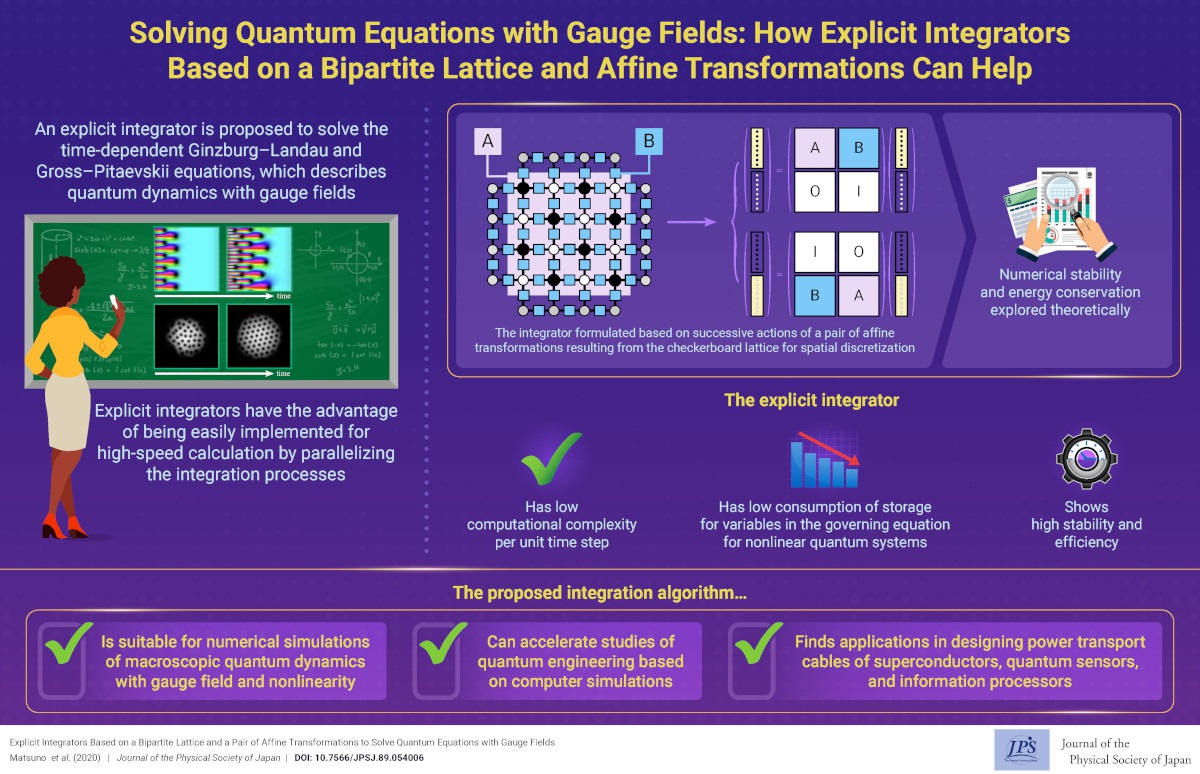
We proposed an explicit numerical integrator consisting of affine transformation pairs resulting from the checkerboard lattice for spatial discretization. It can efficiently solve time evolution equations that describe dynamical quantum phenomena under gauge fields, e.g., generation, motion, interaction of quantum vortices in superconductors or superfluids.
Explicit Integrators Based on a Bipartite Lattice and a Pair of Affine Transformations to Solve Quantum Equations with Gauge Fields
(JPSJ Editors' Choice)
J. Phys. Soc. Jpn.
89,
054006
(2020)
.
Share this topic


Fields
Related Articles
-
Shining Light on Magnetic Flux Trapped in a Superconductor
Dielectric, optical, and other properties in condensed matter
Magnetic properties in condensed matter
Superconductivity
2026-11-16
The magnetic flux trapped in a superconductor was resolved through ultrasensitive magneto-optical Kerr-effect measurements, thereby providing a basis for using an unconventional superconducting order parameter to distinguish between vortex-induced and magnetic signals.
-
Revealing Electronic Quantum Behavior Masked by Nuclear Heat
Measurement, instrumentation, and techniques
Structure and mechanical and thermal properties in condensed matter
Superconductivity
2026-9-7
The initial slope method is used to reveal intrinsic electronic specific heat by eliminating the overwhelming nuclear contributions during low-temperature calorimetry, opening a new window into quantum materials.
-
Unlocking a 40-Year-Old Mystery: Full-gap Spin-Triplet Superconductivity Unveiled in UBe13
Magnetic properties in condensed matter
Superconductivity
2026-8-12
Recent precise NMR measurements on the heavy-fermion superconductor UBe13 provided “smoking-gun” evidence for a fully-gapped spin-triplet superconducting state, opening a new chapter in the field.
-
Monitored Quantum Systems and Quantum Trajectories
Mathematical methods, classical and quantum physics, relativity, gravitation, numerical simulation, computational modeling
Statistical physics and thermodynamics
2026-7-21
This review in Progress of Theoretical and Experimental Physics introduces monitored quantum systems and quantum trajectories, emphasizing their spectral properties, typical behaviors such as ergodicity and purification, and measurement-induced phases.
-
Path Towards Experimental Exploration of Quantum Gravity
Mathematical methods, classical and quantum physics, relativity, gravitation, numerical simulation, computational modeling
2026-6-15
This study presents a novel route for experimentally realizing the Sachdev–Ye–Kitaev (SYK) model, considered holographically dual to charged black holes, offering the first step towards experimental studies of quantum gravity.