

Current Melt Frozen Electrons
© The Physical Society of Japan
This article is on
Current-Induced Metallization and Valence Transition in Black SmS
(JPSJ Editors' Choice)
J. Phys. Soc. Jpn.
93,
013701
(2024)
.
The origin of the current-induced insulator-to-metal transition of samarium monosulfide was explained by the 4f−5d hybridization observed using optical reflectivity and photoelectron spectroscopies.
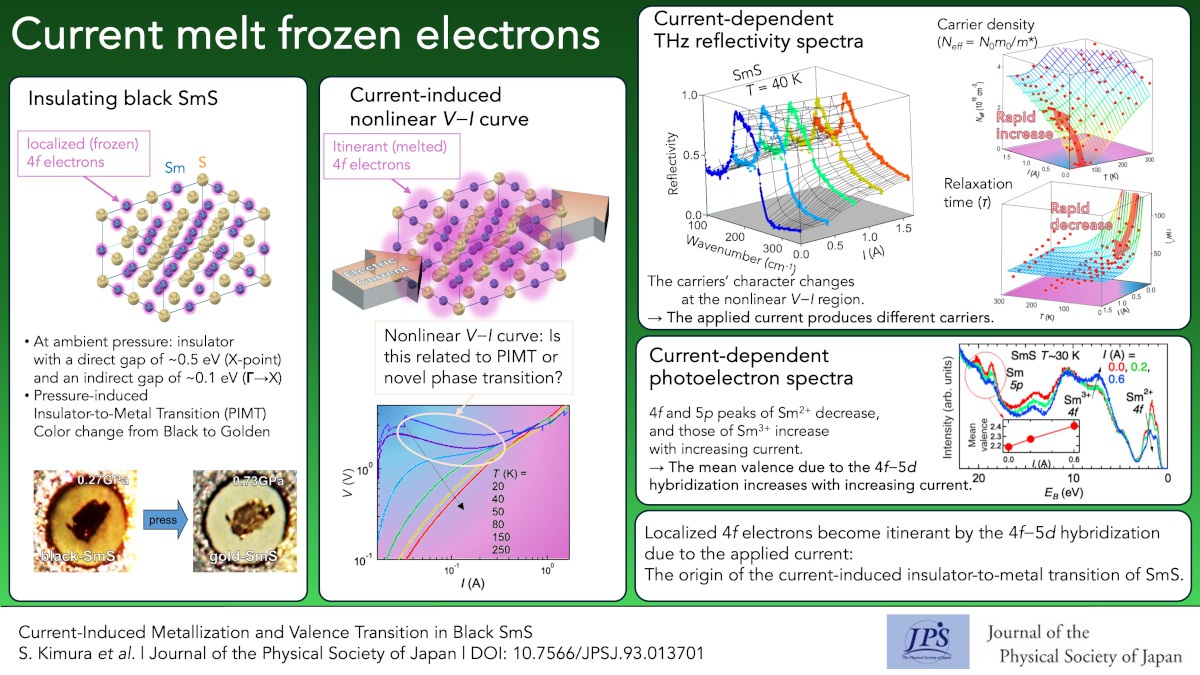
Different external environments, such as temperature and pressure, can change physical properties, such as transport, magnetism, and light transparency. One phenomenon is the Pressure-induced Insulator-to-Metal Transition (PIMT), in which a transparent, nonconducting material (insulator) becomes opaque and begins to conduct electricity (metallization) when pressure is applied. Some materials exhibit the PIMT at pressures below 10,000 atm (approximately 1 GPa). One substance that exhibits PIMT at low pressure is samarium monosulfide (SmS), an insulator at ambient pressure (1 atm) with high electrical resistance and transmits infrared and terahertz regions. When SmS is damaged by a needle tip or applying pressure above approximately 7,000 atm (~0.7 GPa), it undergoes PIMT and transforms into a metal. This property change, as well as the color change of SmS from black to golden-yellow, has attracted the attention of many researchers and has been the subject of numerous studies. However, the origin of PIMT is yet to be identified, even more than 50 years after its discovery.
More recently, the behavior of SmS in external environments that differs from that of pressure has attracted attention. The first is the negative differential resistance (dV/dI) when a current higher than the normal measurement condition is applied to SmS at low temperatures. Because ordinary materials obey Ohm's law, dV/dI is constant regardless of the current magnitude. However, SmS exhibits negative dV/dI at low temperatures, where the voltage decreases when the current is increased.
Here, the origin of dV/dI was investigated using optical reflectivity spectra in the region from the terahertz to vacuum-ultraviolet and angle-integrated photoelectron spectra under the application of current. The obtained spectra suggest that the material exhibited a Current-induced Insulator-to-Metal Transition (CIMT). Detailed analysis of the electronic state change revealed that the CIMT was caused by the hybridization of the Sm 4f orbital and Sm 5d conduction band owing to the pushing out of the 4f electrons localized in the atom by the applied electric current. The metallic state of the CIMT has a lower conduction electron density than the metallic phase of the PIMT of SmS, suggesting that the same phase transition in the PIMT cannot occur by increasing only the 4f-5d hybridization strength. This result suggests that effects other than hybridization are required for PIMT.
(Written by S. Kimura on behalf of all the authors)
Current-Induced Metallization and Valence Transition in Black SmS
(JPSJ Editors' Choice)
J. Phys. Soc. Jpn.
93,
013701
(2024)
.
Share this topic


Fields
Related Articles
-
Shining Light on Magnetic Flux Trapped in a Superconductor
Dielectric, optical, and other properties in condensed matter
Magnetic properties in condensed matter
Superconductivity
2026-11-16
The magnetic flux trapped in a superconductor was resolved through ultrasensitive magneto-optical Kerr-effect measurements, thereby providing a basis for using an unconventional superconducting order parameter to distinguish between vortex-induced and magnetic signals.
-
Why Does Magnetization Lose its Motion? - Magnetic Damping from Low Temperatures to the Curie Point -
Magnetic properties in condensed matter
2026-11-10
A unified physical outlook of magnetic damping is presented, explaining how the relaxation of magnetization changes from low to Curie temperatures by combining the microscopic spin relaxation and magnetic response.
-
Frustrated Sawtooth Yb Chain Yielding Ferromagnetic Order with Reduced Magnetic Moments
Magnetic properties in condensed matter
2026-9-1
The ytterbium-based semiconductor ZnYb2S4 exhibits ferromagnetic order with contracted Yb moments, representing a novel quantum ground state attributed to competing exchange interactions in an effective spin-1/2 frustrated sawtooth chain.
-
Holonomy Reveals Hidden Strain Incompatibilities in Birefringence Imaging
Dielectric, optical, and other properties in condensed matter
Measurement, instrumentation, and techniques
2026-8-17
Holonomy measures how local optical directions fail to return to their original orientation after a closed loop, revealing hidden electromechanical structures in stress-induced ferroelectric SrTiO3.
-
Unlocking a 40-Year-Old Mystery: Full-gap Spin-Triplet Superconductivity Unveiled in UBe13
Magnetic properties in condensed matter
Superconductivity
2026-8-12
Recent precise NMR measurements on the heavy-fermion superconductor UBe13 provided “smoking-gun” evidence for a fully-gapped spin-triplet superconducting state, opening a new chapter in the field.