

Quantum Dripping of Superfluid 4He
© The Physical Society of Japan
This article is on
Robust Quantization of the Dripping Periods of Superfluid 4He
J. Phys. Soc. Jpn.
92,
124601
(2023)
.
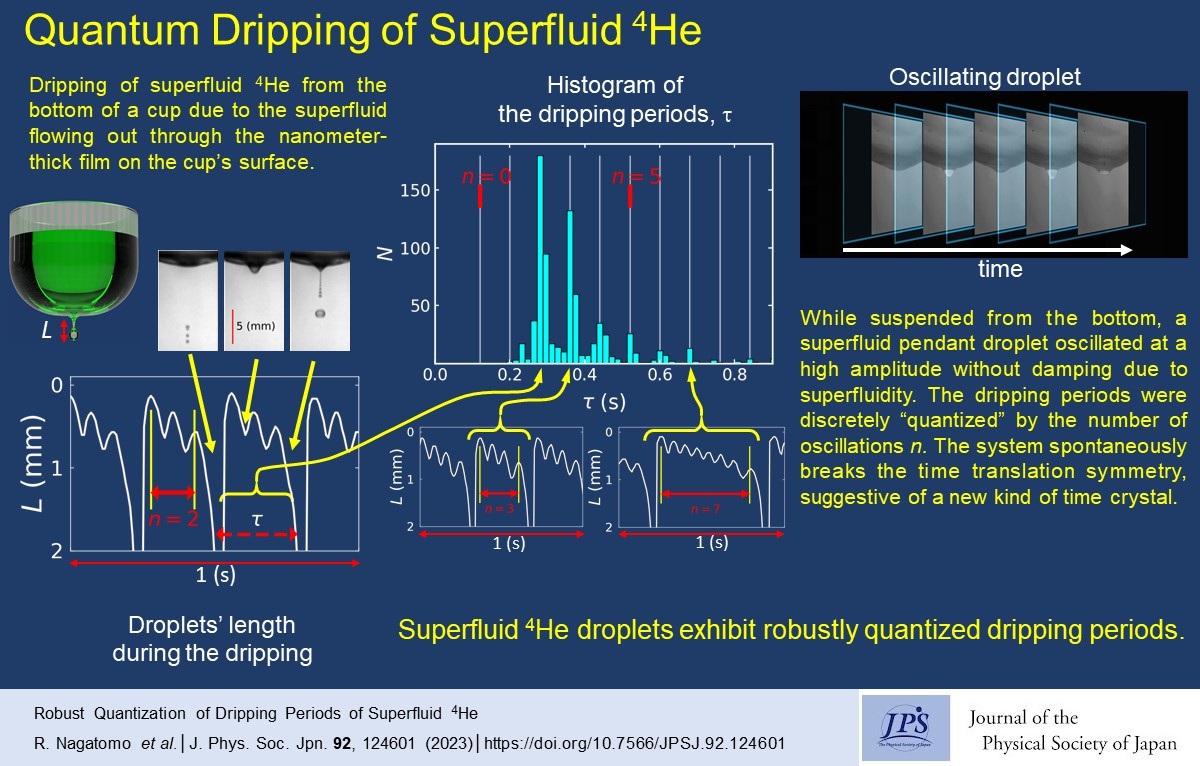
Water dripping from faucets is a common occurrence in daily life. People have noticed that water does not drip at regular intervals, even if the flow rate remains the same. It may drip at short or long intervals with no predictable patterns. This chaotic behavior is caused by tiny droplet oscillations, which cause complex dynamics in classical fluids. Although there is considerable interest in understanding the differences between superfluid and dissipative classical flows, very little is known about their essential differences, particularly in highly nonlinear regimes. This study shows that the dripping behavior of superfluid 4He droplets is very different from that of classical droplets. The dripping periods of the superfluid droplets were quantized at discrete values, even when the input flow rates gradually varied. This is due to the high-amplitude and undamped oscillation of the droplets, which is a direct consequence of superfluidity.
To observe the dripping of the superfluid, spontaneous flow from a cup with an open top, the so-called superfluid film flow, was utilized. This has been used as a popular demonstration to demonstrate the peculiarity of a superfluid that can flow without dissipation through a nanometer-thick film formed on the cup surface. A high-speed video camera was used to capture the dripping of superfluid 4He droplets from the bottom of the cup via superfluid film flow.
When a superfluid pendant droplet is suspended from the bottom, it oscillates with a high amplitude and negligible damping. The amplitude is sufficiently high, causing it to consistently pinch off during the downward phase of the oscillation. The dripping periods of the droplets were discretized at the values specified by the number of oscillations when suspended from the bottom. This is in contrast to a water droplet, which oscillates at a small amplitude and only causes a delay or hast in the pinch-off, resulting in the chaotic behavior of classical fluids. The high-amplitude oscillation of the superfluid droplet removed the small difference and suppressed the occurrence of chaos in the dripping dynamics. The stably discretized periods indicate the spontaneous breaking of time translation symmetry, suggesting a new kind of time crystal realized in superfluid dripping; however, further investigation is needed for confirmation.
(Written by Nomura on behalf of all the authors )
Robust Quantization of the Dripping Periods of Superfluid 4He
J. Phys. Soc. Jpn.
92,
124601
(2023)
.
Share this topic


Fields
Related Articles
-
Mysterious Critical Phenomena Driven by Role Reversal in Multicomponent Systems: From Normal to Reverse RKKY — Twofold Reversal and Induced Critical Exponent
Electronic transport in condensed matter
Structure and mechanical and thermal properties in condensed matter
2026-10-5
The Reverse RKKY mechanism drives a twofold reversal, yielding an anomalous specific‑heat peak with a large, induced critical exponent.
-
Direct Observation of Piezoelectricity from Electric Toroidal Quadrupole Order
Electron states in condensed matter
Structure and mechanical and thermal properties in condensed matter
2026-9-30
This study reports the direct observation of piezoelectricity in the spin-orbit-coupled metal Cd2Re2O7. The findings reveal how electric toroidal quadrupole order drives successive inversion-symmetry-breaking transitions and anisotropic electromechanical responses.
-
Revealing Electronic Quantum Behavior Masked by Nuclear Heat
Measurement, instrumentation, and techniques
Structure and mechanical and thermal properties in condensed matter
Superconductivity
2026-9-7
The initial slope method is used to reveal intrinsic electronic specific heat by eliminating the overwhelming nuclear contributions during low-temperature calorimetry, opening a new window into quantum materials.
-
Giant Brute-Force Simulation to Reveal Nucleation and Growth of Ultrasonic Cavitation Bubbles
Electromagnetism, optics, acoustics, heat transfer, and classical and fluid mechanics
Statistical physics and thermodynamics
2026-7-27
This study reveals the early-stage dynamics of ultrasonic cavitation using a record 100-billion-atom simulation to capture bubble nucleation, growth, clustering, and periodic splitting under nonequilibrium conditions.
-
The Thermal Einstein–de Haas Effect: Theoretical Prediction and Observability in Chiral Carbon Nanotubes
Cross-disciplinary physics and related areas of science and technology
Structure and mechanical and thermal properties in condensed matter
2026-6-22
Although the Einstein–de Haas (EdH) effect describes material rotation in a magnetic field, a thermal EdH effect, driven by a temperature gradient, remains unobserved. Recently, chiral carbon nanotubes were theoretically proposed as promising candidates to observe it.