

Strange Elastic Anomalies with Ultraslow Dynamics around Magnetic Critical Endpoint
© The Physical Society of Japan
This article is on
J. Phys. Soc. Jpn.
92,
104603
(2023)
.
Near the magnetic critical endpoint of UCoAl, peculiar elastic anomalies exhibiting exotic ultraslow dynamics arising from electric quadrupoles are indicated. Combining this with diverse fluctuations, intriguing phenomena and exotic ground states are expected.
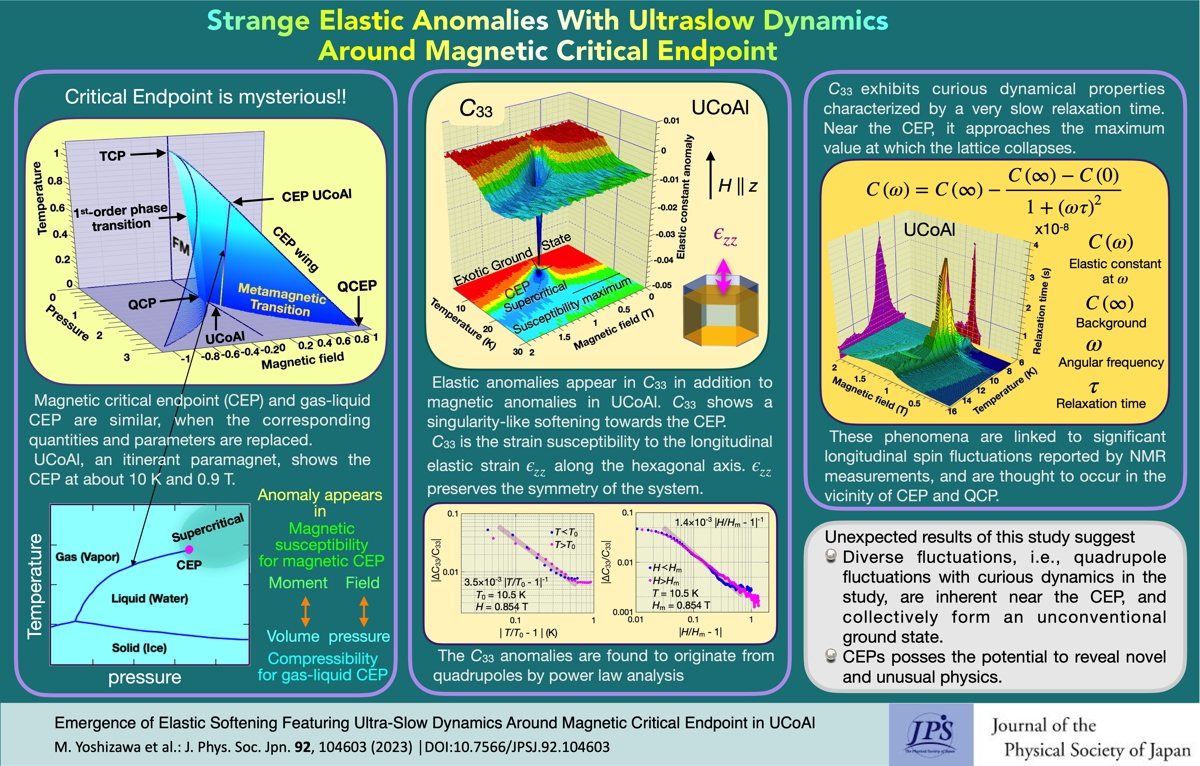
Since the mathematical description of boundary-separating gas and liquid states by van der Waals, the critical endpoint (CEP) has garnered the attention of many researchers because of its intriguing nature. At high temperatures and pressures, water achieves a CEP, in which the gas and liquid phases coexist harmoniously. An anomaly in the compressibility emerges in the water CEP. In magnetic materials, CEP appears as a function of temperature and the magnetic field. The magnetic susceptibility shows an anomaly in the magnetic CEP. Gas-liquid and magnetic CEPs are assumed to be similar. Nevertheless, the presence of non-magnetic fluctuations is unanticipated in magnetic CEPs.
UCoAl, which is an itinerant paramagnet, is located near both the tri-critical point and the quantum critical point (QCP). At ambient pressure, a CEP was observed at approximately 10 K and 0.9 T. In this study, ultrasonic sound velocities ranging from 12 to 106 MHz were measured, and the elastic constant C33, which represents the strain susceptibility for elastic strain (displacement along the hexagonal axis), was obtained. We observed a singularity-like elastic softening toward the CEP and discovered that this anomaly cannot be attributed to magnetostrictive coupling. Power law analyses indicate that it originates from electric quadrupoles.
Furthermore, C33exhibited a fascinating ultrasonic dispersion effect, in which the elastic anomaly diminished as the frequency increased. The recorded relaxation time of 3.5 × 10⁻⁸ s at the CEP is the lowest value reported thus far for solids. This value approached the maximum value, at which the crystal collapsed, thus indicating significant structural fluctuations.
Based on NMR studies, UCoAl exhibits pronounced longitudinal spin fluctuations related to the C33 anomaly. The crystal symmetry of UCoAl remains unchanged at CEPs, and maintains the symmetry of the crystal. Fluctuations in the magnetic and structural properties that retain symmetry coevolve toward the CEP. The unconventional slow dynamics indicate the existence of an exotic ground state in this system, which is believed to emerge near the CEP in distinct and extreme environments.
Recently, peculiar superconducting and quadrupolar states were observed in URhGe, UTe2, and URhSn. The distinct features of UCoAl near the CEP are speculated to be associated with the enigmatic properties of these compounds.
CEPs contribute to various fields ranging from industrial processes to particle physics. Despite extensive research, the nature of CEPs remains unclear. CEPs can potentially reveal novel and unusual physics, thus presenting an interesting avenue for investigating undisclosed facets of matter.
Written by M. Yoshizawa on behalf of all the authors.
J. Phys. Soc. Jpn.
92,
104603
(2023)
.
Share this topic


Fields
Related Articles
-
Mysterious Critical Phenomena Driven by Role Reversal in Multicomponent Systems: From Normal to Reverse RKKY — Twofold Reversal and Induced Critical Exponent
Electronic transport in condensed matter
Structure and mechanical and thermal properties in condensed matter
2026-10-5
The Reverse RKKY mechanism drives a twofold reversal, yielding an anomalous specific‑heat peak with a large, induced critical exponent.
-
Direct Observation of Piezoelectricity from Electric Toroidal Quadrupole Order
Electron states in condensed matter
Structure and mechanical and thermal properties in condensed matter
2026-9-30
This study reports the direct observation of piezoelectricity in the spin-orbit-coupled metal Cd2Re2O7. The findings reveal how electric toroidal quadrupole order drives successive inversion-symmetry-breaking transitions and anisotropic electromechanical responses.
-
Revealing Electronic Quantum Behavior Masked by Nuclear Heat
Measurement, instrumentation, and techniques
Structure and mechanical and thermal properties in condensed matter
Superconductivity
2026-9-7
The initial slope method is used to reveal intrinsic electronic specific heat by eliminating the overwhelming nuclear contributions during low-temperature calorimetry, opening a new window into quantum materials.
-
Frustrated Sawtooth Yb Chain Yielding Ferromagnetic Order with Reduced Magnetic Moments
Magnetic properties in condensed matter
2026-9-1
The ytterbium-based semiconductor ZnYb2S4 exhibits ferromagnetic order with contracted Yb moments, representing a novel quantum ground state attributed to competing exchange interactions in an effective spin-1/2 frustrated sawtooth chain.
-
Unlocking a 40-Year-Old Mystery: Full-gap Spin-Triplet Superconductivity Unveiled in UBe13
Magnetic properties in condensed matter
Superconductivity
2026-8-12
Recent precise NMR measurements on the heavy-fermion superconductor UBe13 provided “smoking-gun” evidence for a fully-gapped spin-triplet superconducting state, opening a new chapter in the field.