

Refining Primordial Black Hole Formation with Peak Theory and a Physical Collapse Criterion
© The Physical Society of Japan
This article is on
Primordial black hole abundance from random Gaussian curvature perturbations and a local density threshold
(The 31st Outstanding Paper Award of the Physical Society of Japan)
Prog. Theor. Exp. Phys.
2018,
123E01
(2026)
.
This study introduces a refined framework for primordial black hole formation, replacing older approximations with peak theory and physical collapse criterion, resulting in revised predictions for their mass and abundance.
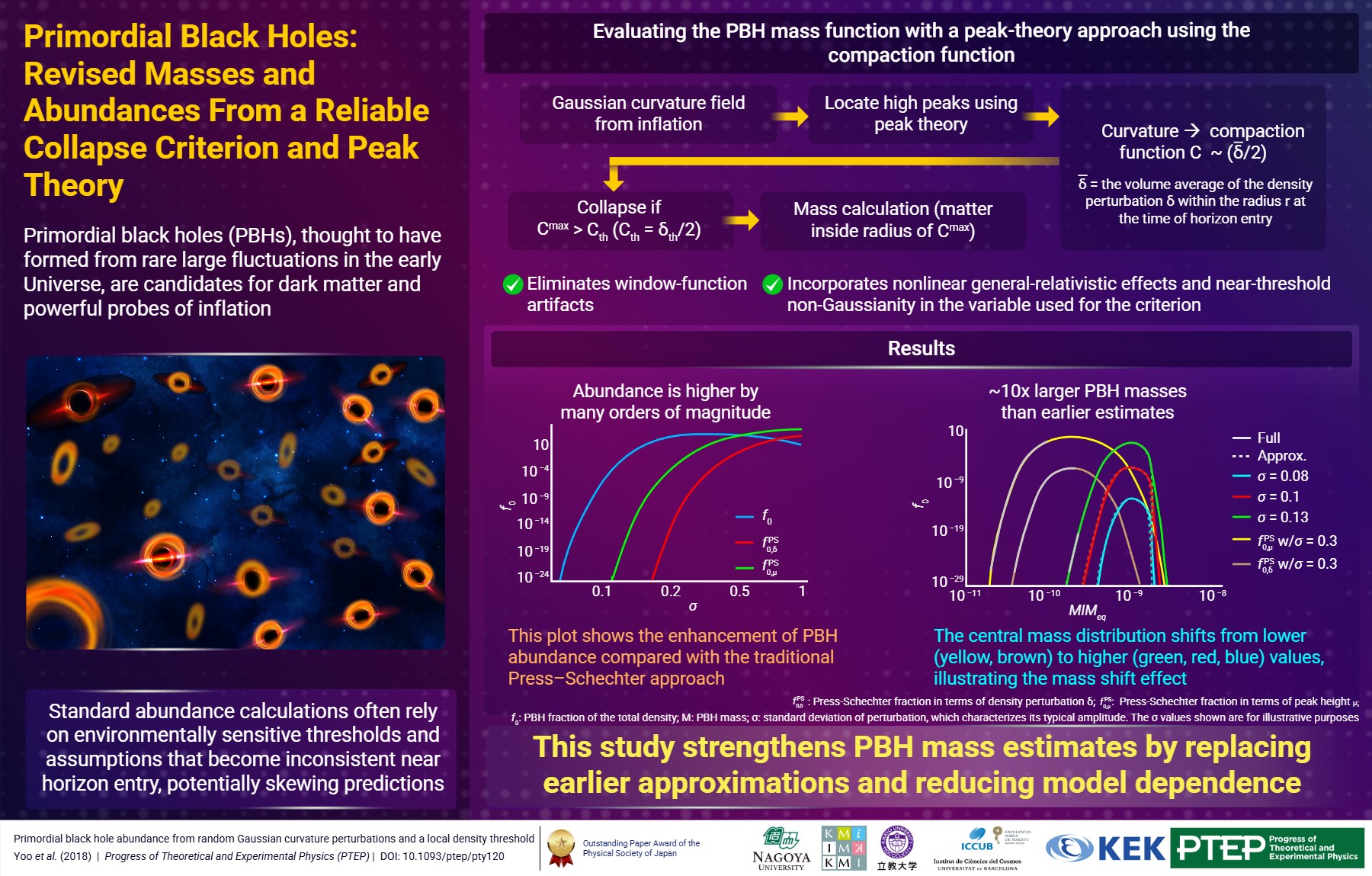
Primordial black holes (PBHs) are potential candidates for dark matter and offer a unique way to probe the inflationary models that describe the very early universe. They are hypothesized to have formed from the gravitational collapse of regions with extremely high density in the moments after the Big Bang. As a result, the predicted number of PBHs provides a way to test the properties of the small density fluctuations generated during inflation, a brief period of extremely rapid expansion that occurred fractions of a second after the Big Bang.
In most conventional calculations, the production rate of PBHs is estimated by assuming that cosmological perturbations follow a nearly Gaussian distribution. Black holes are then assumed to form wherever the amplitude of a perturbation exceeds a certain threshold value. However, the curvature threshold is sensitive to surrounding environmental effects that are not directly related to the local collapse dynamics, introducing ambiguity in the predicted abundance. Moreover, the density perturbation has an upper bound at horizon entry, which causes its distribution near the collapse threshold to deviate from a simple Gaussian description.
To address the inherent limitations of earlier Press–Schechter–based methods, we construct a new framework based on peak theory for estimating the primordial black hole mass function and abundance. This framework eliminates the dependence on arbitrary window functions, replaces the environmentally sensitive curvature threshold with a local and physically meaningful compaction function as the formation criterion, and consistently incorporates the relevant nonlinear general relativistic effects.
The compaction function is defined as the mass excess above the background divided by the area radius. For nearly spherical perturbations, it is equivalent to half of the volume-averaged density perturbation at the moment of horizon entry. PBH formation is assumed to occur when the maximum value of this function exceeds a specified threshold.
Our results offer a significant revision to previous estimates. We find that the predicted mass of PBHs is shifted to larger scales by about an order of magnitude compared to conventional calculations. Furthermore, the overall abundance of PBHs increases significantly. By refining the theoretical calculation of the PBH mass function and removing the approximations and model dependence inherent in earlier methods, this approach deepens our understanding of PBH formation and the statistics of the early Universe, earning the Outstanding Paper Award of the Physical Society of Japan in 2026.
Primordial black hole abundance from random Gaussian curvature perturbations and a local density threshold
(The 31st Outstanding Paper Award of the Physical Society of Japan)
Prog. Theor. Exp. Phys.
2018,
123E01
(2026)
.
Share this topic


Fields
Related Articles
-
Going Beyond Einstein with Modified Theories of Gravity
Astrophysics, cosmology, and geophysics
2023-9-8
This study comprehends a way to probe modified theories of gravity on cosmological scales by combining theoretical advancements and observational data for upcoming cosmological observations.
-
LiteBIRD: A New Frontier in the Search of Cosmic Inflation Imprint
Astrophysics, cosmology, and geophysics
2023-3-22
The newly selected LiteBIRD satellite aims to detect cosmic inflation signals by identifying the imprint of primordial gravitational waves in the Cosmic Microwave Background polarization.
-
A New Look at Our Universe with Gravitational Wave Astronomy
Astrophysics, cosmology, and geophysics
2021-10-26
A new interdisciplinary collaborative project underscores the importance of combining theory with advanced observation techniques to understand gravitational waves and their sources, opening doors to new discoveries about the universe.
-
Designing a New Space-borne Interferometer to Probe the History of Our Universe
Astrophysics, cosmology, and geophysics
2021-9-22
Scientists present a new design for a space-born laser interferometer that could detect gravitational waves below 10 Hz, letting us probe into new astrophysical phenomena.