

Implementation of Nuclear Many-Body Wave Functions via Superpositions of Localized Gaussians
© The Physical Society of Japan
This article is on
An implementation of nuclear many-body wave functions by the superposition of localized Gaussians
(PTEP Editors' Choice)
Prog. Theor. Exp. Phys.
2024,
093D01
(2024)
.
Antisymmetrized molecular dynamics (AMD), developed in the 1990s, provides a unified framework for describing nuclear structures and reactions. It models nucleons as independent Gaussian wave packets, enabling the description of nucleon aggregation and disaggregation dynamics. AMD has significantly advanced the understanding of nuclear fragmentation reactions at medium-to-high energies and cluster structures in light nuclei. However, its reliance on the Gaussian-type single-nucleon wave function limits its application to low-energy nuclear reactions and the structural description of heavier nuclei, where deviations from Gaussian density distributions become significant.
This study introduces a novel model wave function to address these limitations. The single-nucleon wave function was expressed as a superposition of localized Gaussian functions, with the superposition amplitudes and the Gaussian centers (mean positions and momenta of wave packets) serving as model parameters. This formulation enabled a more adaptable representation of nucleon wave functions. Equations of motion were derived for the superposition amplitudes and Gaussian centers by applying the variational principle. The former corresponds to the standard Hartree-Fock equation, while the latter extends the AMD equation, unifying the two approaches within a single framework. Benchmark calculations for spherical nuclei, such as calcium isotopes and 100Sn, are presented, demonstrating significant improvements over conventional AMD methods (Figure 1).
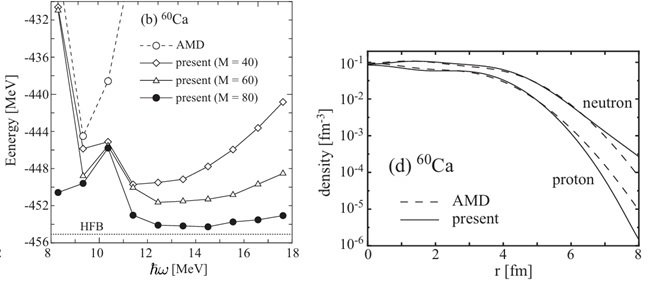
Future developments include incorporating pairing correlations, angular momentum projections, and generator coordinate methods to enhance nuclear structure descriptions. Additionally, extending this approach to real-time calculations will facilitate the modeling of low-energy nuclear reactions with higher precision.
(Written by M. Kimura on behalf of all the authors)
An implementation of nuclear many-body wave functions by the superposition of localized Gaussians
(PTEP Editors' Choice)
Prog. Theor. Exp. Phys.
2024,
093D01
(2024)
.
Share this topic


Fields
Related Articles
-
Why Is the Deuteron Advantage in One-Proton Knockout Smaller Than Expected?
Nuclear physics
2026-9-24
Deuteron breakup enhances one-proton knockout, whereas stronger nuclear absorption suppresses it. This explains why the measured deuteron/proton cross-section ratio is about 1.5, much lower than the naive expectation of 4.
-
A Journey into Nuclear Diversity: Discovery of 22 New Exotic Isotopes Using an Intense 208Pb Beam
Nuclear physics
2026-8-3
Using a newly developed intense 208Pb beam at the RIKEN RI Beam Factory (RIBF), we discovered 22 new proton- and neutron-rich isotopes, which significantly expand the nuclear chart.
-
Verification of Magnetic Structure Observation at the Atomic Scale
Atomic and molecular physics
Cross-disciplinary physics and related areas of science and technology
Nuclear physics
2026-6-2
Magnetic neutron scattering holography (MNH) were performed on a Fe0.08Co0.92 single crystal. The resulting holograms provided the first experimental evidence that MNH is sensitive to magnetic signals.
-
Seven New Pieces of the Nuclear Landscape Puzzle Uncovered Near Cerium-159
Nuclear physics
2026-3-13
RIKEN discovered seven neutron-rich isotopes in the rare-earth region, pushing the nuclear landscape frontier toward an astrophysical r-process path. RIKEN discovered over 200 isotopes using in-flight separation.
-
Probing New Routes to the Synthesis of Superheavy Elements with Intense Titanium-50 Isotopic Beam
Nuclear physics
2025-9-24
Discovery of new superheavy elements require beams beyond the emblematic Calcium-48. Intense titanium-50 beams open a new route used in the present tentative synthesis of oganesson (Z=118).