

Having a Good Friend around Makes Life Better
© The Physical Society of Japan
This article is on
J. Phys. Soc. Jpn.
93,
073801
(2024)
.
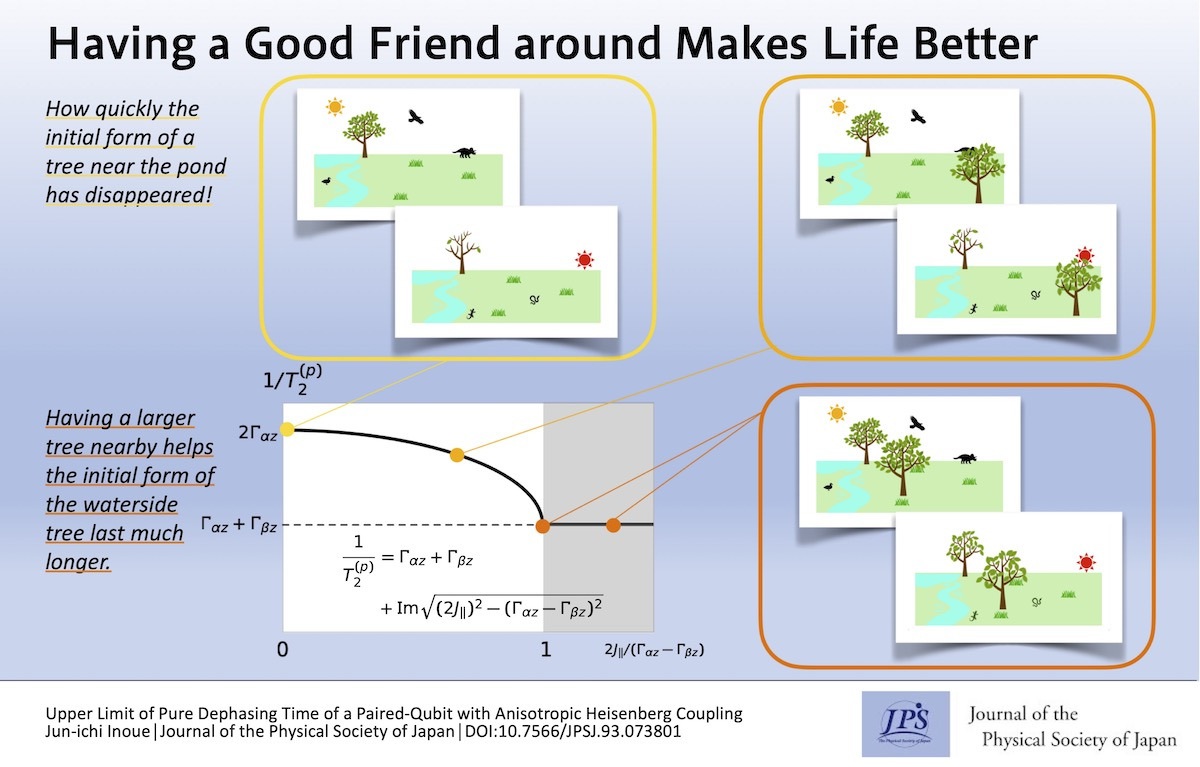
We are almost ready to roll out the application of qubits, which are two-state quantum-mechanical systems. Quantum computers are likely to be at the forefront, but sensors using quantum technology represent other platforms that are worthy of consideration. In this case, the best bet for qubits is to use point defects in diamonds, which are called negatively charged nitrogen-vacancy (NV-minus) centers. The qubit situated in the center is ideal in that it operates stably even at room temperature. This property is in stark contrast to that observed in superconductors.
Any quantum state is susceptible to a variety of noise sources, which ultimately result in the decay of the quantum state over time. A comprehensive study has demonstrated that the use of qubits with slow decay rates facilitates the attainment of a more refined sensing resolution. Therefore, one of the most important things to consider in a sensor is how long the quantum states can be maintained. Hence, a slow decay rate is a big plus.
As is easily expected, a short distance between a quantum sensor and a target to be measured is good for sensing. Therefore, having the sensor right next to the diamond surface would be advantageous. However, it's not that simple because surfaces have many of surface-specific sources that can accelerate the decay.
To address this trade-off, this article demonstrates that coupling with another qubit that has a slow decay rate improves the decay rate of a qubit near the diamond surface. For the case that anisotropic Heisenberg coupling between a qubit pair is assumed, the analytical result for the decay rate as a function of the coupling strength has been derived. The formula demonstrates which component of the interaction is the most dominant, and reveals that there is a limit to the potential for improvement in the decay rate.
This finding could be useful in quantum sensing technology, especially cases involving NV-minus centers in diamonds.
(Written by J.-i. Inoue.)
J. Phys. Soc. Jpn.
93,
073801
(2024)
.
Share this topic


Fields
Related Articles
-
Topological Defects as Seeds of Phase Separation: Insights from a Minimal Lattice Model
Cross-disciplinary physics and related areas of science and technology
Statistical physics and thermodynamics
2026-7-13
A minimal lattice model revealed that topological defects with winding number +1 serve as nucleation sites for phase separation in active matter systems.
-
A Deep Dive Into AI-Driven Materials Science
Cross-disciplinary physics and related areas of science and technology
2026-7-6
This review from the Journal of the Physical Society of Japan examines how artificial intelligence overcomes traditional materials science bottlenecks, highlighting the shift from intuition-based discovery to data-driven innovation.
-
Peculiar Magnet Pointing Against an Applied Magnetic Field
Cross-disciplinary physics and related areas of science and technology
Magnetic properties in condensed matter
2026-7-1
TbNiC2 exhibits negative magnetization. A new mechanism, based on the coupling between the charge density wave and the antiferromagnetic order, is proposed to account for this peculiar phenomenon.
-
The Thermal Einstein–de Haas Effect: Theoretical Prediction and Observability in Chiral Carbon Nanotubes
Cross-disciplinary physics and related areas of science and technology
Structure and mechanical and thermal properties in condensed matter
2026-6-22
Although the Einstein–de Haas (EdH) effect describes material rotation in a magnetic field, a thermal EdH effect, driven by a temperature gradient, remains unobserved. Recently, chiral carbon nanotubes were theoretically proposed as promising candidates to observe it.
-
Negative Apparent Viscosity in Liquid Crystals
Cross-disciplinary physics and related areas of science and technology
Electromagnetism, optics, acoustics, heat transfer, and classical and fluid mechanics
Structure and mechanical and thermal properties in condensed matter
2026-6-8
Electrically driven liquid-crystal turbulence generates self-sustained flow and negative apparent viscosity. The fluorinated, chemically robust nematic PPDFB shows a substantially larger negative-viscosity effect than Schiff-base nematics.