

d2 Trimer and d3 Tetramer in a Pyrochlore Lattice
© The Physical Society of Japan
This article is on
Charge Disproportionation for Trimerization and Tetramerization in Spinel-Type AlV2O4
(JPSJ Editors' Choice)
J. Phys. Soc. Jpn.
93,
074709
(2024)
.
Based on the charge disproportionation of V3+ and V2+, the V3+(d2) trimers and V2+(d3) tetramers in the vanadium pyrochlore lattice of AlV2O4 are described by the orbitally-induced Peierls mechanism.
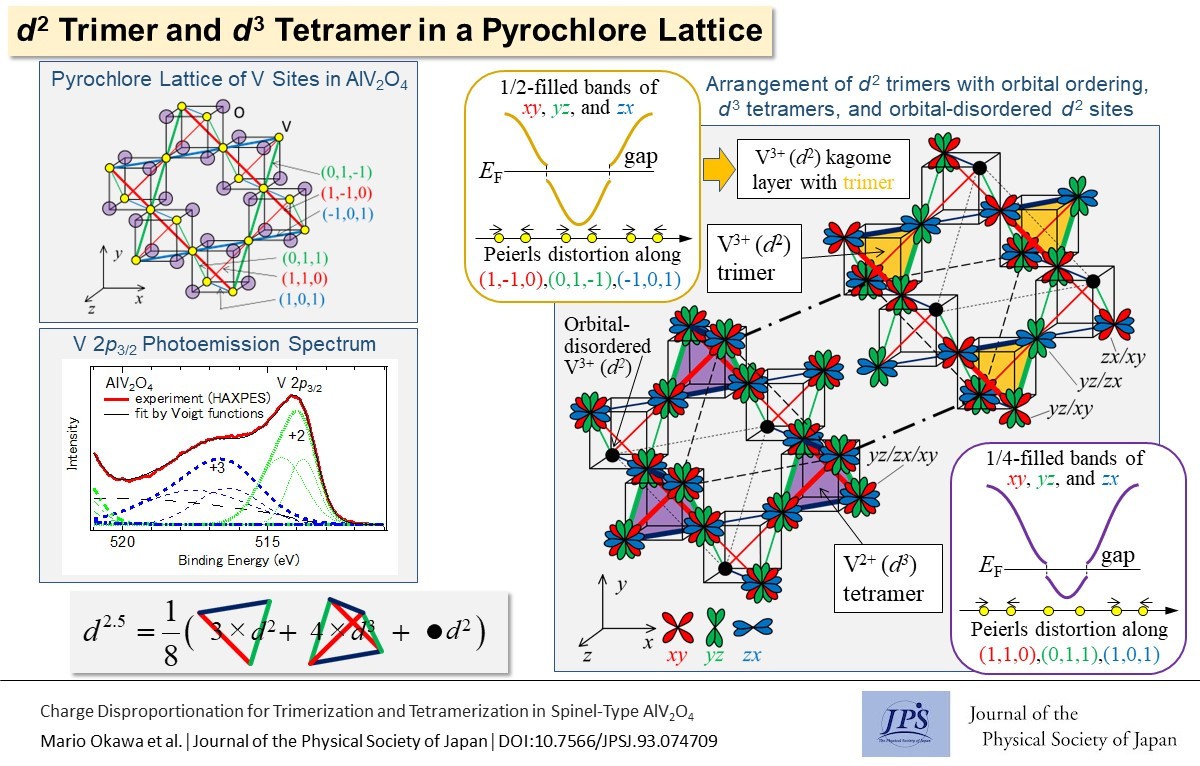
When a one-dimensional band is partially filled with electrons in a one-dimensional lattice, the lattice undergoes Peierls distortion with a new periodicity that can create a bandgap at the Fermi level. When the one-dimensional band is half(quarter)-filled, the Peierls distortion results in a two(four)-fold periodicity of the original lattice. Spinel-type transition metal compounds with partially filled xy, yz, or zx orbitals often exhibit lattice distortions that can be interpreted as Peierls distortions of one-dimensional xy bands along the (1,1,0) and (1,-1,0) chains, yzbands along the (0,1,1) and (0,1,-1) chains, or zx bands along the (1,0,1) and (1,0,-1) chains of the pyrochlore lattice formed by the transition metal sites. For example, in CuIr2S4, the Ir pyrochlore lattice undergoes octamerization because of Peierls distortion (Ir–Ir dimerization), and it displays a four-fold periodicity along the (1,1,0) and (1,-1,0) directions, which are selected by the Ir 5d orbital polarization (in which only the xy band is partially filled). This microscopic description of multimer formation is called the orbitally-induced Peierls mechanism.
In spinel-type AlV2O4, the vanadium pyrochlore lattice contains vanadium trimers and tetramers. It is difficult to describe this complicated distortion using the orbitally-induced Peierls mechanism. Using hard-X-ray photoemission spectroscopy (HAXPES) performed at SPring-8, Okawa et al. showed that V2+and V3+ coexisted in a 1:1 ratio in AlV2O4. The main and shoulder peaks of the V 2p3/2 core-level HAXPES spectra were assigned to V2+ with a d3configuration and V3+ with a d2 configuration, respectively. Based on the charge disproportionation of V2+:V3+=1:1, the formation of V trimers and tetramers in AlV2O4 is explained by an orbitally-induced Peierls mechanism, in which the half-filled xy, yz, and zx bands along the (1,-1,0), (0,1,-1), and (-1,0,1) chains yield V3+ trimers. The extra electrons of V2+ are accommodated in the xy, yz, and zxbands along the (1,1,0), (0,1,1), and (1,0,1) chains, thereby creating quarter-filled bands. The short V–V bonds were created by Peierls distortions with a four-fold periodicity and connected to the trimers. Half of the V3+(d2) trimers were transformed into V2+(d3) tetramers. This work suggests that the interaction between the charge and orbital degrees of freedom plays a vital role in the multimer formation of various transition metal compounds.
(Written by T. Mizokawa and T. Saitoh on behalf of all the authors)
Charge Disproportionation for Trimerization and Tetramerization in Spinel-Type AlV2O4
(JPSJ Editors' Choice)
J. Phys. Soc. Jpn.
93,
074709
(2024)
.
Share this topic


Fields
Related Articles
-
Enhancing Accuracy and Reliability Bayesian Framework for Analysis of AR-HAXPES of Hard X-ray Photoelectron Spectroscopy
Dielectric, optical, and other properties in condensed matter
Electronic structure and electrical properties of surfaces and nanostructures
Measurement, instrumentation, and techniques
2026-4-28
We present a Bayesian framework for angle-resolved hard X-ray photoelectron spectroscopy (AR-HAXPES), combining Replica Exchange Monte Carlo with hierarchical integration to objectively and precisely estimate thin-film thickness.
-
A Novel Type of Magnetic Band Splitting in a Fe Spin Ladder System
Dielectric, optical, and other properties in condensed matter
Magnetic properties in condensed matter
Superconductivity
2026-1-22
An investigation of a Fe spin ladder system using angle-resolved photoemission spectroscopy revealed a novel type of magnetic band splitting resembling that in altermagnets.
-
Imaging Micron-Scale Pressure Landscapes with NV Nanodiamonds
Dielectric, optical, and other properties in condensed matter
Magnetic properties in condensed matter
2025-12-22
Nanodiamonds containing nitrogen-vacancy centers can be used to map pressure and nonhydrostatic stress inside diamond anvil cells to obtain micron-scale pressure landscapes that clarify local conditions affecting high-pressure materials research.
-
The Physics of Light-Spin Interactions: Advances in Photodriven Quantum Spin Systems
Dielectric, optical, and other properties in condensed matter
Electromagnetism, optics, acoustics, heat transfer, and classical and fluid mechanics
Electronic transport in condensed matter
Magnetic properties in condensed matter
Statistical physics and thermodynamics
2025-12-17
This Special Topics edition of the Journal of the Physical Society of Japan discusses the recent progress and future directions for the rapidly progressing field of photodriven quantum spin systems.
-
Hybrid Quantum-Classical Computing for Quasiparticle Band Structures
Electron states in condensed matter
Mathematical methods, classical and quantum physics, relativity, gravitation, numerical simulation, computational modeling
2025-12-12
The proposed hybrid quantum-classical computing method enables practical calculations of quasiparticle band structures to expand the possibilities for quantum materials research.