

Single-Crystal Growth of a Cuprate Superconductor with the Highest Critical Temperature
© The Physical Society of Japan
This article is on
Single-Crystal Growth and Characterization of Cuprate Superconductor (Hg,Re)Ba2Ca2Cu3O8+δ
(JPSJ Editors' Choice)
J. Phys. Soc. Jpn.
93,
044707
(2024)
.
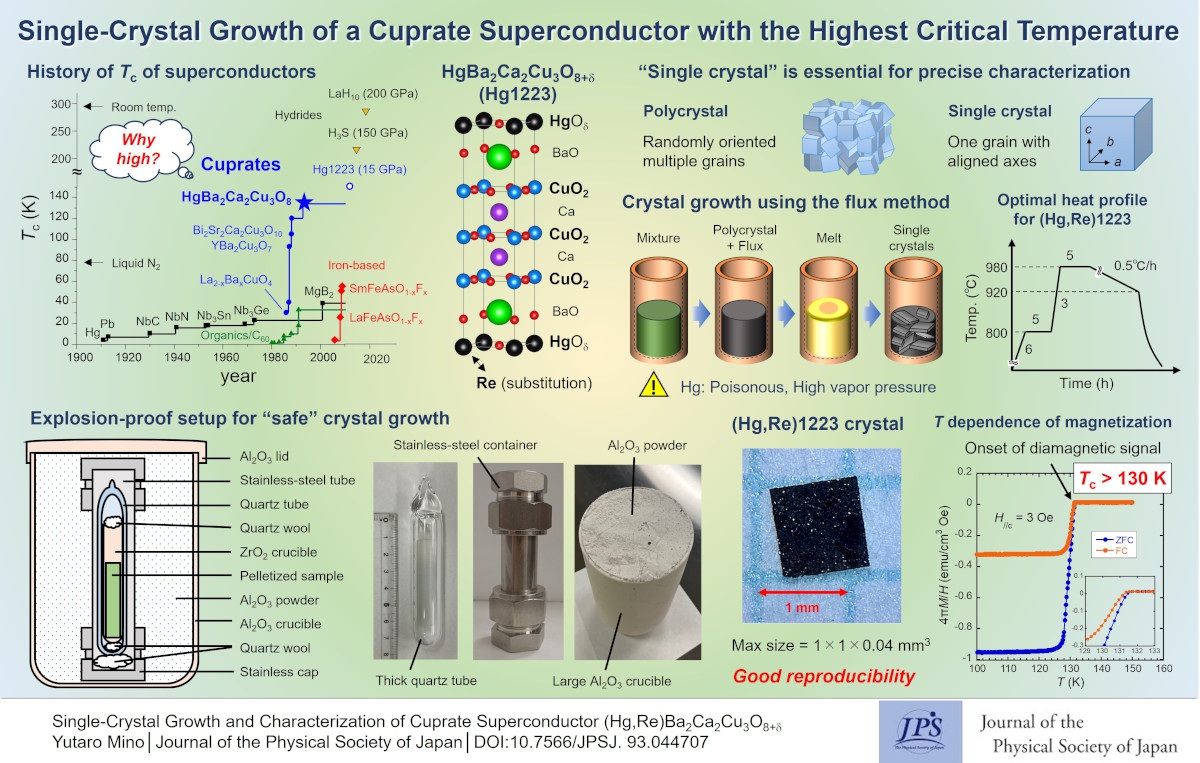
Since the discovery of high critical temperature (high-Tc) superconductivity in cuprates in 1986, numerous experimental and theoretical research have been conducted to elucidate this mechanism. However, the reason for an extremely high Tc has not yet been completely understood. One approach to understanding the high-Tcmechanism is to investigate the physical properties of the material with the highest Tc and determine the essential parameters for realizing a high Tc. Among high-Tc cuprates, Hg-based cuprates with three CuO2 layers, HgBa2Ca2Cu3O8+d (Hg-1223), have the highest Tc above 130 K at ambient pressure.
However, at present, information on the physical properties of Hg-1223 is insufficient because of the lack of high-quality large single crystals of Hg-1223. One reason for this lack may be the nature of Hg; that is, it is poisonous and has high vapor pressure. Moreover, because Hg-1223 is chemically unstable at high temperatures and difficult to obtain the phase, the range of chemical compositions and temperatures at which single crystals can be grown is extremely narrow, causing difficulty in growing Hg-1223 single crystals with good reproducibility.
Accordingly, we carefully examined earlier studies on the single crystal growth of Hg-1223 and determined the key factors for obtaining large single crystals reproducibly and safely. We employed an explosion-proof stainless-steel container to control the high pressure of the Hg vapor at high temperatures to ensure safe crystal growth.
We attempted crystal growth more than 100 times and established a method for growing Re-doped Hg-1223 ((Hg,Re)1223) single crystals using the self-flux method by optimizing the growth conditions. Under the optimal conditions, large single crystals with sizes up to 1 × 1 × 0.04 mm3were obtained, and crystals with sizes of approximately 0.8 × 0.8 mm2in the ab-plane area were obtained with good reproducibility. We expect that further research using Hg-1223 single crystals will provide clues to understand the high-Tc mechanism in cuprates.
Written by Shigeyuki Ishida on behalf of all authors.
Single-Crystal Growth and Characterization of Cuprate Superconductor (Hg,Re)Ba2Ca2Cu3O8+δ
(JPSJ Editors' Choice)
J. Phys. Soc. Jpn.
93,
044707
(2024)
.
Share this topic


Fields
Related Articles
-
Unveiling the Nodal Topology of the Spin-Triplet Superconductor Candidate UTe2
Structure and mechanical and thermal properties in condensed matter
Superconductivity
2026-4-13
Using high-quality UTe2 (Tc = 2.1 K), we identify its nodal gap structure. Field-angle‑resolved specific‑heat reveals a b-axis singularity, supporting spin-triplet superconductivity with nodes along the b axis.
-
Do Superconductors Dream of Tsunamis?
— A Cross-disciplinary Journey of Solitons —
Mathematical methods, classical and quantum physics, relativity, gravitation, numerical simulation, computational modeling
Superconductivity
2026-2-10
Tsunami-like solitons propagating over rocky-desert-like disordered backgrounds have been identified in a novel soliton equation derived from the theory of parity-mixed superconductivity.
-
A Novel Type of Magnetic Band Splitting in a Fe Spin Ladder System
Dielectric, optical, and other properties in condensed matter
Magnetic properties in condensed matter
Superconductivity
2026-1-22
An investigation of a Fe spin ladder system using angle-resolved photoemission spectroscopy revealed a novel type of magnetic band splitting resembling that in altermagnets.
-
Advances in Photoemission Study of Functional Molecular Materials
Dielectric, optical, and other properties in condensed matter
Superconductivity
2025-11-25
This work provides the first observation of the superconducting gap in molecular superconductors and their gap symmetry using photoemission spectroscopy, which will significantly accelerate the study of molecular conductors.
-
Exotic Superconductivity in Altermagnets with Rashba Spin–Orbit Coupling
Superconductivity
2025-8-6
We theoretically demonstrate the emergence of finite-momentum superconductivity in a two-dimensional altermagnet with Rashba-type spin–orbit coupling (RSOC), where anisotropic deformations of the Fermi surfaces stabilize this unconventional superconducting state.