

Cooking in Salt for Ultra-Clean Superconductor UTe2
© The Physical Society of Japan
This article is on
Molten Salt Flux Liquid Transport Method for Ultra Clean Single Crystals UTe2
J. Phys. Soc. Jpn.
93,
043703
(2024)
.
A new crystal growth technique, the molten salt flux liquid transport method, was developed to produce high-quality single crystals of spin-triplet superconductor UTe2. This method is promising for exploring the exotic superconductivity of other materials.
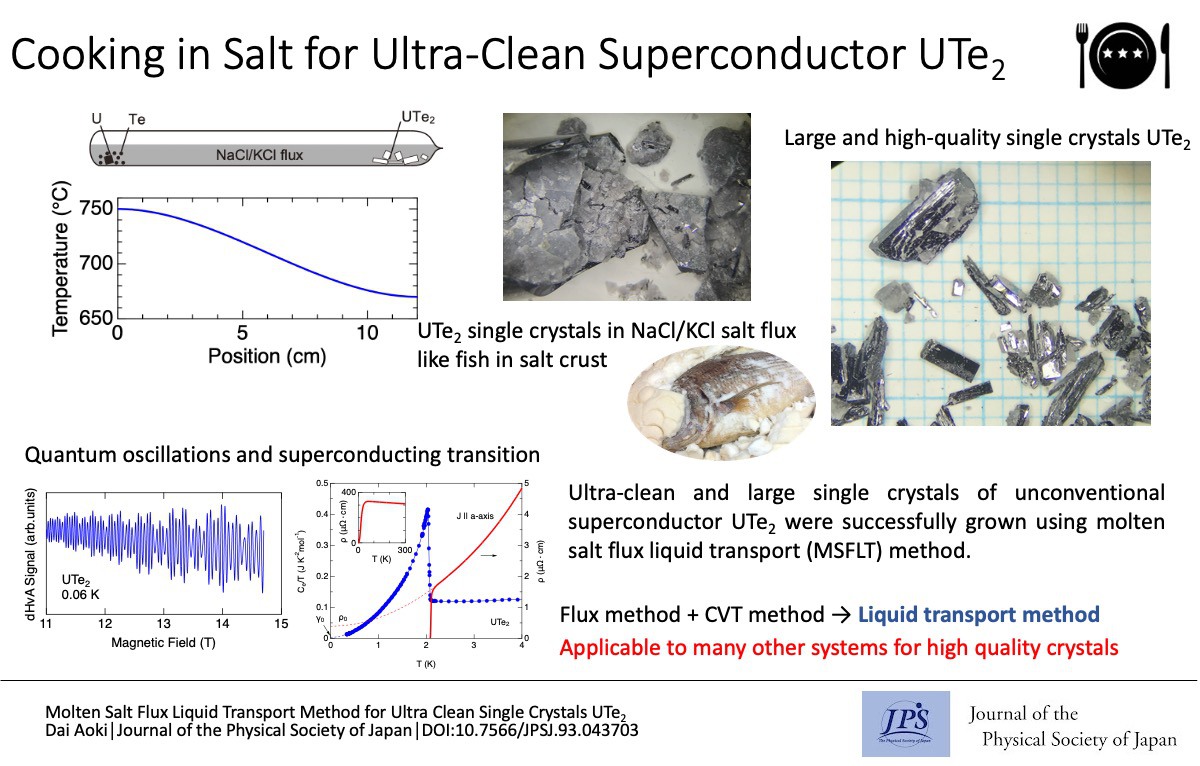
UTe2 is among the most intriguing materials in condensed matter physics owing to its unusual superconducting properties. The significant features of UTe2 include its immense field-reentrant superconductivity and the observation of multiple superconducting phases that have been highlighted in the study of superconducting phenomena. These experimental findings align with the spin-triplet superconductivity scenario, in which the superconducting upper critical field surpasses the limit of the critical field for conventional superconductivity. Moreover, spin and orbital degrees of freedom may contribute to the emergence of multiple superconducting phases.
To thoroughly investigate this fascinating material, precise experiments conducted under extreme conditions using high-quality single crystals are essential. This paper introduces a novel approach known as molten salt flux liquid transport (MSFLT) method for growing high-quality single crystals of UTe2. This technique is a hybrid of the molten salt flux (MSF) and chemical vapor transport (CVT) methods . Large, high-quality single crystals were obtained by gradually synthesizing UTe2 single crystals at relatively low temperatures that were maintained throughout the process. These single crystals were buried in the NaCl/KCl salt, akin to fish in a salt crust.
The quality of the single crystals was validated by resistivity and specific heat measurements. The superconducting transition temperature reached 2.1 K for the highest-quality sample, and the residual density of states in the superconducting state approached zero, indicating an ideal superconducting transition. The observation of quantum oscillations, known as the de Haas–van Alphen effect, under extreme conditions (low temperature and high field) clearly suggested that the high-field condition was satisfied for the cyclotron motion of the conduction electrons.
The MSFLT method, also known as the liquid transport method or horizontal flux method, holds promise for broader applications beyond UTe2. This technique can be extended to many other materials for which high-quality single crystals are scarce, opening new avenues for the discovery of exotic superconductors.
Written by D. Aoki
Molten Salt Flux Liquid Transport Method for Ultra Clean Single Crystals UTe2
J. Phys. Soc. Jpn.
93,
043703
(2024)
.
Share this topic


Fields
Related Articles
-
Unveiling the Nodal Topology of the Spin-Triplet Superconductor Candidate UTe2
Structure and mechanical and thermal properties in condensed matter
Superconductivity
2026-4-13
Using high-quality UTe2 (Tc = 2.1 K), we identify its nodal gap structure. Field-angle‑resolved specific‑heat reveals a b-axis singularity, supporting spin-triplet superconductivity with nodes along the b axis.
-
Do Superconductors Dream of Tsunamis?
— A Cross-disciplinary Journey of Solitons —
Mathematical methods, classical and quantum physics, relativity, gravitation, numerical simulation, computational modeling
Superconductivity
2026-2-10
Tsunami-like solitons propagating over rocky-desert-like disordered backgrounds have been identified in a novel soliton equation derived from the theory of parity-mixed superconductivity.
-
A Novel Type of Magnetic Band Splitting in a Fe Spin Ladder System
Dielectric, optical, and other properties in condensed matter
Magnetic properties in condensed matter
Superconductivity
2026-1-22
An investigation of a Fe spin ladder system using angle-resolved photoemission spectroscopy revealed a novel type of magnetic band splitting resembling that in altermagnets.
-
Advances in Photoemission Study of Functional Molecular Materials
Dielectric, optical, and other properties in condensed matter
Superconductivity
2025-11-25
This work provides the first observation of the superconducting gap in molecular superconductors and their gap symmetry using photoemission spectroscopy, which will significantly accelerate the study of molecular conductors.
-
Exotic Superconductivity in Altermagnets with Rashba Spin–Orbit Coupling
Superconductivity
2025-8-6
We theoretically demonstrate the emergence of finite-momentum superconductivity in a two-dimensional altermagnet with Rashba-type spin–orbit coupling (RSOC), where anisotropic deformations of the Fermi surfaces stabilize this unconventional superconducting state.