

New Chiral Molecular Ferroelectrics
© The Physical Society of Japan
This article is on
Ferroelectric Transition of a Chiral Molecular Crystal BINOL∙2DMSO
(JPSJ Editors' Choice)
J. Phys. Soc. Jpn.
91,
064702
(2022)
.
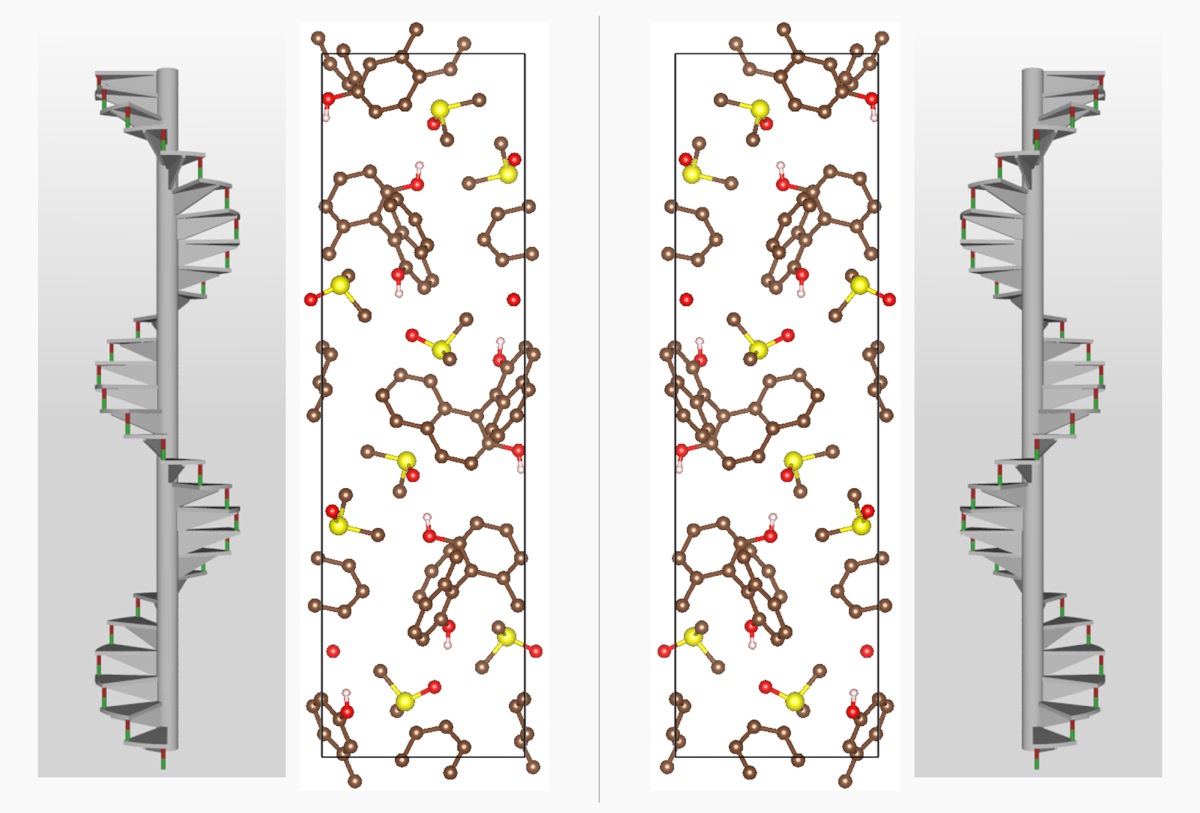
Left- and right-handed crystalline structures of BINOL∙2DMSO. Inside the chiral framework of BINOL, polar molecules DMSO produce the electric polarization.
Ferroelectrics are widely used for applications including capacitors, memory, and speakers. Despite the extensive research in this field, it remains challenging to theoretically predict new ferroelectric material groups, and in most cases, the discovery of new ferroelectric families is coincidental.
In this research, the authors report a new molecular ferroelectric material with a chiral crystal structure, 1,1’-bi-2-naphthol・2 dimethyl sulfoxide (BINOL・2DMSO). In this crystal, chiral molecules (BINOL) form the structural framework, and DMSO molecules are present at the gap as a guest. At room temperature, the orientation of the DMSO molecule is fluctuating. However, when the crystal is cooled down, the fluctuation is suppressed and the ordering of DMSO occurs at 190 K. At this point, the electric dipole moment of DMSO also orders, resulting in a ferroelectric transition along with the crystal-symmetry breaking. At 125 K, another structural transition occurs. The space group of the crystal subsequently changes as P41212 → P41 → P1121. Because of the chiral framework of BINOL, all of these crystal structures are also chiral.
This results of this study demonstrate that when chiral molecules such as BINOL incorporate polar molecules and form a composite molecular crystal, they generally become a chiral (anti-)ferroelectric crystal. This will be useful to guide future research into new chiral ferroelectric materials.
(Witten by T. Nomura on behalf of all authors)
Ferroelectric Transition of a Chiral Molecular Crystal BINOL∙2DMSO
(JPSJ Editors' Choice)
J. Phys. Soc. Jpn.
91,
064702
(2022)
.
Share this topic


Fields
Related Articles
-
Enhancing Accuracy and Reliability Bayesian Framework for Analysis of AR-HAXPES of Hard X-ray Photoelectron Spectroscopy
Dielectric, optical, and other properties in condensed matter
Electronic structure and electrical properties of surfaces and nanostructures
Measurement, instrumentation, and techniques
2026-4-28
We present a Bayesian framework for angle-resolved hard X-ray photoelectron spectroscopy (AR-HAXPES), combining Replica Exchange Monte Carlo with hierarchical integration to objectively and precisely estimate thin-film thickness.
-
A Novel Type of Magnetic Band Splitting in a Fe Spin Ladder System
Dielectric, optical, and other properties in condensed matter
Magnetic properties in condensed matter
Superconductivity
2026-1-22
An investigation of a Fe spin ladder system using angle-resolved photoemission spectroscopy revealed a novel type of magnetic band splitting resembling that in altermagnets.
-
Imaging Micron-Scale Pressure Landscapes with NV Nanodiamonds
Dielectric, optical, and other properties in condensed matter
Magnetic properties in condensed matter
2025-12-22
Nanodiamonds containing nitrogen-vacancy centers can be used to map pressure and nonhydrostatic stress inside diamond anvil cells to obtain micron-scale pressure landscapes that clarify local conditions affecting high-pressure materials research.
-
The Physics of Light-Spin Interactions: Advances in Photodriven Quantum Spin Systems
Dielectric, optical, and other properties in condensed matter
Electromagnetism, optics, acoustics, heat transfer, and classical and fluid mechanics
Electronic transport in condensed matter
Magnetic properties in condensed matter
Statistical physics and thermodynamics
2025-12-17
This Special Topics edition of the Journal of the Physical Society of Japan discusses the recent progress and future directions for the rapidly progressing field of photodriven quantum spin systems.
-
Topological Photonics: Recent Advances in Controlling Light
Cross-disciplinary physics and related areas of science and technology
Dielectric, optical, and other properties in condensed matter
Electromagnetism, optics, acoustics, heat transfer, and classical and fluid mechanics
Electronic structure and electrical properties of surfaces and nanostructures
Structure and mechanical and thermal properties in condensed matter
2025-12-8
The special topics edition of the Journal of the Physical Society of Japan presents five new review articles offering cutting-edge information on the emerging field of topological photonics.