

Solving Quantum Equations with Gauge Fields: How Explicit Integrators Based on a Bipartite Lattice and Affine Transformations Can Help
© The Physical Society of Japan
This article is on
Explicit Integrators Based on a Bipartite Lattice and a Pair of Affine Transformations to Solve Quantum Equations with Gauge Fields
(JPSJ Editors' Choice)
J. Phys. Soc. Jpn.
89,
054006
(2020)
.
We proposed an explicit numerical integrator consisting of affine transformation pairs resulting from the checkerboard lattice for spatial discretization. It can efficiently solve time evolution equations that describe dynamical quantum phenomena under gauge fields, e.g., generation, motion, interaction of quantum vortices in superconductors or superfluids.
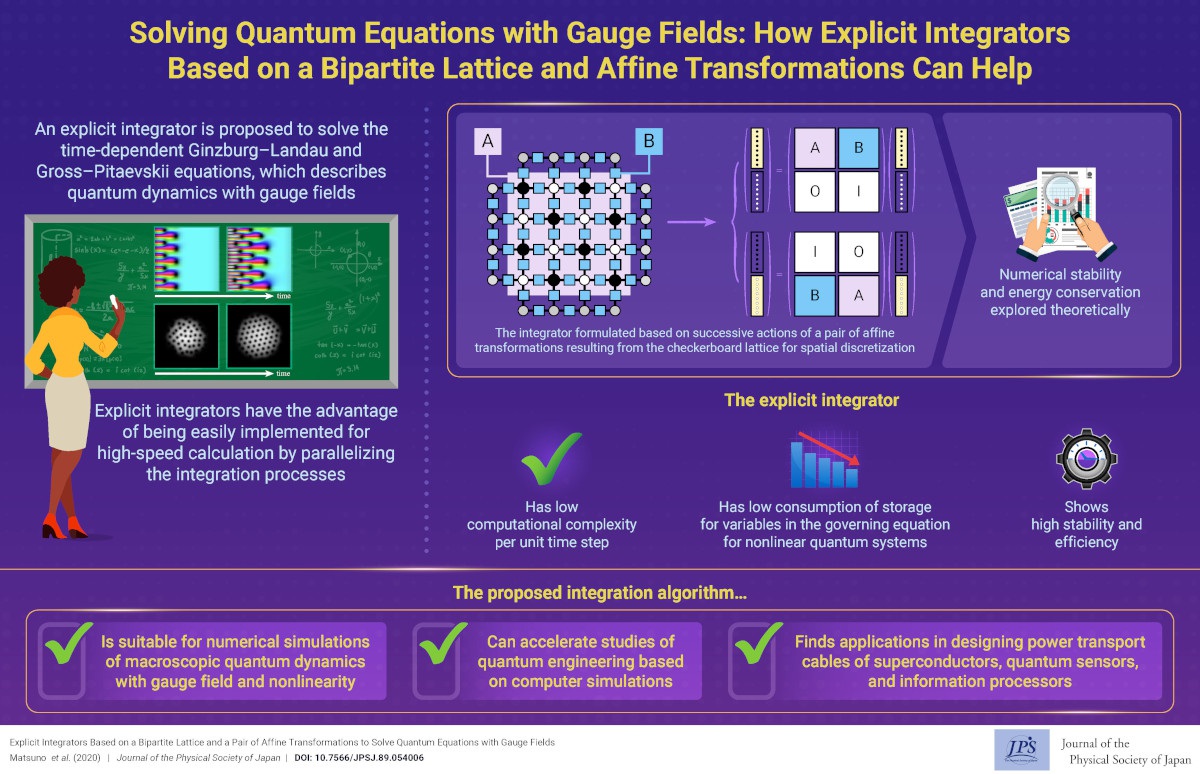
Explicit Integrators Based on a Bipartite Lattice and a Pair of Affine Transformations to Solve Quantum Equations with Gauge Fields
(JPSJ Editors' Choice)
J. Phys. Soc. Jpn.
89,
054006
(2020)
.
Share this topic


Fields
Related Articles
-
Monitored Quantum Systems and Quantum Trajectories
General and Mathematical Physics
Mathematical methods, classical and quantum physics, relativity, gravitation, numerical simulation, computational modeling
Statistical physics and thermodynamics
2026-7-21
This review in Progress of Theoretical and Experimental Physics introduces monitored quantum systems and quantum trajectories, emphasizing their spectral properties, typical behaviors such as ergodicity and purification, and measurement-induced phases.
-
Path Towards Experimental Exploration of Quantum Gravity
Mathematical methods, classical and quantum physics, relativity, gravitation, numerical simulation, computational modeling
2026-6-15
This study presents a novel route for experimentally realizing the Sachdev–Ye–Kitaev (SYK) model, considered holographically dual to charged black holes, offering the first step towards experimental studies of quantum gravity.
-
Unveiling the Nodal Topology of the Spin-Triplet Superconductor Candidate UTe2
Structure and mechanical and thermal properties in condensed matter
Superconductivity
2026-4-13
Using high-quality UTe2 (Tc = 2.1 K), we identify its nodal gap structure. Field-angle‑resolved specific‑heat reveals a b-axis singularity, supporting spin-triplet superconductivity with nodes along the b axis.
-
Quantum Fluctuations Stabilize Droplets in Dipolar Bose–Einstein Condensate
Mathematical methods, classical and quantum physics, relativity, gravitation, numerical simulation, computational modeling
2026-3-9
This study shows how quantum fluctuations can stabilize droplets in the Bose-Einstein condensates consisting of strong magnetic dipolar interactions using path-integral Monte Carlo method, explaining past experimental observations.
-
Do Superconductors Dream of Tsunamis?
— A Cross-disciplinary Journey of Solitons —
Mathematical methods, classical and quantum physics, relativity, gravitation, numerical simulation, computational modeling
Superconductivity
2026-2-10
Tsunami-like solitons propagating over rocky-desert-like disordered backgrounds have been identified in a novel soliton equation derived from the theory of parity-mixed superconductivity.