

How Heart Cells Come to Beat Together through an Elastic Substrate
© The Physical Society of Japan
This article is on
Dynamical Theory of Elastic Synchronization of Cardiomyocytes
J. Phys. Soc. Jpn.
95,
073001
(2026)
.
Two isolated cardiomyocytes (heart muscle cells) can synchronize through deformations of a soft substrate. A dynamical theory explains geometry-dependent phase-locking and synchronization time.
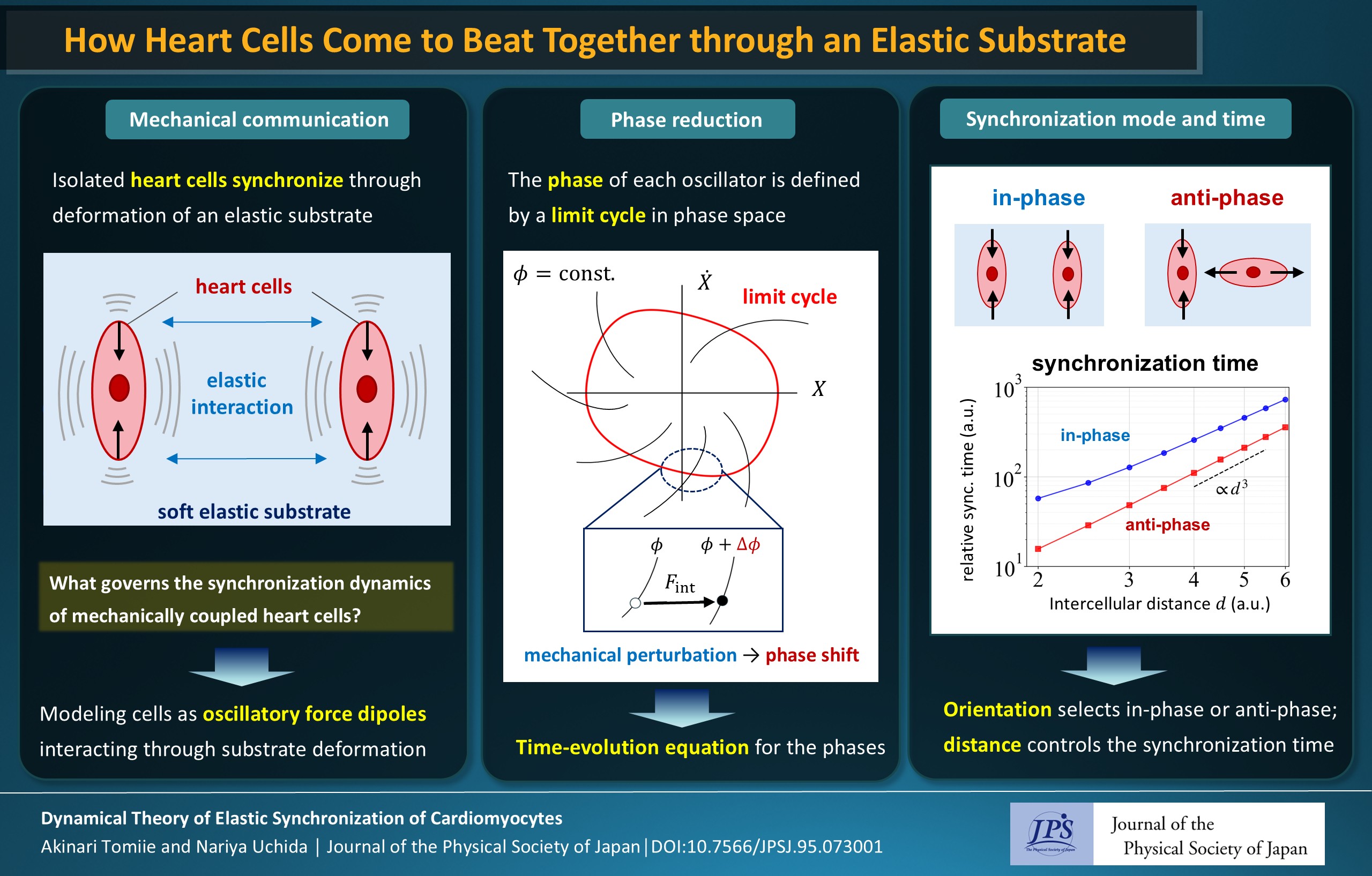
The synchronized beating of heart muscle cells is vital for the heart to pump blood efficiently. In living cardiac tissue, this coordination is usually associated with electrical and chemical signaling. However, experiments have shown that even isolated heart muscle cells, or cardiomyocytes, can synchronize when placed on a soft elastic substrate, without direct electrical or chemical communication. This suggests that heart cells can also communicate mechanically through the material on which they sit.
A recent study has developed a dynamical theory for this form of synchronization. The theory considers two cardiomyocytes attached to the surface of an elastic medium. Each cell repeatedly contracts and relaxes, deforming the substrate like an oscillating force dipole. The deformation produced by one cell is transmitted through the elastic medium and changes the mechanical force acting on the other cell. In this way, the two cells become mechanically coupled oscillators.
The spontaneous beating of each cell is described by a Rayleigh-type nonlinear oscillator, which is a minimal model for self-sustained rhythmic motion. The elastic response of the substrate determines the interaction force between the cells. Phase reduction theory is then applied as a standard method for weakly coupled oscillators. This method reduces the state of each beating cell to a single phase variable, allowing the time evolution of the phase difference between two cells to be predicted.
The main result is that the final phase-locked state is selected by geometry. Depending on the relative orientation of the two elongated cells, they can synchronize either in phase (beating together) or in anti-phase (beating in opposite phases). Direct numerical simulations agree well with the phase reduction analysis. A state diagram was also constructed to show how the selected state depends on the orientations of the two cells and their separation. The relative orientation mainly determines whether the cells beat in phase or in anti-phase, while the distance controls the strength of the elastic coupling and synchronization time.
This dynamical viewpoint goes beyond simply identifying which synchronized state is energetically preferred. It also explains how the cells approach that state and how long synchronization takes. In this sense, the theory bridges earlier energetic descriptions of mechanically coupled cardiomyocytes and dynamical oscillator models of beating cells.
Although the study focused on two cells, the same approach can be extended to larger cell assemblies. Mechanical communication through elastic environments may provide a useful physical framework for understanding the collective rhythmic motion in cardiac tissues and engineered biological materials.
(Written by Akinari Tomiie and Nariya Uchida)
Dynamical Theory of Elastic Synchronization of Cardiomyocytes
J. Phys. Soc. Jpn.
95,
073001
(2026)
.
Share this topic


Fields
Related Articles
-
Rumors Spread Wider Despite Low Transmissibility
Cross-disciplinary physics and related areas of science and technology
2026-8-7
This study proposes an SIS competition model that integrates rumor spread and opinion changes. This analysis reveals novel mechanisms for conflicting rumor coexistence, thus demonstrating that rumors paradoxically survive through low transmissibility.
-
Giant Brute-Force Simulation to Reveal Nucleation and Growth of Ultrasonic Cavitation Bubbles
Electromagnetism, optics, acoustics, heat transfer, and classical and fluid mechanics
Statistical physics and thermodynamics
2026-7-27
This study reveals the early-stage dynamics of ultrasonic cavitation using a record 100-billion-atom simulation to capture bubble nucleation, growth, clustering, and periodic splitting under nonequilibrium conditions.
-
Monitored Quantum Systems and Quantum Trajectories
Mathematical methods, classical and quantum physics, relativity, gravitation, numerical simulation, computational modeling
Statistical physics and thermodynamics
2026-7-21
This review in Progress of Theoretical and Experimental Physics introduces monitored quantum systems and quantum trajectories, emphasizing their spectral properties, typical behaviors such as ergodicity and purification, and measurement-induced phases.
-
Topological Defects as Seeds of Phase Separation: Insights from a Minimal Lattice Model
Cross-disciplinary physics and related areas of science and technology
Statistical physics and thermodynamics
2026-7-13
A minimal lattice model revealed that topological defects with winding number +1 serve as nucleation sites for phase separation in active matter systems.
-
A Deep Dive Into AI-Driven Materials Science
Cross-disciplinary physics and related areas of science and technology
2026-7-6
This review from the Journal of the Physical Society of Japan examines how artificial intelligence overcomes traditional materials science bottlenecks, highlighting the shift from intuition-based discovery to data-driven innovation.