

Giant Brute-Force Simulation to Reveal Nucleation and Growth of Ultrasonic Cavitation Bubbles
© The Physical Society of Japan
This article is on
100-Billion-Atom Molecular Dynamics Simulation of Acoustic Cavitation in a Simple Liquid
(JPSJ Editors' Choice)
J. Phys. Soc. Jpn.
95,
064401
(2026)
.
This study reveals the early-stage dynamics of ultrasonic cavitation using a record 100-billion-atom simulation to capture bubble nucleation, growth, clustering, and periodic splitting under nonequilibrium conditions.
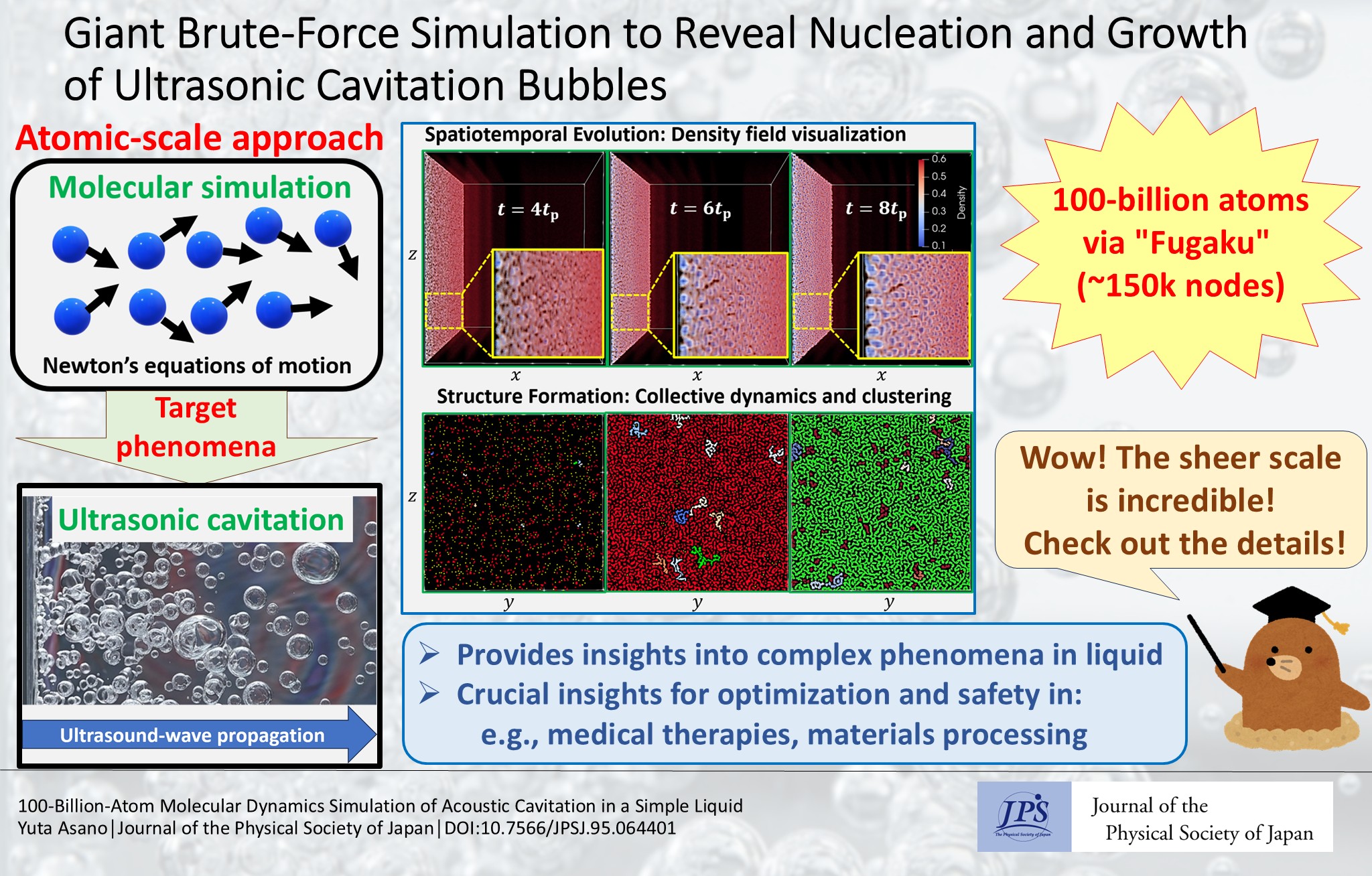
Ultrasound, which is defined as sound waves with frequencies above 20 kHz, is widely used in science and technology, ranging from medical applications to industrial cleaning. When intense ultrasound is applied to a liquid, it generates a fascinating phenomenon known as cavitation. Cavitation occurs when rapid pressure changes result in the formation, growth, and collapse of miniscule bubbles within the liquid. These bubbles can generate extremely high temperatures and pressures upon collapse, thus facilitating chemical reactions and mechanical effects that are otherwise challenging to achieve.
Despite its importance in fields such as medicine, chemistry, and engineering, the fundamental mechanism of cavitation remains poorly understood. A primary challenge is the wide range of scales involved: the process originates from microscopic molecular motions (phase transitions between liquid and gas) but generates macroscopic effects observable at much larger scales. In particular, the initial stage of bubble formation, known as nucleation, is extremely challenging to examine both experimentally and theoretically.
This problem is addressed in this study via an unprecedented large-scale molecular dynamics simulation involving approximately 100 billion atoms. By directly solving Newton’s equations of motion for all atoms in the system, this approach avoids the introduction of artificial assumptions regarding bubble formation and naturally captures the process from a purely atomistic perspective. The simulation is performed under conditions corresponding to ultrasonic irradiation, thus enabling observations of bubbles emerging and evolving in real time.
The results reveal that numerous bubbles were simultaneously generated near the ultrasound source. These bubbles grew and merged into large clusters, which repeatedly split and recombined synchronously with the ultrasound oscillation. Such collective dynamics of bubble clusters, which highlight the importance of many-body interactions in cavitation, have not been reproduced in previous simulations.
This study provides a unified illustration of cavitation dynamics from the initial phase transition to large-scale collective behavior. The findings not only improve the understanding of nonequilibrium phenomena in liquids but also contribute to practical applications, including medical therapies, sonochemical reactions, and material processing. Furthermore, the simplicity and scalability of the simulation method render it applicable to more complex systems, such as liquids containing impurities or dissolved gases, thus facilitating future research directions.
(Written by Yuta Asano on behalf of all authors.)
100-Billion-Atom Molecular Dynamics Simulation of Acoustic Cavitation in a Simple Liquid
(JPSJ Editors' Choice)
J. Phys. Soc. Jpn.
95,
064401
(2026)
.
Share this topic


Fields
Related Articles
-
Monitored Quantum Systems and Quantum Trajectories
General and Mathematical Physics
Mathematical methods, classical and quantum physics, relativity, gravitation, numerical simulation, computational modeling
Statistical physics and thermodynamics
2026-7-21
This review in Progress of Theoretical and Experimental Physics introduces monitored quantum systems and quantum trajectories, emphasizing their spectral properties, typical behaviors such as ergodicity and purification, and measurement-induced phases.
-
Topological Defects as Seeds of Phase Separation: Insights from a Minimal Lattice Model
Cross-disciplinary physics and related areas of science and technology
Statistical physics and thermodynamics
2026-7-13
A minimal lattice model revealed that topological defects with winding number +1 serve as nucleation sites for phase separation in active matter systems.
-
Negative Apparent Viscosity in Liquid Crystals
Cross-disciplinary physics and related areas of science and technology
Electromagnetism, optics, acoustics, heat transfer, and classical and fluid mechanics
Structure and mechanical and thermal properties in condensed matter
2026-6-8
Electrically driven liquid-crystal turbulence generates self-sustained flow and negative apparent viscosity. The fluorinated, chemically robust nematic PPDFB shows a substantially larger negative-viscosity effect than Schiff-base nematics.
-
Topological Recast of Vortex Structures in Human Heart Blood Flow
Cross-disciplinary physics and related areas of science and technology
Electromagnetism, optics, acoustics, heat transfer, and classical and fluid mechanics
2026-2-16
We developed a new topological data analysis method to objectively identify the cardiac vortex structures. The method provides robust quantitative metrics for advancing cardiovascular diagnostics.
-
Rethinking Replica Analysis of Learning
Cross-disciplinary physics and related areas of science and technology
Statistical physics and thermodynamics
2026-1-19
The statistical physics analysis of learning parametric models was revisited by combining the replica method with a grand canonical ensemble and variational approach, enabling prediction error estimation for learning systems with real data.