

Triangular Lattice Magnet GdGa2: Spin Cycloids and Skyrmions
© The Physical Society of Japan
This article is on
Triangular Lattice Magnet GdGa2 with Short-Period Spin Cycloids and Possible Skyrmion Phases
(JPSJ Editors' Choice)
J. Phys. Soc. Jpn.
94,
024705
(2025)
.
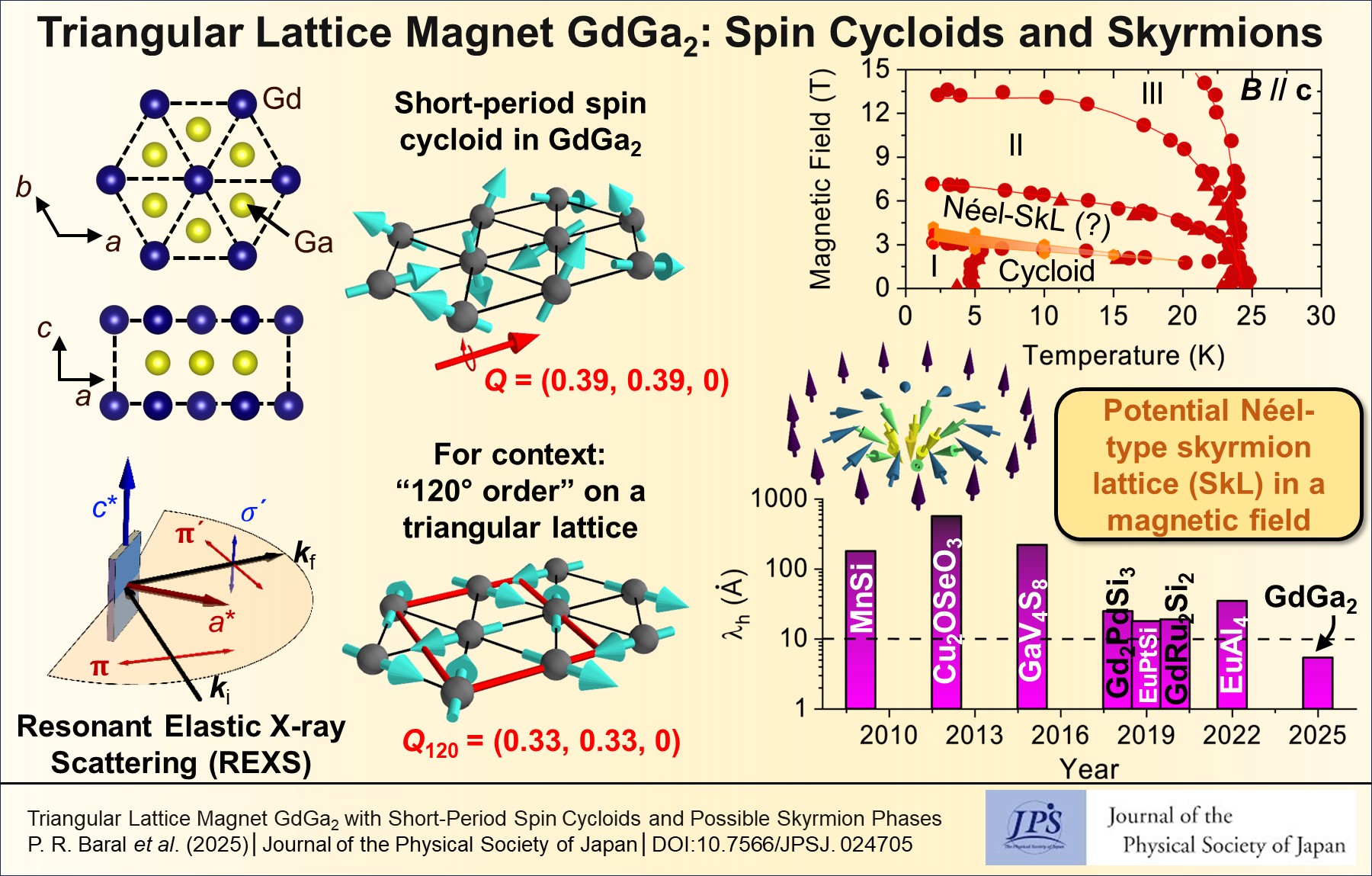
Careful measurements were conducted on the hexagonal magnet GdGa2 to reveal the experimental signatures of ultrasmall spin cycloids and of a potential Néel-type skyrmion lattice phase induced by a magnetic field.
The necessity for faster, more efficient data storage has produced a bottleneck in the memory device industry, as manufacturers are unable to accommodate the demand for larger storage space and faster data access rates. Skyrmions, which are topologically stable, vortex-like magnetic structures at the nanometer scale, have emerged as a promising alternative to conventional data storage and computing. Recent research has demonstrated their viability in racetrack memory architectures and for unconventional (‘neuromorphic’) computing.
Information storage density in skyrmion devices can be enhanced by reducing the skyrmion size. Okubo, Chung and Kawamura (Phys. Rev. Lett. 108, 017206) proposed the magnetic frustration concept on a triangular lattice to miniaturize skyrmions, where the competition of various magnetic interactions was realized by the crystal lattice geometry. Subsequent work demonstrated that intermetallic materials are well-suited to implement this theoretical proposal in practical reality.
Therefore, this study focuses on the intermetallic GdGa2 with a perfect triangular lattice of magnetic gadolinium (Gd) ions. Utilizing a high-brilliance synchrotron X-ray beam at Photon Factory (KEK, Tsukuba, Ibaraki, Japan), the authors revealed the magnetic structure of GdGa2 using Resonant Elastic X-ray Scattering (REXS). In REXS, the X-ray polarization of the scattered beam kf, described as π’ or σ’ in the Infographic, provides information about the direction and spatial arrangement of magnetic moments in a solid.
In GdGa2, the periodicity of the magnetic structure was approximately 0.55 nm, which is not much larger than the distance between Gd ions (0.42 nm). Furthermore, the direction of magnetic moments was determined by REXS and a cycloidal spin texture was revealed. This magnetic cycloid is very close in character, but distinct from 120° structure that is well known in the field of frustration physics.
By further applying a magnetic field, evidence of various magnetic phases was identified using detailed magnetization and electronic resistivity measurements. Out of these phases, a regime of intermediate magnetic fields shows characteristics of a Néel skyrmion lattice, as illustrated in the Infographic. Néel skyrmion lattices, which represent a linear superposition of three magnetic cycloids, have seldom been discovered in bulk materials, but are common at interfaces and surfaces of magnetic materials. The observation of Néel skyrmions in a centrosymmetric bulk material therefore lays the foundation for further studies of nanometer-sized Néel skyrmions and their functional responses.
Early research in the field of magnetic skyrmions revealed magnetic vortices with a diameter ranging from tens to hundreds of nanometers. With recent advances in materials engineering, their diameter has now been reduced to 1-2 nm. Further exploration of the physics and controllability of such nano-sized magnetic vortices is required to advance skyrmion research towards device applications.
Further information can be found in the press release of this article.
(Written by Dr. Priya R. Baral on behalf of all authors)
Triangular Lattice Magnet GdGa2 with Short-Period Spin Cycloids and Possible Skyrmion Phases
(JPSJ Editors' Choice)
J. Phys. Soc. Jpn.
94,
024705
(2025)
.
Share this topic


Fields
Related Articles
-
Shining Light on Magnetic Flux Trapped in a Superconductor
Dielectric, optical, and other properties in condensed matter
Magnetic properties in condensed matter
Superconductivity
2026-11-16
The magnetic flux trapped in a superconductor was resolved through ultrasensitive magneto-optical Kerr-effect measurements, thereby providing a basis for using an unconventional superconducting order parameter to distinguish between vortex-induced and magnetic signals.
-
Why Does Magnetization Lose its Motion? - Magnetic Damping from Low Temperatures to the Curie Point -
Magnetic properties in condensed matter
2026-11-10
A unified physical outlook of magnetic damping is presented, explaining how the relaxation of magnetization changes from low to Curie temperatures by combining the microscopic spin relaxation and magnetic response.
-
Only Certain Angles Allow Layer-by-Layer Stacking of Corrugated Rods
Cross-disciplinary physics and related areas of science and technology
2026-10-13
Rods with periodic surface corrugations stack helicoidally at only a discrete set of pitch angles. This rule opens a route for programming the fiber-stacking angle based on fiber surface texture.
-
Mysterious Critical Phenomena Driven by Role Reversal in Multicomponent Systems: From Normal to Reverse RKKY — Twofold Reversal and Induced Critical Exponent
Electronic transport in condensed matter
Structure and mechanical and thermal properties in condensed matter
2026-10-5
The Reverse RKKY mechanism drives a twofold reversal, yielding an anomalous specific‑heat peak with a large, induced critical exponent.
-
Frustrated Sawtooth Yb Chain Yielding Ferromagnetic Order with Reduced Magnetic Moments
Magnetic properties in condensed matter
2026-9-1
The ytterbium-based semiconductor ZnYb2S4 exhibits ferromagnetic order with contracted Yb moments, representing a novel quantum ground state attributed to competing exchange interactions in an effective spin-1/2 frustrated sawtooth chain.