

Reducing the Number of Tests Using Bayesian Inference to Identify Infected Patients in Group Testing
© The Physical Society of Japan
This article is on
Bayesian Inference of Infected Patients in Group Testing with Prevalence Estimation
(JPSJ Editors' Choice)
J. Phys. Soc. Jpn.
89,
084001
(2020)
.
Group testing is a method of identifying infected patients by performing tests on a pool of specimens. Bayesian inference and a corresponding belief propagation (BP) algorithm are introduced to identify the infected patients in group testing.
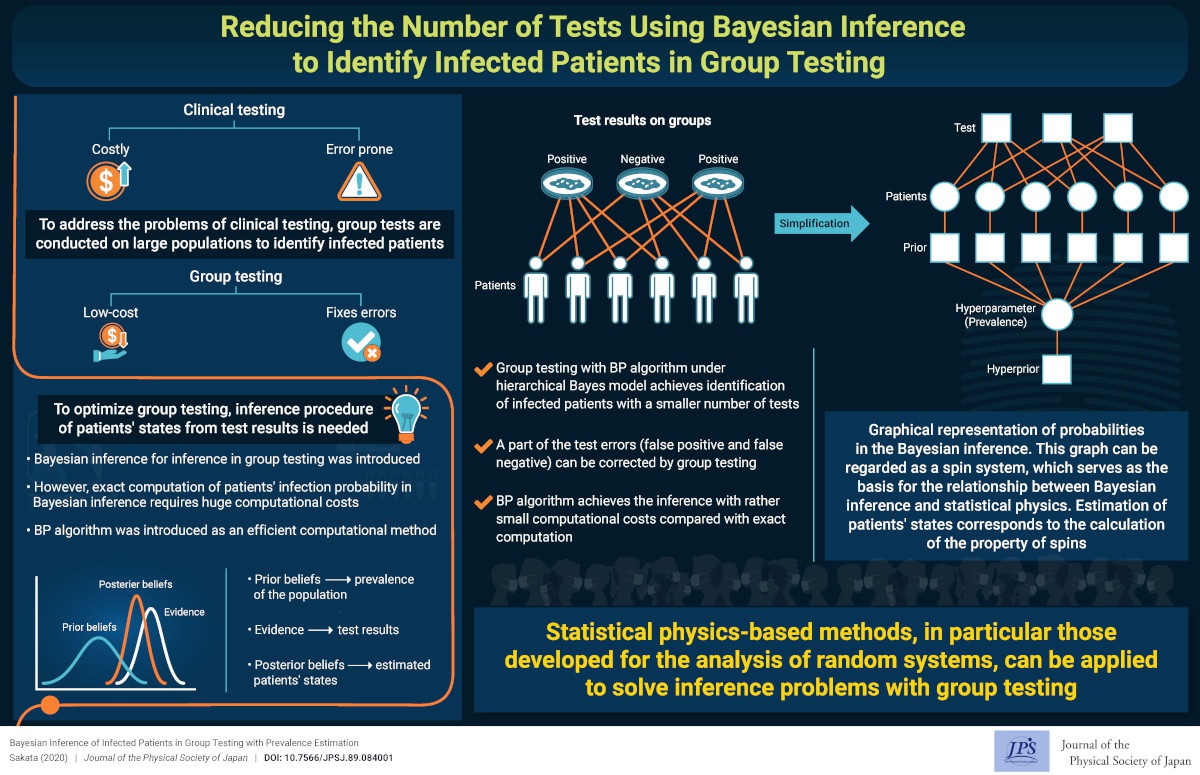
Bayesian Inference of Infected Patients in Group Testing with Prevalence Estimation
(JPSJ Editors' Choice)
J. Phys. Soc. Jpn.
89,
084001
(2020)
.
Share this topic


Fields
Related Articles
-
Giant Brute-Force Simulation to Reveal Nucleation and Growth of Ultrasonic Cavitation Bubbles
Electromagnetism, optics, acoustics, heat transfer, and classical and fluid mechanics
Statistical physics and thermodynamics
2026-7-27
This study reveals the early-stage dynamics of ultrasonic cavitation using a record 100-billion-atom simulation to capture bubble nucleation, growth, clustering, and periodic splitting under nonequilibrium conditions.
-
Monitored Quantum Systems and Quantum Trajectories
General and Mathematical Physics
Mathematical methods, classical and quantum physics, relativity, gravitation, numerical simulation, computational modeling
Statistical physics and thermodynamics
2026-7-21
This review in Progress of Theoretical and Experimental Physics introduces monitored quantum systems and quantum trajectories, emphasizing their spectral properties, typical behaviors such as ergodicity and purification, and measurement-induced phases.
-
Topological Defects as Seeds of Phase Separation: Insights from a Minimal Lattice Model
Cross-disciplinary physics and related areas of science and technology
Statistical physics and thermodynamics
2026-7-13
A minimal lattice model revealed that topological defects with winding number +1 serve as nucleation sites for phase separation in active matter systems.
-
A Deep Dive Into AI-Driven Materials Science
Cross-disciplinary physics and related areas of science and technology
2026-7-6
This review from the Journal of the Physical Society of Japan examines how artificial intelligence overcomes traditional materials science bottlenecks, highlighting the shift from intuition-based discovery to data-driven innovation.
-
Peculiar Magnet Pointing Against an Applied Magnetic Field
Cross-disciplinary physics and related areas of science and technology
Magnetic properties in condensed matter
2026-7-1
TbNiC2 exhibits negative magnetization. A new mechanism, based on the coupling between the charge density wave and the antiferromagnetic order, is proposed to account for this peculiar phenomenon.