

Microscopic Exploration of Electronic States in Nickelate Superconductors
© The Physical Society of Japan
This article is on
Multiband Metallic Ground State in Multilayered Nickelates La3Ni2O7 and La4Ni3O10 Probed by 139La-NMR at Ambient Pressure
(JPSJ Editors' Choice)
J. Phys. Soc. Jpn.
93,
053702
(2024)
.
The multilayered nickelates, La3Ni2O7 and La4Ni3O10 , were investigated using nuclear magnetic resonance (NMR) at ambient pressure. Metallic electronic states under the density wave order were observed microscopically for both compounds.
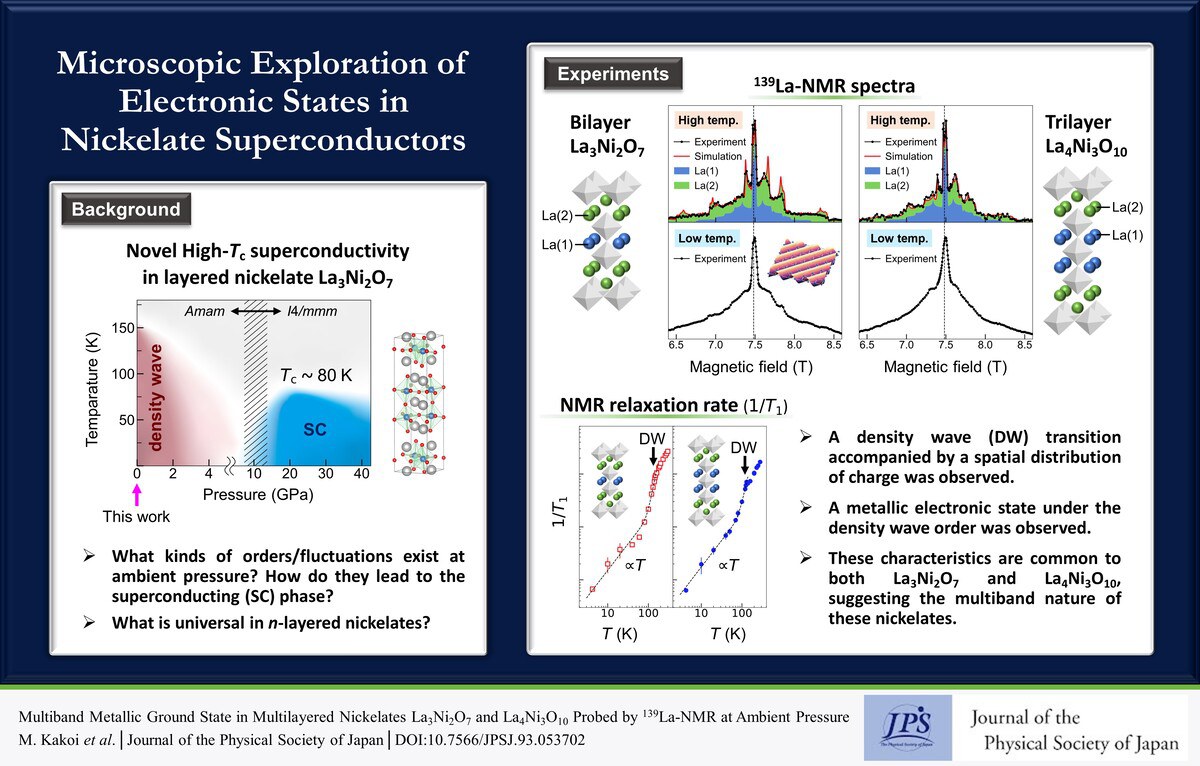
In 2023, the discovery of the superconductivity of La3Ni2O7 with a transition temperature (Tc) of ~80 K under pressure led to nickelates joining the family of high-Tc superconductors. La3Ni2O7 has a two-layered perovskite structure resembling cuprates, which are well-known high-Tc superconductors. However, it actually possesses different characteristics from those of cuprates, anticipating a new superconducting mechanism.
One of the major mysteries of La3Ni2O7 is what kind of electronic orders and/or fluctuations exist and how they lead to the superconducting phase from the non-superconducting phase at ambient pressure. In addition, La3Ni2O7 belongs to the Ruddlesden–Popper (RP) phase Lan+1NinO3n+1, which includes similar compounds with different numbers of layers (n). Systematic studies of the RP series are expected to provide clues regarding the origin of superconductivity and the exploration of new superconductors.
We investigated the electronic states of (La3Ni2O7) (n=2) and La4Ni3O10 (n=3) at ambient pressure using nuclear magnetic resonance (NMR) experiments, which can be used to microscopically observe the orders and/or fluctuations of charge and spin. The NMR spectra at high temperatures exhibited multiple distinct peaks, which allowed us to identify two crystallographically inequivalent sites. At temperatures below 150 K for La3Ni2O7 and 130 K for La4Ni3O10, significant broadening of their spectra, particularly in the satellite peaks, was observed. This suggests the existence of a density-wave transition accompanied by a spatial charge distribution. We also measured the nuclear spin relaxation rate (1/T1), showing that, in addition to the sharp drop in 1/T1 associated with the density wave transition, the relaxation remains finite at lower temperatures. This result indicates that the system has a metallic ground state with a partial gap at the Fermi energy owing to the density-wave transition.
The fact that these characteristics are commonly observed in La3Ni2O7 and La4Ni3O10 provides important insights. These observations are likely associated with the different features of the multiple bands composed of the dx2-y2 and d3z2-r2 orbitals, which are common to these compounds. Recently, superconductivity with a of ~25 K under pressure was also discovered in La4Ni3O10. This finding suggests a connection between the multiband nature, density wave phase, and emergence of the superconducting phase under high pressure. The possibility of spin order coexisting with charge order remains debatable, and further investigations are required to understand how the charge and spin degrees of freedom evolve toward the superconducting phase under high pressure.
Written by M. Kakoi and H. Mukuda on behalf of all authors.
Multiband Metallic Ground State in Multilayered Nickelates La3Ni2O7 and La4Ni3O10 Probed by 139La-NMR at Ambient Pressure
(JPSJ Editors' Choice)
J. Phys. Soc. Jpn.
93,
053702
(2024)
.
Share this topic


Fields
Related Articles
-
Revealing Electronic Quantum Behavior Masked by Nuclear Heat
Measurement, instrumentation, and techniques
Structure and mechanical and thermal properties in condensed matter
Superconductivity
2026-9-7
The initial slope method is used to reveal intrinsic electronic specific heat by eliminating the overwhelming nuclear contributions during low-temperature calorimetry, opening a new window into quantum materials.
-
Frustrated Sawtooth Yb Chain Yielding Ferromagnetic Order with Reduced Magnetic Moments
Magnetic properties in condensed matter
2026-9-1
The ytterbium-based semiconductor ZnYb2S4 exhibits ferromagnetic order with contracted Yb moments, representing a novel quantum ground state attributed to competing exchange interactions in an effective spin-1/2 frustrated sawtooth chain.
-
Unlocking a 40-Year-Old Mystery: Full-gap Spin-Triplet Superconductivity Unveiled in UBe13
Magnetic properties in condensed matter
Superconductivity
2026-8-12
Recent precise NMR measurements on the heavy-fermion superconductor UBe13 provided “smoking-gun” evidence for a fully-gapped spin-triplet superconducting state, opening a new chapter in the field.
-
Peculiar Magnet Pointing Against an Applied Magnetic Field
Cross-disciplinary physics and related areas of science and technology
Magnetic properties in condensed matter
2026-7-1
TbNiC2 exhibits negative magnetization. A new mechanism, based on the coupling between the charge density wave and the antiferromagnetic order, is proposed to account for this peculiar phenomenon.
-
Magnetic-Field Driven Switching of Multipolar Order in an f-Electron System
Magnetic properties in condensed matter
2026-5-22
This study investigates high-rank multipole physics in f-electron systems, providing the first clear experimental evidence for field-induced switching of ferro-quadrupole order in a non-Kramer ion system, along with a new conceptual framework