

How Good is the Transition-State Theory?
© The Physical Society of Japan
This article is on
J. Phys. Soc. Jpn.
90,
114005
(2021)
.
For the first time, the main assumption of the transition-state theory for the decay of complex quantum systems across a potential barrier was realized using a microscopic many-body Hamiltonian.
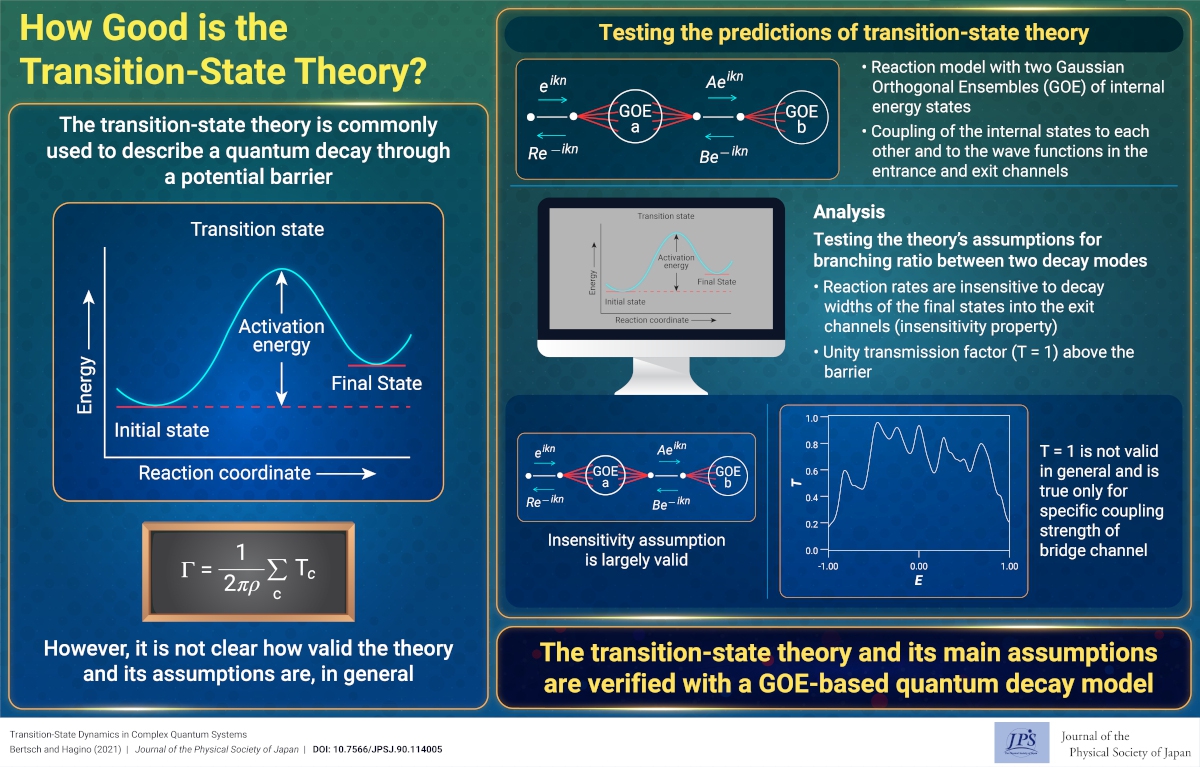
The decay of quantum systems through a potential barrier is ubiquitous in many fields of physics and chemistry, occurring in electron conduction within devices and quantum dots as well as chemical reactions, and nuclear fission. The usual framework for describing the barrier crossing is the "transition-state" theory, which was invented long ago to investigate chemical reactions and nuclear fission. The main assumption of this theory is that the decay rate is entirely determined at the highest point of the barrier and does not depend on what occurs afterward. This remarkable theory has been part of reaction theory since the 1930s and has been used in disciplines as widely distinct as chemistry and nuclear physics. However, this theory has not been validated for the quantum mechanics of many interacting particles.
In this study, a model was proposed to study reactions in systems with many interacting particles. The model allowed us to test whether the assumptions of the transition state theory could be satisfied in a full quantum theory. The model contains two reservoirs of internal states connected to each other by additional barrier-top states, and the reservoir states were considered using random matrix theory.
For the first time, we demonstrated that a main assumption of the transition-state theory can be easily satisfied by a more detailed theory, that is, the overall decay rate going through the far-side reservoir is largely determined by the barrier region and internal properties of the reservoirs, and is insensitive to the individual decay rates of the states out of the far-side reservoir.
In a subsequent paper (K. Hagino and G.F. Bertsch, Phys. Rev. E104, L052104(2021)), we applied the same model to discuss the variation of the decay rates between states. There is a well-established theory known as the Porter-Thomas distribution that has been validated for many systems, including atomic spectra, chemical reaction spectra, and nuclei. Surprisingly, our transition-state model revealed that this distribution differed depending on how large the individual rates were. The new distribution followed a different random matrix model, namely the Gaussian Unitary Ensemble, proposed by Dyson in 1960.
(Written by K. Hagino on behalf of all authors)
J. Phys. Soc. Jpn.
90,
114005
(2021)
.
Share this topic


Fields
Related Articles
-
Monitored Quantum Systems and Quantum Trajectories
General and Mathematical Physics
Mathematical methods, classical and quantum physics, relativity, gravitation, numerical simulation, computational modeling
Statistical physics and thermodynamics
2026-7-21
This review in Progress of Theoretical and Experimental Physics introduces monitored quantum systems and quantum trajectories, emphasizing their spectral properties, typical behaviors such as ergodicity and purification, and measurement-induced phases.
-
Topological Defects as Seeds of Phase Separation: Insights from a Minimal Lattice Model
Cross-disciplinary physics and related areas of science and technology
Statistical physics and thermodynamics
2026-7-13
A minimal lattice model revealed that topological defects with winding number +1 serve as nucleation sites for phase separation in active matter systems.
-
Verification of Magnetic Structure Observation at the Atomic Scale
Atomic and molecular physics
Cross-disciplinary physics and related areas of science and technology
Nuclear physics
2026-6-2
Magnetic neutron scattering holography (MNH) were performed on a Fe0.08Co0.92 single crystal. The resulting holograms provided the first experimental evidence that MNH is sensitive to magnetic signals.
-
Seven New Pieces of the Nuclear Landscape Puzzle Uncovered Near Cerium-159
Nuclear physics
2026-3-13
RIKEN discovered seven neutron-rich isotopes in the rare-earth region, pushing the nuclear landscape frontier toward an astrophysical r-process path. RIKEN discovered over 200 isotopes using in-flight separation.
-
Rethinking Replica Analysis of Learning
Cross-disciplinary physics and related areas of science and technology
Statistical physics and thermodynamics
2026-1-19
The statistical physics analysis of learning parametric models was revisited by combining the replica method with a grand canonical ensemble and variational approach, enabling prediction error estimation for learning systems with real data.